LDAP Watchdog: A real-time linux-compatible LDAP monitoring tool for detecting directory changes, providing visibility into additions, modifications, and deletions for administrators and security researchers.

LDAP Watchdog is a tool designed to monitor record changes in an LDAP directory in real-time.
It provides a mechanism to track and visualize modifications, additions, and removals to user and group entries, allowing users to correlate expected changes with actual changes and identify potential security incidents.
It was created with OpenLDAP and Linux in mind, and needs a server that gives every entry an entryUUID (RFC 4530), so Active Directory, which uses objectGUID instead, is not supported.
It is written in Python and requires the ldap3 library, plus requests for Slack notifications.
This software was written by Joshua Rogers.
If you're interested in any of the following, then LDAP Watchdog is for you:
In addition to monitoring for modifications, additions, and removals in an LDAP directory, it can be configured to ignore specific attributes, or even fine-tuned to ignore fine-grained attributes depending on their old/new values.
Changes are always printed to the terminal, and are also forwarded to a Slack webhook if one is configured. Colored output can be turned off.
Previously named LDAP-Stalker (because monitoring changes of an LDAP directory is an excellent way to stalk changes in a company: learn about promotions before they're announced, new hires, leavers, etc.), a blog post about the details and history of this project can be found here.
Note: in the below examples, changes to entryCSN and modifyTimestamp on existing entries can be ignored by setting LDAP_WATCHDOG_IGNORED_ATTRIBUTES=entryCSN,modifyTimestamp.
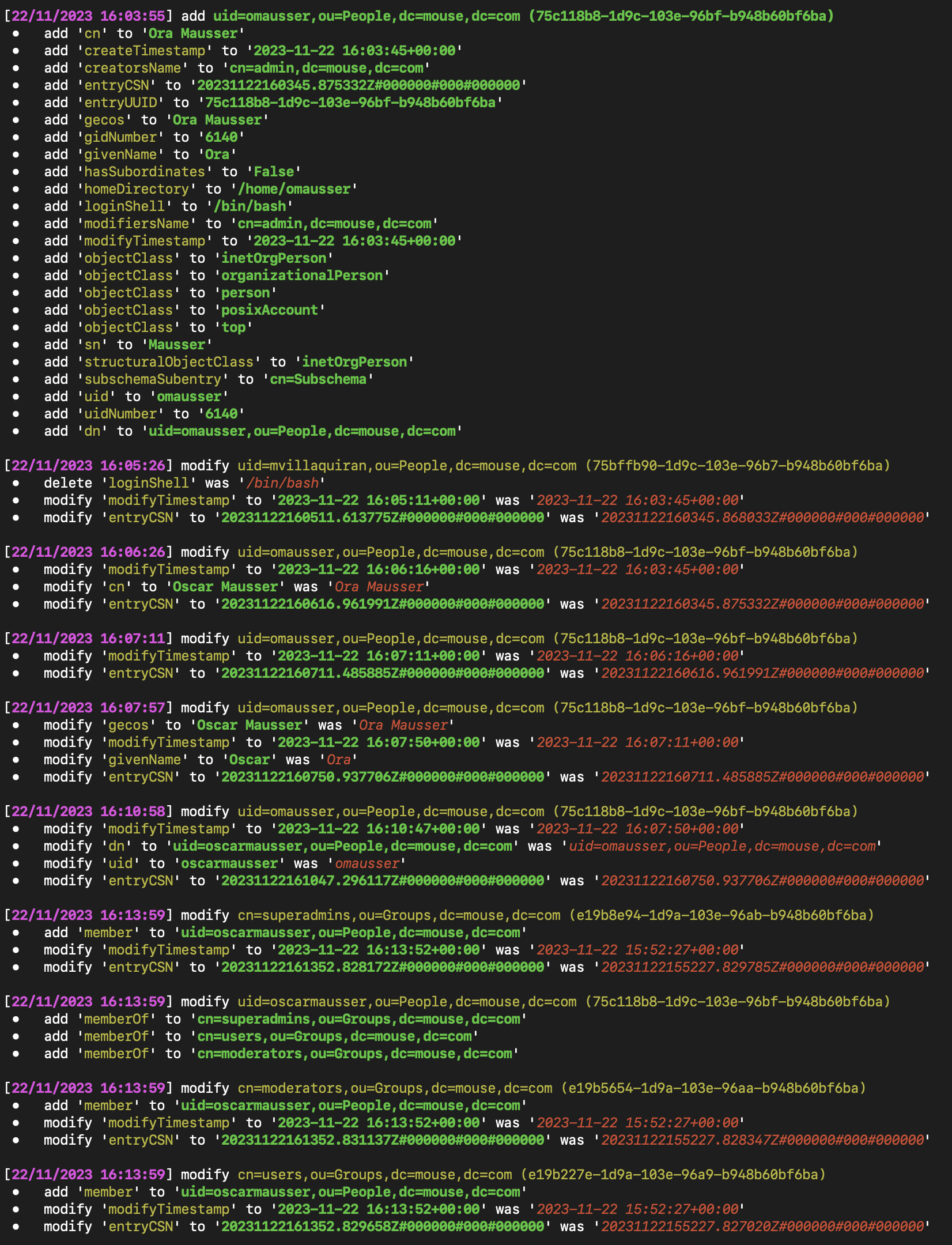
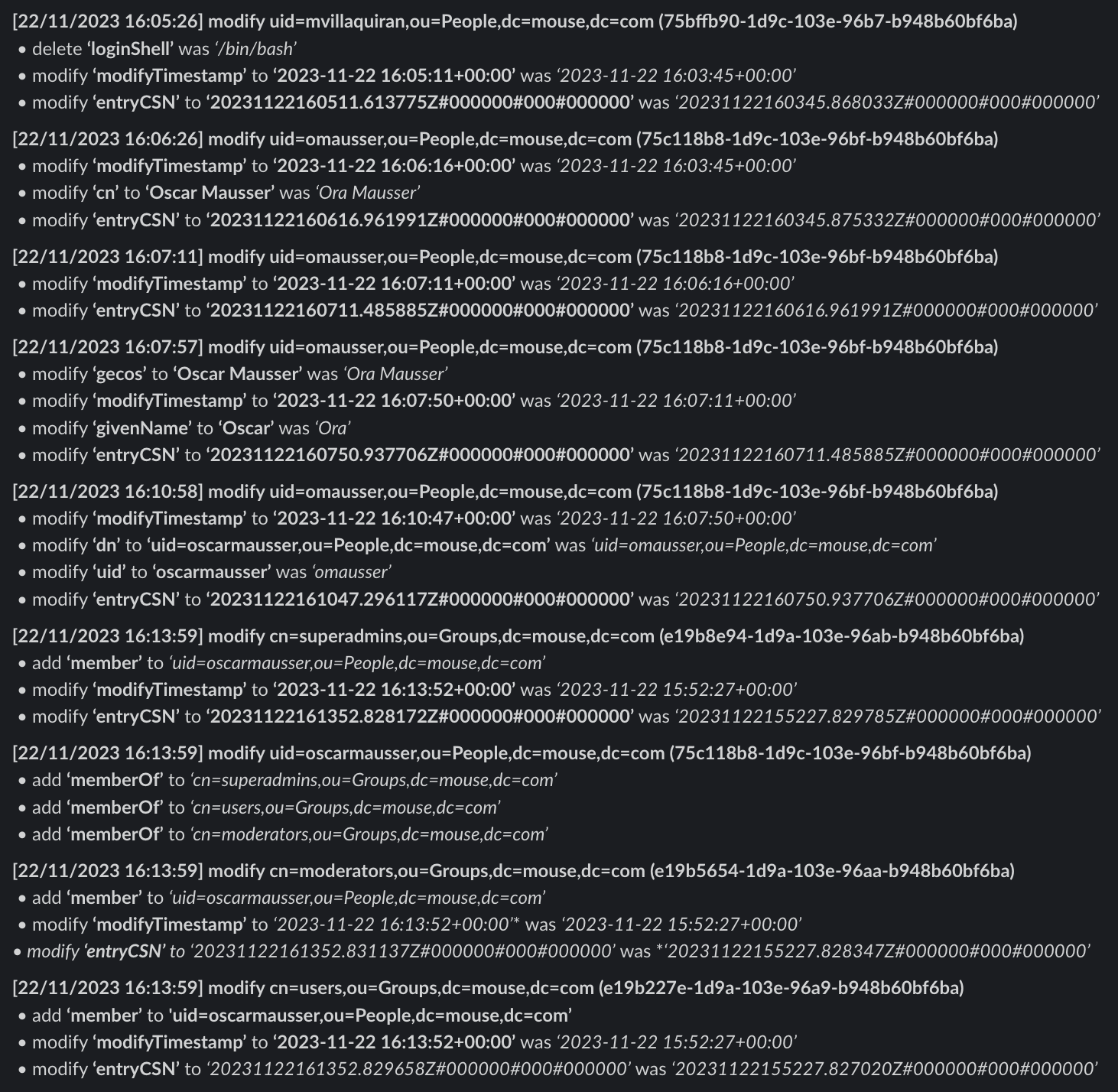
Real-time Monitoring: LDAP Watchdog continuously monitors an LDAP directory for changes in user and group entries.
Change Comparison: The tool compares changes between consecutive LDAP searches, highlighting additions, modifications, and deletions.
Control User Verification: LDAP Watchdog supports a control user mechanism, triggering an error if the control user's changes are not found.
Flexible LDAP Filtering: Users can customize LDAP filtering using the LDAP_WATCHDOG_SEARCH_FILTER environment variable to focus on specific object classes or attributes.
Slack Integration: Receive real-time notifications on Slack for added, modified, or deleted LDAP entries.
Customizable Output: Console output provides clear and colored indications of additions, modifications, and deletions for easy visibility.
Ignored Entries and Attributes: Users can specify UUIDs and attributes to ignore when comparing changes to existing entries.
Conditional Ignored Attributes: Users can ignore changes to an attribute only when they involve specific values, such as one group in memberOf.
ldap3 package. If using a Slack webhook, the requests package is also required.pip install LDAP-Monitor
To include Slack webhook support:
pip install "LDAP-Monitor[slack]"
docker pull megamansec/ldap-monitor
Or from GitHub Container Registry:
docker pull ghcr.io/megamansec/ldap-monitoring-watchdog
git clone https://github.com/MegaManSec/LDAP-Monitoring-Watchdog.git
cd LDAP-Monitoring-Watchdog
pip install ".[slack]"
From 1.x: Since 2.0.0, LDAPS connections verify the server certificate and that it matches the host name or IP address in LDAP_WATCHDOG_SERVER; 1.0.0 checked neither. Before upgrading, set LDAP_WATCHDOG_CA_CERTS_FILE if the certificate is self-signed or from a private CA, and if it does not match that name, use a matching certificate or set LDAP_WATCHDOG_TLS_VERIFY=false (see the TLS notes under Configuration). The release notes list the other changes.
From 1.x or 2.0.0: Since 2.0.1, boolean settings only accept the values listed under Configuration. Earlier versions read anything other than true, 1 or yes as false. Now an unrecognized value stops the process at startup, an empty value means the default, and on or a quoted "true" means true. For example, an empty LDAP_WATCHDOG_USE_SSL with a bare host name now connects with LDAPS on port 636 instead of plain LDAP on port 389.
export LDAP_WATCHDOG_SERVER='ldaps://ldaps.intra.lan'
export LDAP_WATCHDOG_BASE_DN='dc=mouse,dc=com'
export LDAP_WATCHDOG_USERNAME='cn=Emily,ou=People,dc=mouse,dc=com'
export LDAP_WATCHDOG_PASSWORD='qwerty123'
ldap-watchdog
Or using python -m:
python -m ldap_watchdog
docker run -d --restart unless-stopped \
  -e LDAP_WATCHDOG_SERVER='ldaps://ldaps.intra.lan' \
  -e LDAP_WATCHDOG_BASE_DN='dc=mouse,dc=com' \
  -e LDAP_WATCHDOG_USERNAME='cn=Emily,ou=People,dc=mouse,dc=com' \
  -e LDAP_WATCHDOG_PASSWORD='qwerty123' \
  -e SLACK_WEBHOOK_URL='https://hooks.slack.com/services/[...]' \
  -e LDAP_WATCHDOG_IGNORED_ATTRIBUTES='entryCSN,modifyTimestamp,telephoneNumber,roomNumber,gecos' \
  -e LDAP_WATCHDOG_DISABLE_COLOR_OUTPUT='true' \
  megamansec/ldap-monitor
A Debian-based installation script, install.sh, is provided. It needs Python 3.10 or later and the python3-venv package. When run as root from a clone of this repository, this script:
/opt/ldap-watchdog.requirements.txt./etc/ldap-watchdog.env for configuration, unless one already exists./etc/systemd/system/ldap-watchdog.service) that runs ldap-watchdog in the background as an unprivileged dynamic user, so a CA bundle must be world-readable./var/log/ldap-watchdog.log and /var/log/ldap-watchdog-error.log./etc/logrotate.d/ldap-watchdog.Rerunning the script from an updated clone upgrades the installation.
You may optionally pass a single argument to install.sh to set the SLACK_WEBHOOK_URL when the environment file is first created:
sudo ./install.sh "https://hooks.slack.com/services/[...]"
After installation, edit /etc/ldap-watchdog.env to configure the LDAP connection settings (the service fails until then), then restart the service:
sudo systemctl restart ldap-watchdog
All configuration is done via environment variables; an empty value is the same as an unset one, except for LDAP_WATCHDOG_SLACK_BULLETPOINT. The following variables are supported: