 anonghosty/looking-glass
CSIRT platform that ingests Shadowserver reports into MongoDB and replays them as interactive maps, analysis, findings, advisories and executive dashboards.

Your Shadowserver reports, replayed as a living picture of your country.
Free and open source (AGPL-3.0) · built in Africa, for African CSIRTs · worldwide coverage in the pipeline
Built by Ike Owuraku Amponsah, Cybersecurity Threat Intelligence Analyst
Documentation · Quick start · Features · Use cases · Comparison · User guide · Glossary · Security
[!NOTE] Coverage: Looking Glass is currently implemented for the 54 African countries — each with its regions map, settings and constituency filters. Global coverage (every country) is in the pipeline.
The Shadowserver Foundation sends free daily reports to over 201 national CSIRTs in 176 countries, in more than 80 report types. They are invaluable, and hard to use by hand: a national CSIRT can receive well over a hundred report e-mails and tens of thousands of rows a day, each report with its own columns, in formats that change over time. A folder of zipped CSV files is not a picture.
Free tools exist — IntelMQ routes and notifies, the Elastic Stack searches everything — but the resources to run them (servers, storage, skilled staff, time) are scarce for many teams, especially across Africa. Looking Glass needs one modest server and a guided installer, and is useful on day one.
Looking Glass complements IntelMQ and Elastic; it does not replace them. See the honest comparison, with sources.
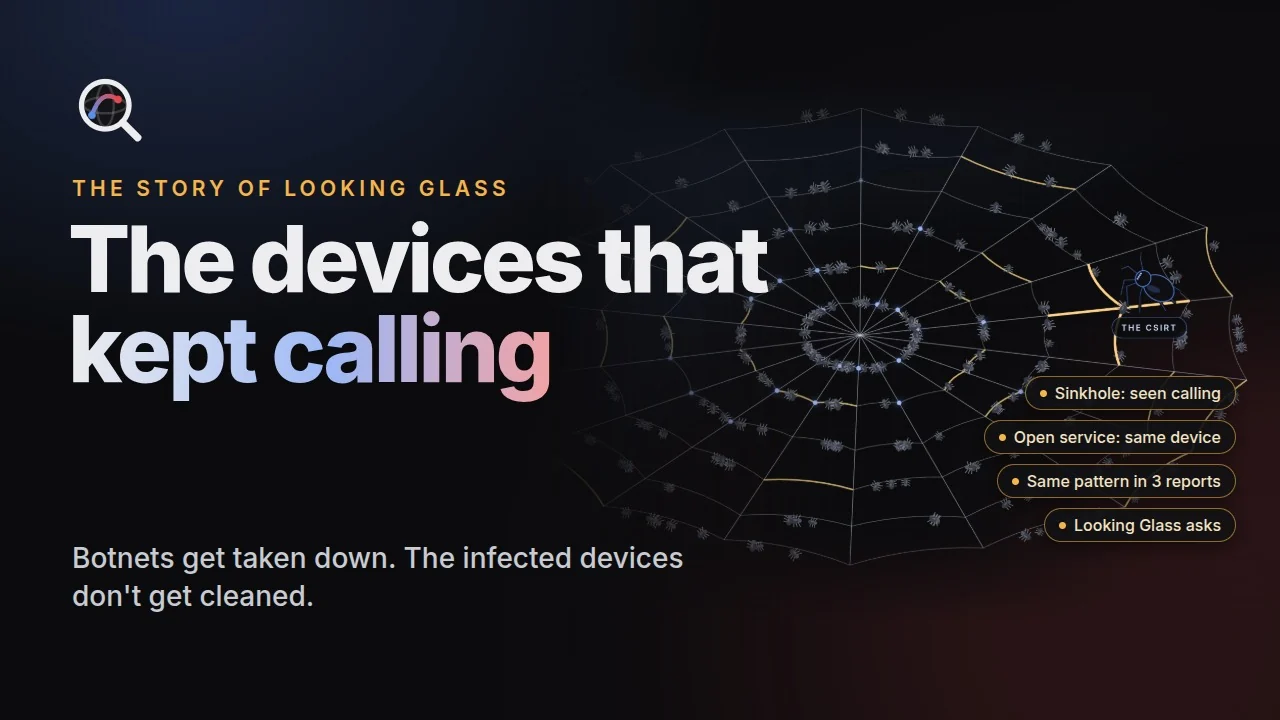
The story behind it. Botnets get taken down; the infected devices don't get cleaned. When a takedown silences the command servers, the devices keep calling, now to a sinkhole, and Shadowserver reports those calls to national CSIRTs every day. Looking Glass began with a question its creator kept hearing from CSIRT teams across Africa: how do we process the Shadowserver data? (4:54, narrated, with captions; animation with made-up data)