 mahlet-inc/hobbits
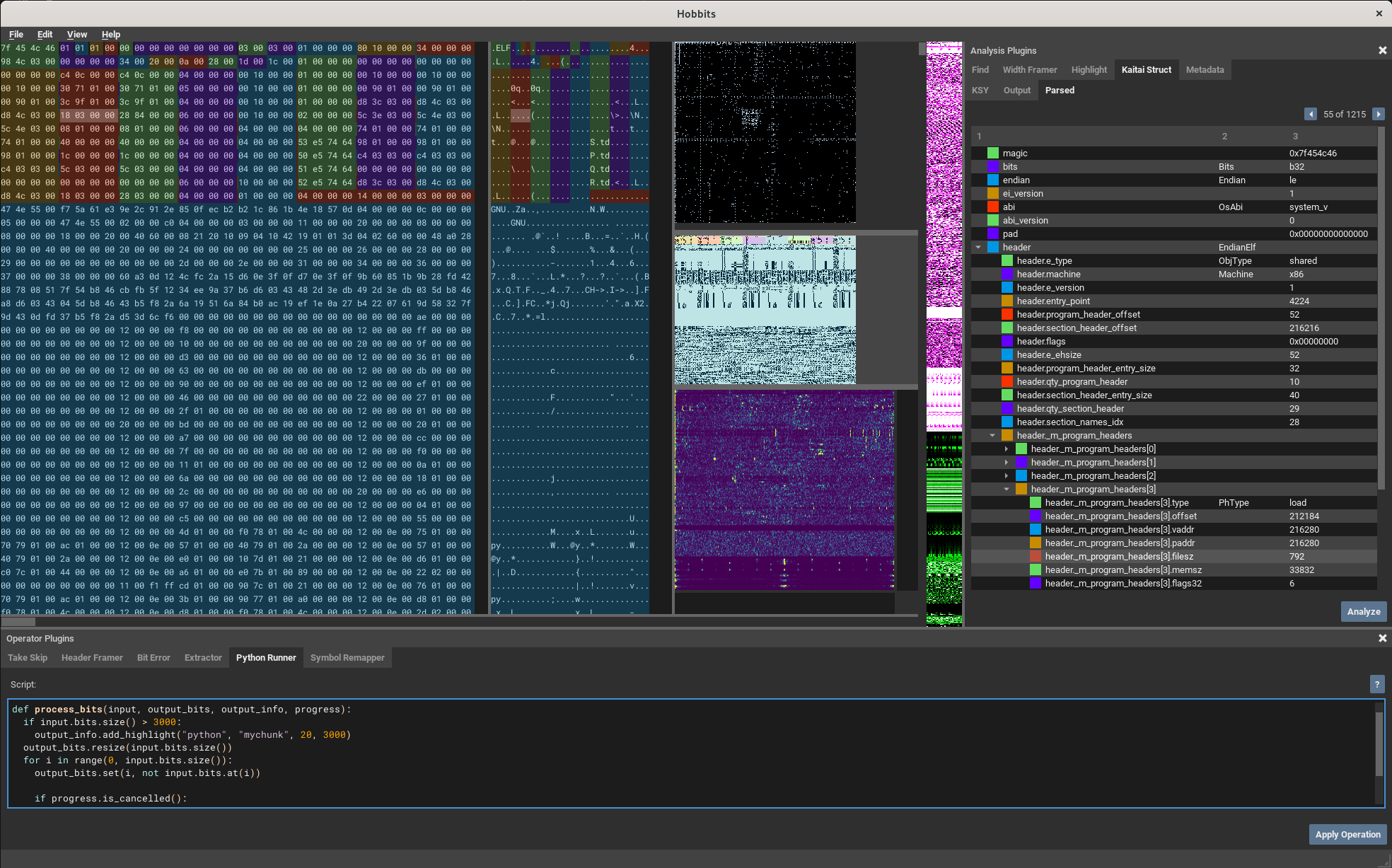
A multi-platform GUI for bit-based analysis, processing, and visualization



Hobbits was developed at Mahlet in 2019 as an integrated data analysis tool. It was open-sourced and is now (passively) maintained by Adam and anyone who wants to contribute. Join the Discord server if you want to ask questions, contribute, or just chat about binary analysis tools.
The documentation is available at mahlet-inc.github.io.
There are pre-built binaries of the latest release on the GitHub releases page.
Read the user guide in the documentation and/or watch this walkthrough video
The default CMake superbuild downloads pinned, SHA-256-checked releases of Qt 6.8.3 (including matching QtWayland on Linux), libpcap, libusb, OpenSSL (Linux), and a pinned PocketFFT revision. No application libraries or Git submodules need to be installed beforehand. The first build includes Qt and can take a while. Dependencies stay inside the build directory.
You need CMake 3.24+, a C++17 compiler, Ninja (or another CMake generator), and your platform SDK. Unix builds also need Make and Perl. Missing m4, Bison and Flex are built automatically for libpcap. Windows builds should run in an MSVC Developer Command Prompt; packet-capture and USB plugins remain Unix-only.
Linux desktop builds include Wayland by default and need its development headers, protocol scanner, and keyboard headers from the OS. Installing the X11/XCB headers also enables the X11 backend for desktops that use it. These packages provide the native display SDK; Qt itself is built by the superbuild. For Ubuntu 24.04, install both backends' SDKs with:
sudo apt-get install cmake ninja-build g++ make perl pkg-config patchelf \
  libwayland-dev wayland-protocols \
  libx11-dev libx11-xcb-dev libxcb1-dev libxcb-cursor-dev libxcb-glx0-dev \
  libxcb-icccm4-dev libxcb-image0-dev libxcb-keysyms1-dev libxcb-randr0-dev \
  libxcb-render-util0-dev libxcb-shape0-dev libxcb-shm0-dev libxcb-sync-dev \
  libxcb-xfixes0-dev libxcb-xinerama0-dev libxcb-xkb-dev libxcb-render0-dev \
  libxkbcommon-dev libxkbcommon-x11-dev
See also Qt's platform requirements.
Configuration fails if the required desktop SDK is missing. Use
-DHOBBITS_ENABLE_WAYLAND=OFF for an X11-only build; its XCB SDK is then required.
-DHOBBITS_HEADLESS=ON is only for automated offscreen tests: it omits both
Wayland and X11 support, so that build cannot open a desktop window.
cmake -S . -B build -G Ninja -DCMAKE_BUILD_TYPE=Release
cmake --build build --parallel 2
ctest --test-dir build --output-on-failure
cmake --install build --prefix "$PWD/install"
If an existing build uses a headless Qt prefix, create a fresh desktop build
directory (for example, replace build with build-desktop above) after
installing the display SDK. Installing headers alone does not add platform
plugins to an existing Qt build. The superbuild uses the same version for QtBase
and QtWayland; do not mix Ubuntu's qt6-wayland plugins with the bundled Qt 6.8.3
runtime.
Build outputs are in build/bin, build/lib, and build/plugins. Run
build/bin/hobbits (on macOS, build/bin/hobbits.app/Contents/MacOS/hobbits).
Visual Studio, Xcode, and Ninja Multi-Config keep each configuration under
build/<Config>/bin, build/<Config>/lib, and build/<Config>/plugins; select it
with cmake --build build --config Release and ctest --test-dir build -C Release.
Build-tree and installed plugins are discovered automatically; -p can add an
extra plugin search directory. Installed paths are relative to the executable,
so moving the install directory or using cmake --install --prefix works.
Python is optional. If a regular Python 3.8+ interpreter and matching shared embedding
development library are found, the Python Runner and Kaitai Struct plugins are
built. On Debian/Ubuntu, install python3-dev to enable them. Otherwise these
plugins and the Python binding library are omitted. Use
-DHOBBITS_ENABLE_PYTHON=OFF to disable them explicitly, or
-DPython3_ROOT_DIR=/path/to/python to select an installation. Set
-DHOBBITS_PYTHON_VERSION=3.14 to require that major/minor version instead of
automatically choosing any available Python.
CI produces standalone Windows ZIPs and Linux tarballs with Python 3.14, using
the latest patch available from setup-python. They include the matching shared
library, standard library, and native modules; Linux also bundles the native
modules' shared-library dependencies, except glibc and the OS loader. These
packages do not need Python installed. Linux standalone builds target Ubuntu
24.04 or a compatible newer system. The bundled interpreter ignores system
Python environment variables and user site-packages. Third-party Python packages
from the build machine are not included. --python-home can explicitly select
another compatible Python home.
The separate Ubuntu 24.04 .deb is built against /usr/bin/python3.12 and depends
on Ubuntu's python3.12 and libpython3.12t64 packages. It does not bundle Python.
Install it with sudo apt install ./hobbits_*.deb so apt installs the dependencies.
The application and Qt libraries live under /usr/lib/hobbits, with hobbits
and hobbits-runner launchers in /usr/bin and a desktop menu entry.
For a local Debian package, install python3.12-dev and dpkg-dev, then configure
a separate build directory:
cmake -S . -B build-deb -G Ninja -DCMAKE_BUILD_TYPE=Release \
  -DCPACK_GENERATOR=DEB -DCMAKE_INSTALL_PREFIX=/usr \
  -DHOBBITS_BUNDLE_PYTHON=OFF -DHOBBITS_PYTHON_VERSION=3.12 \
  -DPython3_EXECUTABLE=/usr/bin/python3.12 -DPython3_ROOT_DIR=/usr
cmake --build build-deb --target package --parallel 2
Build-tree and non-bundled runs still require the matching Python runtime. On macOS, Python's standard library is not bundled.
Useful build options:
-DHOBBITS_USE_SYSTEM_QT=ON: use an installed Qt 6.8+; other dependencies are
still built automatically. Set CMAKE_PREFIX_PATH for a nonstandard Qt path.
On Linux, use a complete Qt installation with matching Wayland or XCB platform plugins.-DHOBBITS_ENABLE_WAYLAND=OFF: build only the X11 desktop backend on Linux.-DHOBBITS_DEPENDENCY_JOBS=4: parallel jobs for each dependency/application
build. The outer --parallel controls how many dependency projects build at once.-DHOBBITS_DOWNLOAD_DIR=/path/to/cache: reuse source archives between builds.-DSELF_CONTAINED_APP=OFF: omit deployment of Qt; also defaults Python bundling to off.-DHOBBITS_BUNDLE_PYTHON=OFF: use an installed Python instead of bundling it,
while retaining Qt deployment. Required for the Ubuntu .deb build.-DHOBBITS_SUPERBUILD=OFF: configure the application directly against existing
dependencies, useful for packaging or IDE work. The normal superbuild's inner
CMake project is build/app.cmake --build build --target package creates a package from the inner project.
Hobbits remains MIT licensed; see THIRD_PARTY_NOTICES.txt
for bundled dependency licenses. Dependency notices are included in installs.