
 completetech-security/node-cve-2026-56848-check
Offline Node.js evidence checker for CVE-2026-56848: HTTP/2 reentrant send use-after-free. Single-file Python; JSON/CSV/HTML reports; no exploit payloads.






Offline version-evidence checker for CVE-2026-56848 — Node.js: HTTP/2 reentrant send use-after-free.
It compares Node.js versions that an operator reports against the fixed releases named in the upstream advisory, and writes a CSV, JSON or HTML report. Python 3.10+, standard library only; the executable can be copied alone.
Overview · Quick start · Inputs · Options · Fixed versions · Results · Output · Limits and exit codes · Sources · License
This checker compares operator-reported runtime versions. It never contacts websites, executes Node.js or project code, or sends exploit payloads, and it has no network mode. It does not scan the current machine, and a public URL is not an inventory.
What a result does and does not say:
exploitability: not_tested.fixed_version_reported means the reported version is at or above the upstream fixed release. It does not attest that the deployed runtime is patched.unknown.Collect versions only from systems you are authorized to inspect. Nothing in this repository assesses a deployed target, attests a runtime, or verifies exploitability.
Run from a checkout, or copy node_cve_2026_56848_check.py on its own:
# One runtime, JSON on stdout
python node_cve_2026_56848_check.py --version 22.23.2 --format json

# Synthetic JSON inventory to an HTML report file
python node_cve_2026_56848_check.py --inventory examples/inventory.example.json --format html --output report.html

# CSV inventory; exit 1 if any result is potentially_affected or unsupported_runtime
python node_cve_2026_56848_check.py --csv-list inventory.csv --fail-on-finding

# All options
python node_cve_2026_56848_check.py --help
The default format is csv, written to stdout unless --output is given. At least one of --version, --inventory or --csv-list is required.
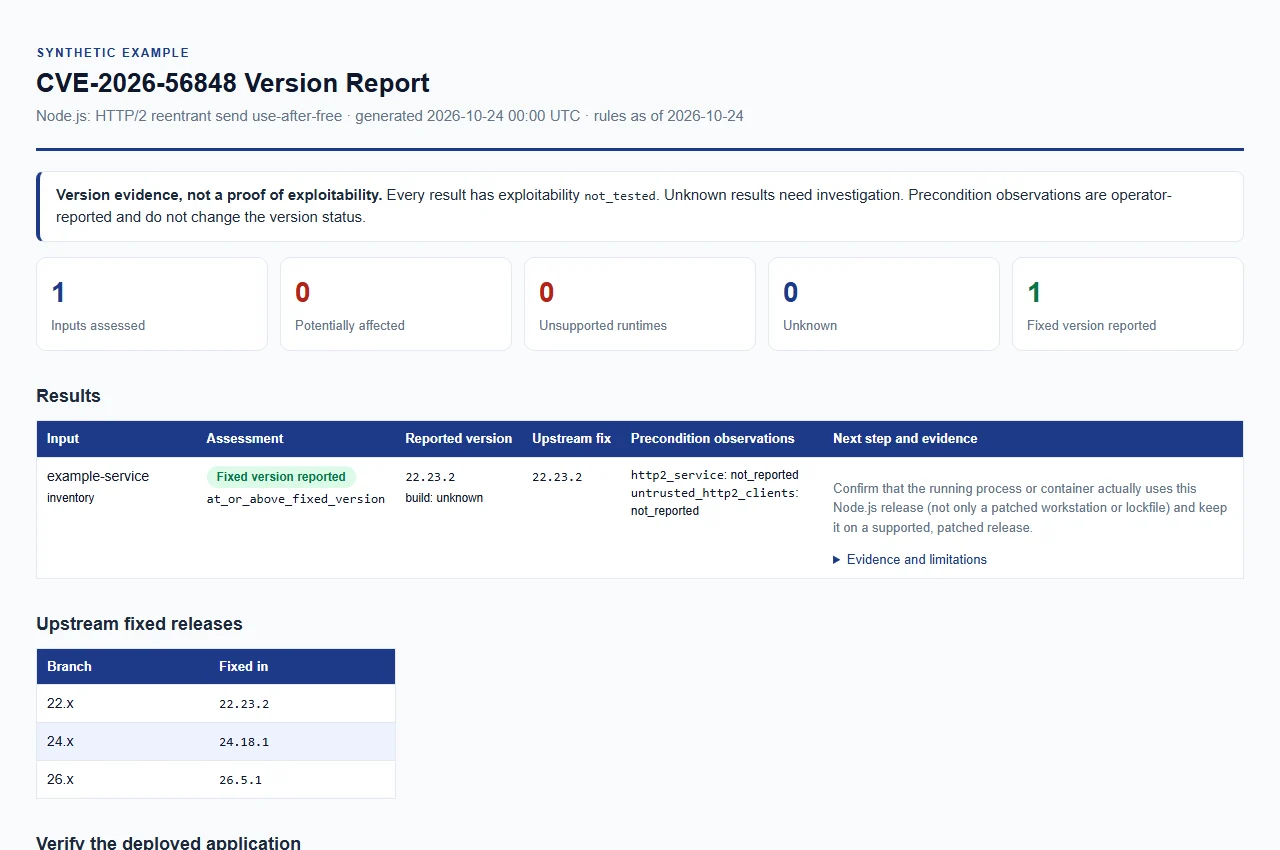
Open the synthetic example report. Example data only; this is not a live assessment.
The three input kinds can be combined in one run. JSON, CSV and HTML reports are built from the same evidence.
Command-line versions. --version (alias --node-version) is repeatable; each value describes a separate runtime. A single leading v and surrounding ASCII whitespace are accepted.
JSON inventory (--inventory FILE, repeatable). One object or an array of objects. See examples/inventory.example.json.
| Field | Required | Type and meaning |
|---|---|---|
schema_version | yes | Integer 1 |
node_version | yes | String |
runtime | no | "node" if present; other runtimes are rejected |
label | no | String used to identify the entry in reports |
build_source | no | String; see build source |
http2_service | no | Boolean or null: http2 service |
untrusted_http2_clients | no | Boolean or null: untrusted http2 clients |
Unknown keys, duplicate keys, non-finite numbers and invalid types are rejected.
CSV list (--csv-list FILE, repeatable). A header row with a node_version column is required. Optional columns are label, build_source, http2_service and untrusted_http2_clients; observation cells are true, false or blank. schema_version and runtime are not CSV columns. Undocumented or duplicate columns, rows with a different field count, bare quotes inside unquoted cells, NUL characters, and files with no rows are rejected.
build_source (or --build-source) records where the build came from. A blank value, unknown (the default), upstream, official and official_upstream are compared as official upstream builds. Any other value, such as a distribution or vendor name, yields unknown with vendor_build_unverified, because an upstream version number does not show which patches or backports a vendor build contains. Because unknown is compared as upstream, supply the real source for any vendor, distribution or custom build.
| Option | Purpose |
|---|---|
--version VERSION, --node-version VERSION | Node.js version to assess offline; repeatable |
--build-source SOURCE | Provenance of every --version build, at most 512 characters; default unknown |
--http2-service {true,false} | Operator observation applied to every --version input |
--untrusted-http2-clients {true,false} | Operator observation applied to every --version input |
--inventory FILE | JSON inventory; repeatable |
--csv-list FILE | CSV inventory; repeatable |
--format {csv,json,html} | Report format; default csv |
--output FILE | Write the report to a new file; default is stdout |
--force | Explicitly replace an existing output file |
--brand NAME | Organization name shown in the HTML report, at most 512 characters; ignored by CSV and JSON |
--fail-on-finding | Exit 1 when any result is potentially_affected or unsupported_runtime |
--tool-version | Print the tool name and version, then exit |
--help | Show usage and exit codes |
--output requires an existing directory and a regular-file path. Existing reports are protected unless --force is explicit, and an input file is never overwritten, even with --force.
Reviewed 2026-10-24 against the official release advisory and linked fixed releases (rules_as_of in reports).






