 completetech-security/node-cve-2026-106069-check
Offline Node.js evidence checker for CVE-2026-106069: TLS leading-zero IPv4 resolver mismatch. Single-file Python; JSON/CSV/HTML reports; no exploit payloads.





Offline version-evidence checker for CVE-2026-106069 — Node.js: TLS leading-zero IPv4 resolver mismatch.
It compares Node.js versions that you report against the fixed releases named in the vendor's advisory and produces CSV, JSON or script-free HTML triage reports. It is a single Python 3.10+ file that uses only the standard library, so the executable can be copied on its own.
This checker compares operator-reported runtime versions. It never contacts websites, executes Node.js or project code, or sends exploit payloads, and there is no network mode. It does not scan the current machine: you supply the version evidence.
exploitability: not_tested.unknown.CI runs the local-only unit tests and the --help check on Ubuntu and Windows with Python 3.10 and 3.14.
# Assess one reported version and print JSON to stdout
python node_cve_2026_106069_check.py --version 22.23.4 --format json

# Assess the synthetic inventory and write an HTML report to a new file
python node_cve_2026_106069_check.py --inventory examples/inventory.example.json --format html --output report.html

# Assess a CSV list and exit 1 if any result is a finding
python node_cve_2026_106069_check.py --csv-list inventory.csv --fail-on-finding

# Show all options, or run the local tests
python node_cve_2026_106069_check.py --help
python -m unittest -v
--version is repeatable; each value describes a separate runtime. CSV, JSON and HTML reports contain the same evidence, and the default format is CSV on stdout.
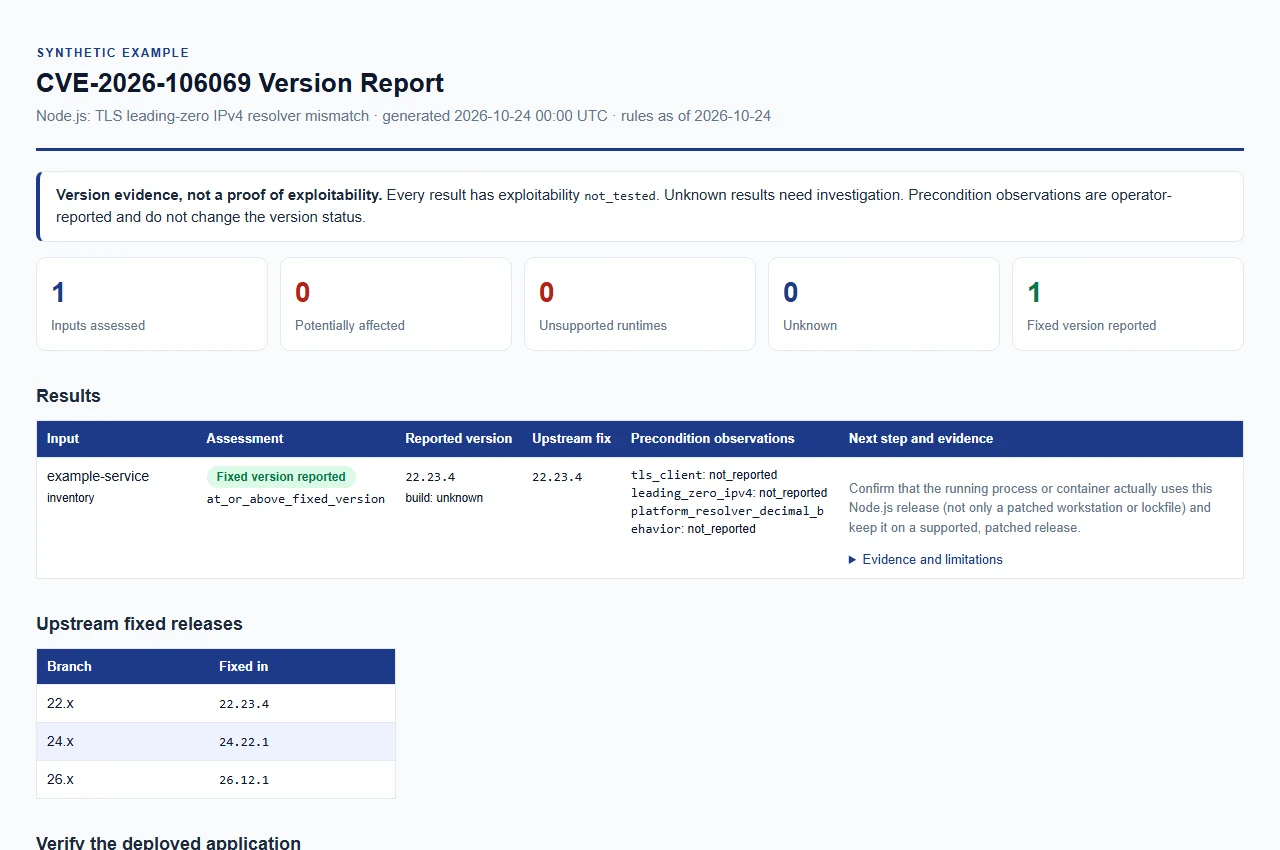
Open the synthetic example report. Example data only; this is not a live assessment and describes no real system.
Provide at least one of --version, --inventory or --csv-list. Inputs can be combined in one run.
| Option | Purpose |
|---|---|
--version VERSION (alias --node-version) | Assess an explicitly supplied Node.js version; a leading v is accepted. Repeatable. |
--inventory FILE | JSON inventory file (one object or an array). Repeatable. |
--csv-list FILE | CSV inventory file with a node_version column. Repeatable. |
--build-source SOURCE | Provenance of the --version builds (see below). Default unknown. |
--tls-client {true,false}--leading-zero-ipv4 {true,false}--platform-resolver-decimal-behavior {true,false} | Operator-reported observations applied to every --version input. |
--format {csv,json,html} | Report format. Default csv. |
--output FILE | Write the report to a new file instead of stdout. |
--force | Replace an existing output file. Never allows overwriting an input file. |
--brand NAME | Organization name shown in the HTML report header (at most 512 characters). Default CompleteTech LLC. |
--fail-on-finding | Exit 1 when any result is potentially_affected or unsupported_runtime. |
--tool-version | Print the checker name and version, then exit. |
--build-source applies to all --version values in the run. The default unknown, and the values upstream, official, official_upstream or empty (compared case-insensitively), are treated as an upstream build and compared by version. Any other value, such as a vendor name, produces unknown with version_status: vendor_build_unverified, because the upstream version does not show which patches or backports the build contains.
Versions are trimmed of ASCII whitespace and one leading v is accepted. Only plain MAJOR.MINOR.PATCH releases are compared; prerelease, nightly, rc, package-suffixed and partial versions remain unknown.
Existing reports are protected unless --force is explicit, and inputs cannot be overwritten even with --force. The output directory must already exist.
Operator-reported observations are optional and are recorded in the report, but they never change the version result or establish reachability.
| Observation key | CLI flag | Advisory precondition |
|---|---|---|
tls_client | --tls-client | tls client |
leading_zero_ipv4 | --leading-zero-ipv4 | leading zero ipv4 |
platform_resolver_decimal_behavior | --platform-resolver-decimal-behavior | platform resolver decimal behavior |
JSON inventory is one object or an array of 1 to 10,000 records. Each record requires integer schema_version: 1 and string node_version. Optional fields are runtime: "node" (any other runtime is rejected), label, build_source, and the observation keys above, each boolean or null. Unknown keys, duplicate keys, non-finite numbers and invalid types are rejected. A complete synthetic record is in examples/inventory.example.json.
CSV inventory requires a header row with a node_version column. Optional columns are label, build_source and the observation keys, with values true, false or blank. There are no schema_version or runtime columns. Duplicate or undocumented columns, rows with a different number of fields than the header, quotes inside unquoted cells, text after a closing quote, unterminated quotes, NUL characters, and files with no rows are rejected.






