
Skip to content
KitploitKITPLOIT
ToolsExploitsBlog
Log in
Submit
ToolsExploitsBlog
Submit

Hacking, PenTest, and Cybersecurity Tools for Your Security Arsenal!

Kitploit is a directory of hacking, cybersecurity, and pentesting tools. Discover the latest project updates to find vulnerabilities, analyze systems, automate testing, and strengthen your security.

FeedsContactPrivacy© 2026 Kitploit

Tool Directory

Categories

View all categories
Loading categories
CVE-2026-125350 — Security research report on CVE-2026-125350, a high-severity use-after-free (CWE-416) in Google Chrome's XML component, covering impact, detection, and mitigation. | Kitploit
Tools/GitHubGitHub/ashrafzaryouh/cve-2026-125350
Memory ForensicsVulnerability AnalysisWeb SecurityPapers & ResearchLearning & Education
GitHubashrafzaryouh/cve-2026-125350

CVE-2026-125350

Security research report on CVE-2026-125350, a high-severity use-after-free (CWE-416) in Google Chrome's XML component, covering impact, detection, and mitigation.


Share
View Repository
19 days agoNot yet reviewed

🔐 CVE-2026-125350 - Google Chrome — XML Use-After-Free Vulnerability

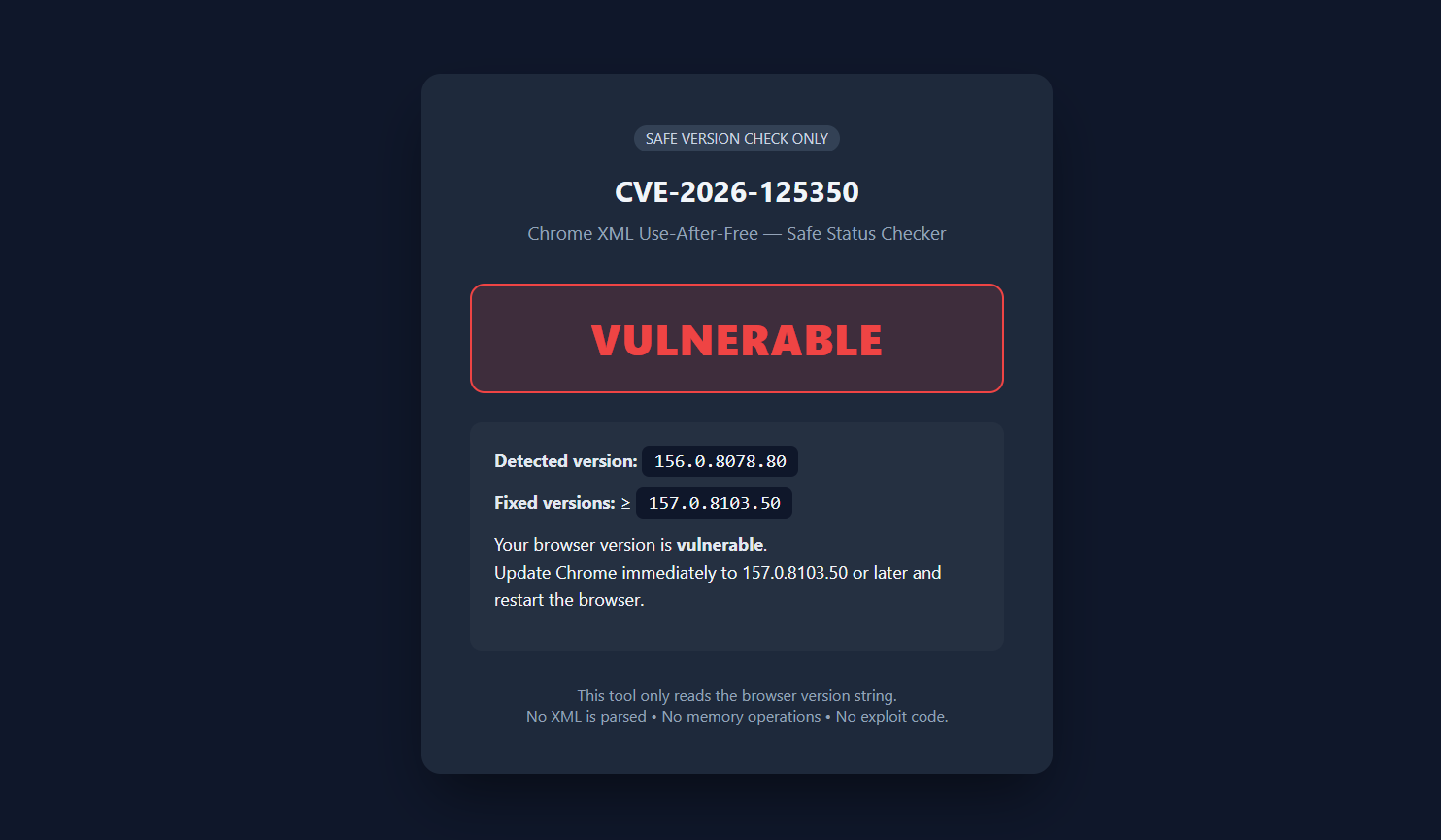
Chrome Zero-Day Security Alert


◈ 01 — Introduction

A security research report documenting a Use-After-Free vulnerability in Google Chrome's XML component.

AttributeInformation
CVECVE-2026-125350
VendorGoogle
ProductGoogle Chrome
ComponentXML
TypeUse-After-Free
CWECWE-416
SeverityHigh
StatusExploitation reported

◈ 02 — Technical Overview

┌───────────────────────────────────┐
│          GOOGLE CHROME             │
├───────────────────────────────────┤
│                                   │
│   XML COMPONENT                   │
│        │                          │
│        ▼                          │
│   MEMORY ALLOCATION               │
│        │                          │
│        ▼                          │
│   MEMORY RELEASE                  │
│        │                          │
│        ▼                          │
│   STALE POINTER ACCESS            │
│        │                          │
│        ▼                          │
│   USE-AFTER-FREE                  │
│                                   │
└───────────────────────────────────┘
◈ 03 — Security Impact

  • Memory corruption
  • Browser instability
  • Potential code execution
  • Possible compromise of browser processes
chromev8

◈ 04 — Detection

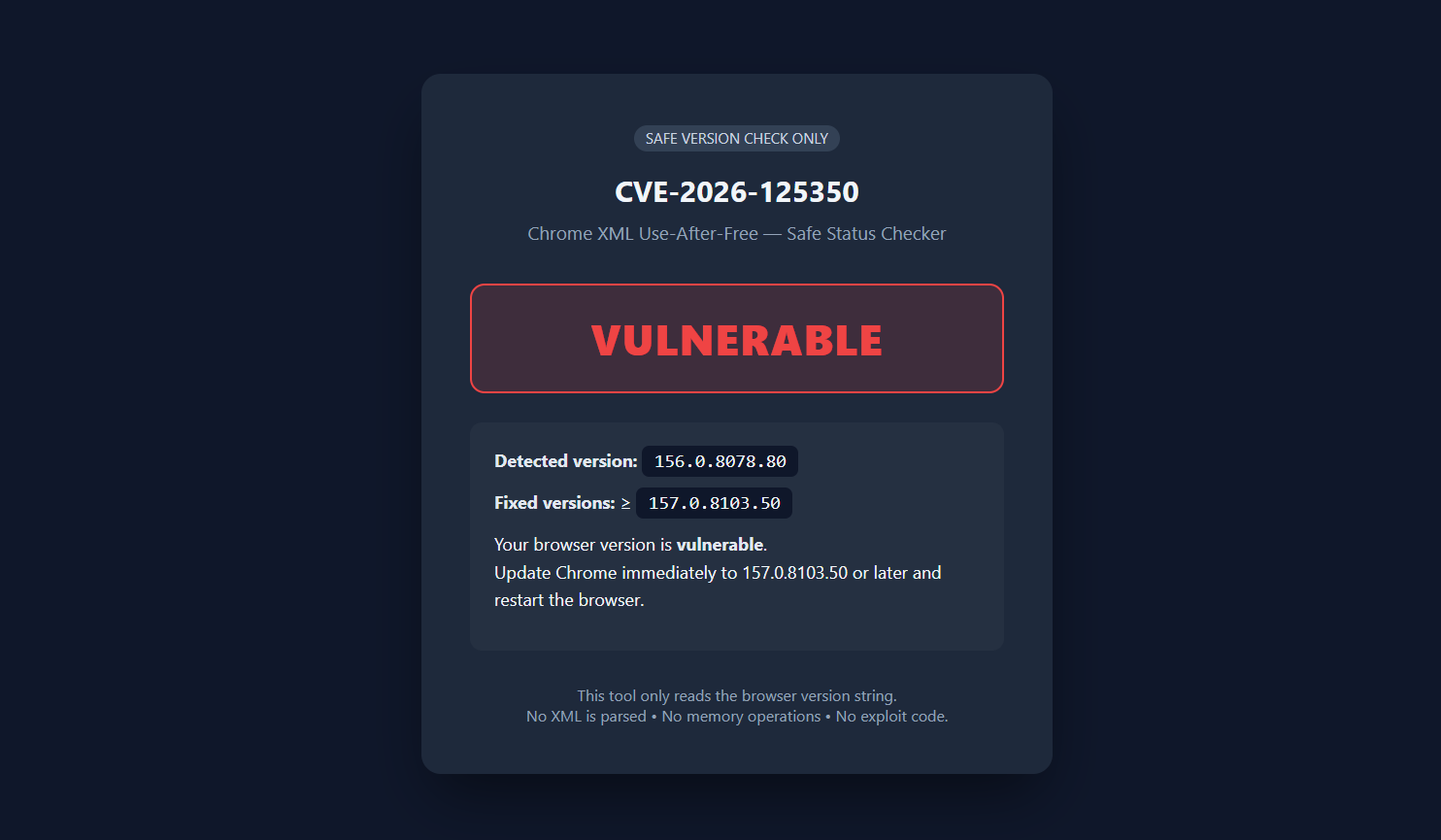
Linux / Kali Linux

google-chrome --version
chromium --version

Windows

start chrome://settings/help

◈ 05 — Mitigation

  1. Update Chrome to a fixed release.
  2. Restart the browser.
  3. Verify the installed version.
  4. Audit enterprise browser deployments.

◈ 06 — Research References

  • Google Chrome Releases
  • CWE-416 — Use After Free
  • NVD — National Vulnerability Database

CYBERSECURITY • VULNERABILITY RESEARCH • DEFENSIVE SECURITY
Educational and authorized security research only.


Download Tool

Most Popular

View all →

Discover the most used tools by our community.

  • 1

    OsintHunter

    letox4/osinthunter

    🎯 The ultimate OSINT toolkit: investigation graph, confidence scoring, alias families, map, timeline and reports. 49 modules, 400+ sites, no API keys required.

    936
  • 2

    ghostlock-app

    yukonga/ghostlock-app

    GhostLock One-Tap Execution App (CVE-2026-43499)

    555
  • 3

    redforge

    cybersecurity91/redforge

    Browser-side red team toolkit with 102 offline tools for recon, payload generation, credential attacks, crypto, encoding and engagement reporting.

    353
  • 4

    ARTEX

    baarai/artex

    LLM multi-agent autonomous penetration testing platform with planner/worker agents, asset and exploration graphs, MITM traffic recording, and vulnerability retesting.

    348
  • 5

    looking-glass

    anonghosty/looking-glass

    CSIRT platform that ingests Shadowserver reports into MongoDB and replays them as interactive maps, analysis, findings, advisories and executive dashboards.

    336
  • 6

    CyberStrikeAI

    ed1s0nz/cyberstrikeai

    The system of action for AI-native cybersecurity—where intent becomes governed execution, evidence becomes operational memory, and every operation improves the next.

    288

Explore all tools

Browse our collection of tools

View all tools →









