Cybersecurity-Handbook v2.0
A community-driven cybersecurity handbook with 400+ notes, labs, mind maps, and cheat sheets — covering everything from networking, Linux, and cryptography to offensive and defensive security. Built to help you understand how things work, not just memorize them.
📚 Cybersecurity Handbook
A modern, open-source cybersecurity knowledge base designed to help students, professionals, and lifelong learners build practical security skills through structured notes, hands-on labs, and real-world concepts.
Built with Quartz • Powered by Markdown • Community Driven • MIT Licensed

Learn cybersecurity with clarity — from fundamentals to advanced concepts, all in one searchable, open-source handbook.
| 📝 Notes | 🧪 Labs | 🔍 Search | ⚡ Performance | 👥 Community |
|---|---|---|---|---|
| Continuously Growing | Hands-on Learning | Lightning Fast | Powered by Quartz | Open Source |
📑 Table of Contents
Preview
What It Looks Like
Clean Homepage | Interactive Graph | Reader Mode
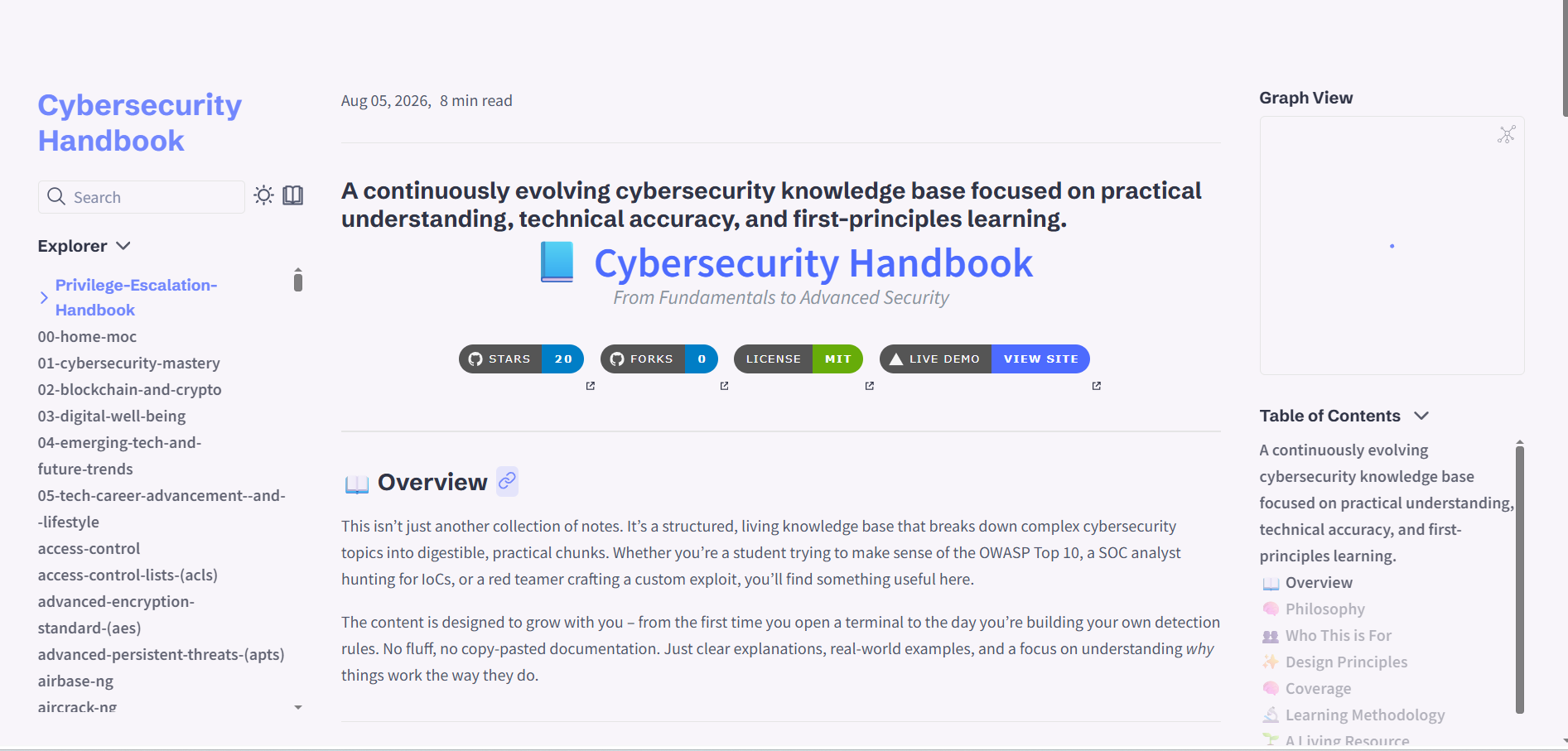
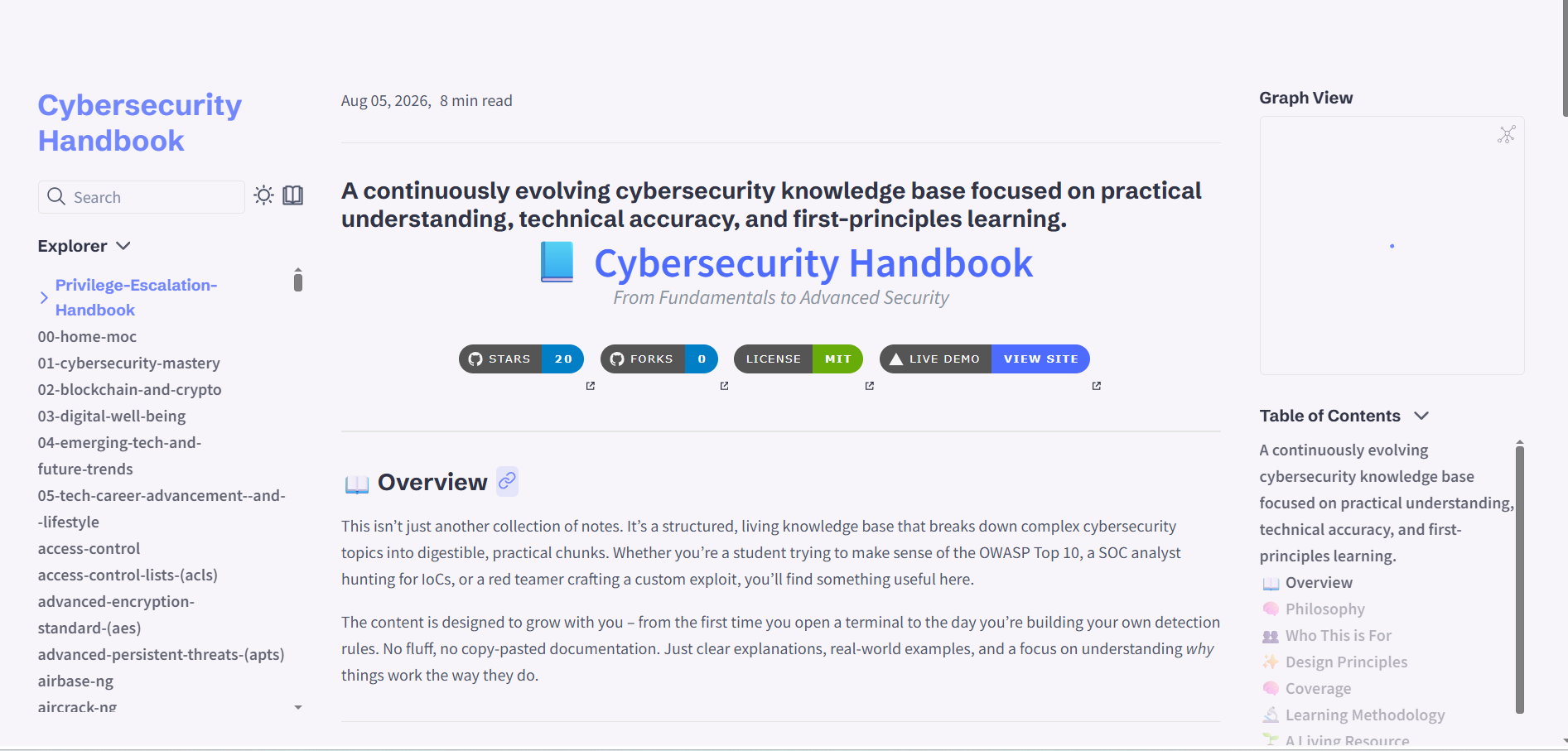
🏠 Homepage
The clean, distraction-free homepage — designed for reading.
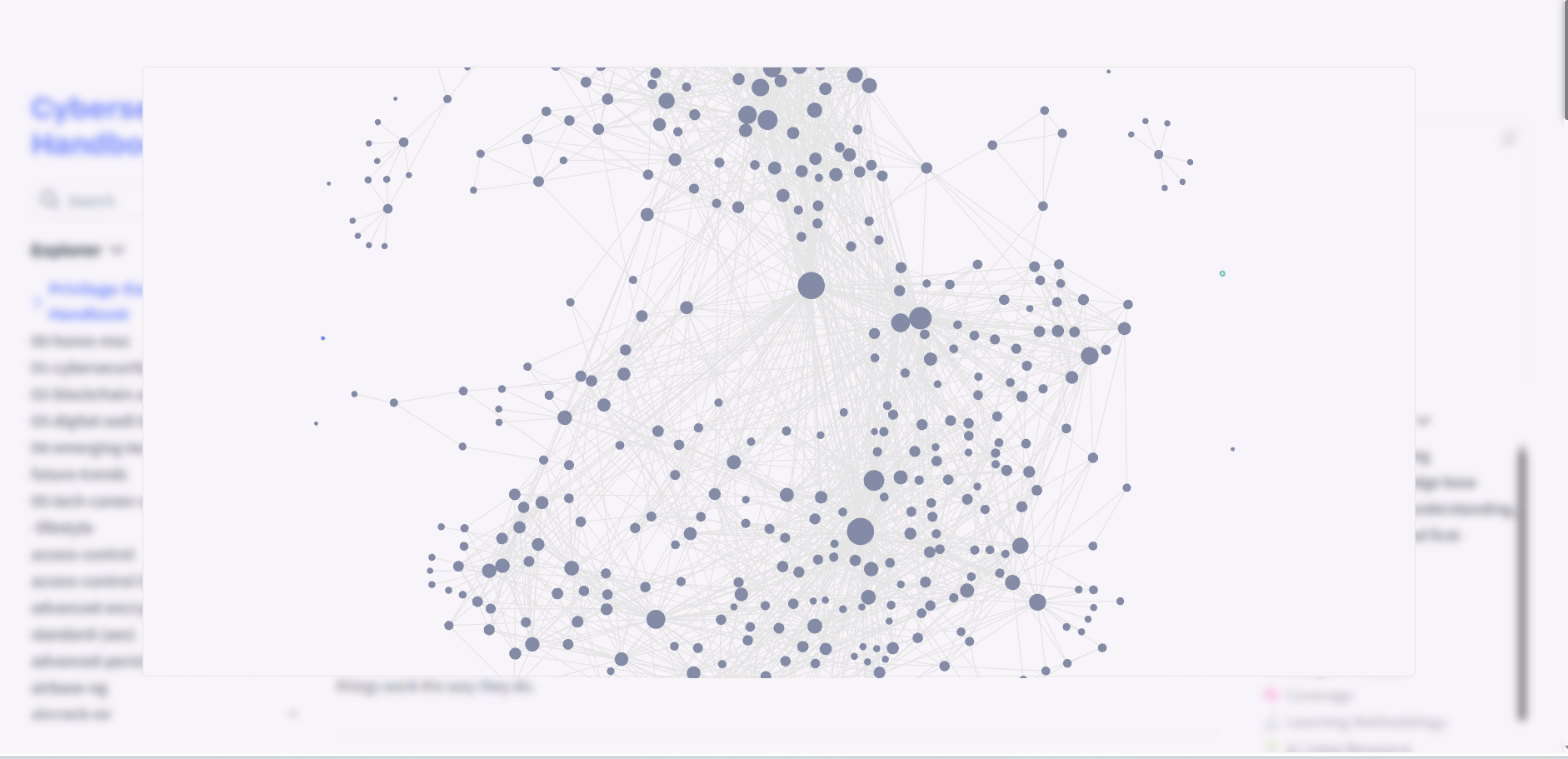
🕸️ Interactive Knowledge Graph
See how topics connect. Every note is linked to related concepts.
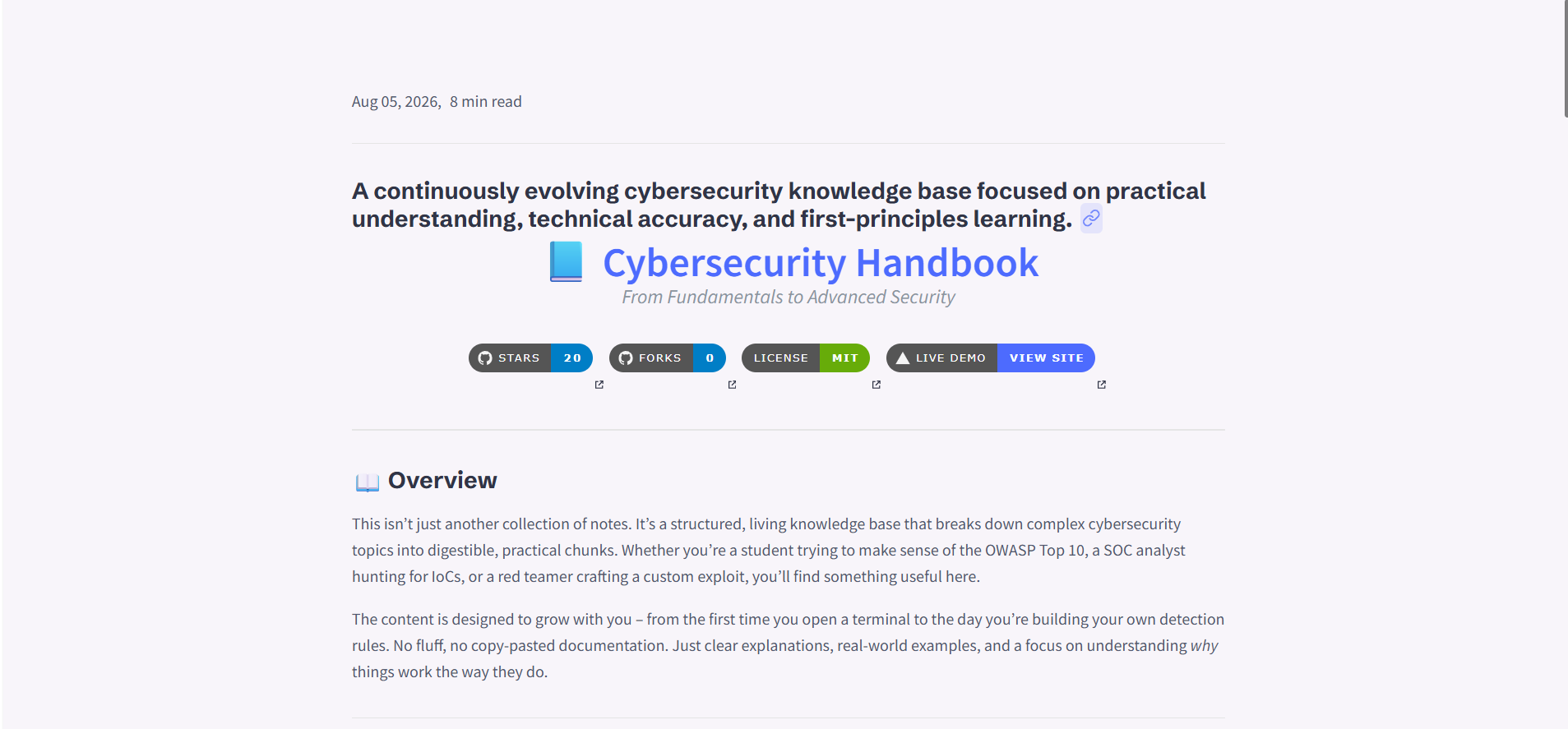
📖 Reader Mode
Focus on what matters. No distractions, just learning.
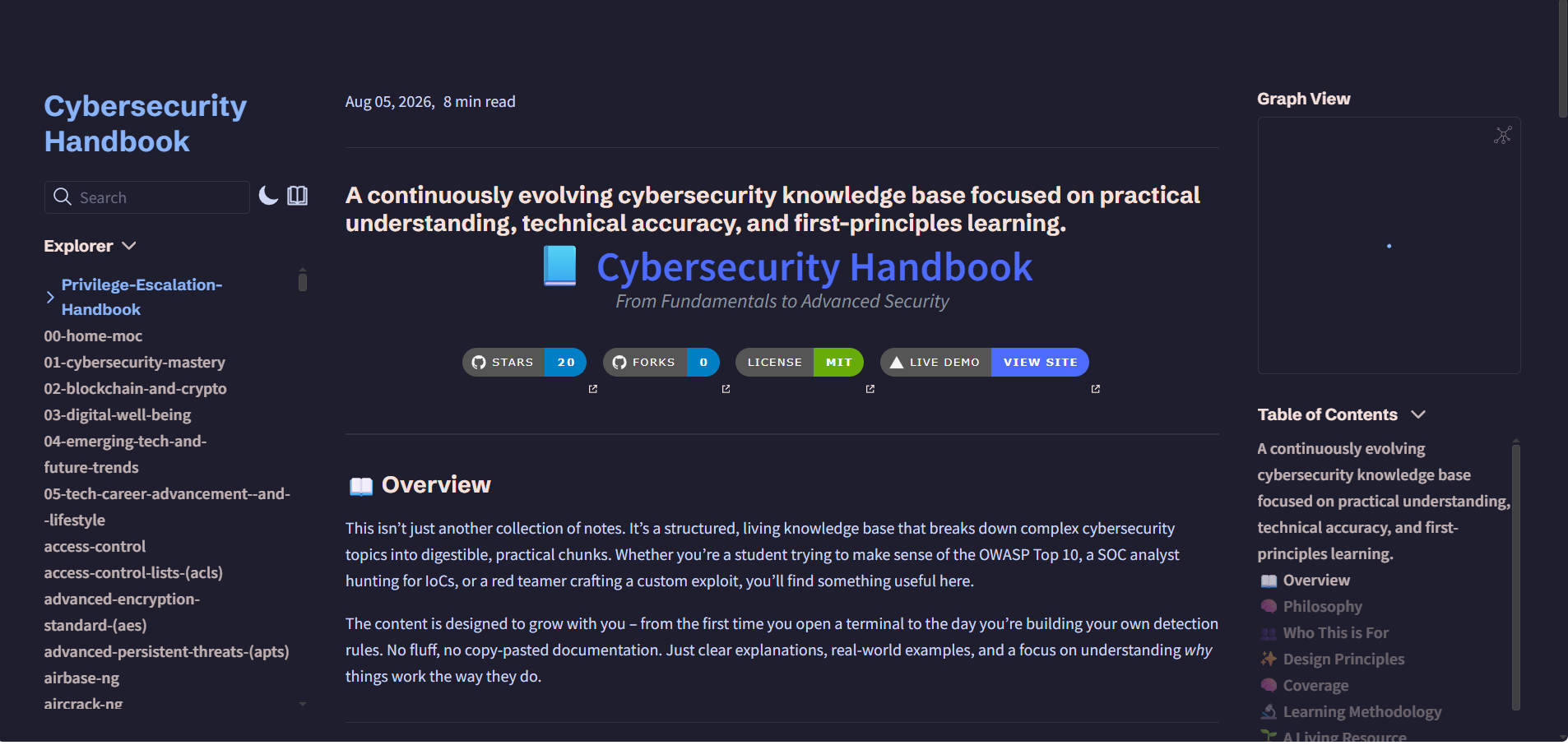
🌙 Dark Mode (Catppuccin Mocha)
Easy on the eyes — perfect for late-night reading sessions.
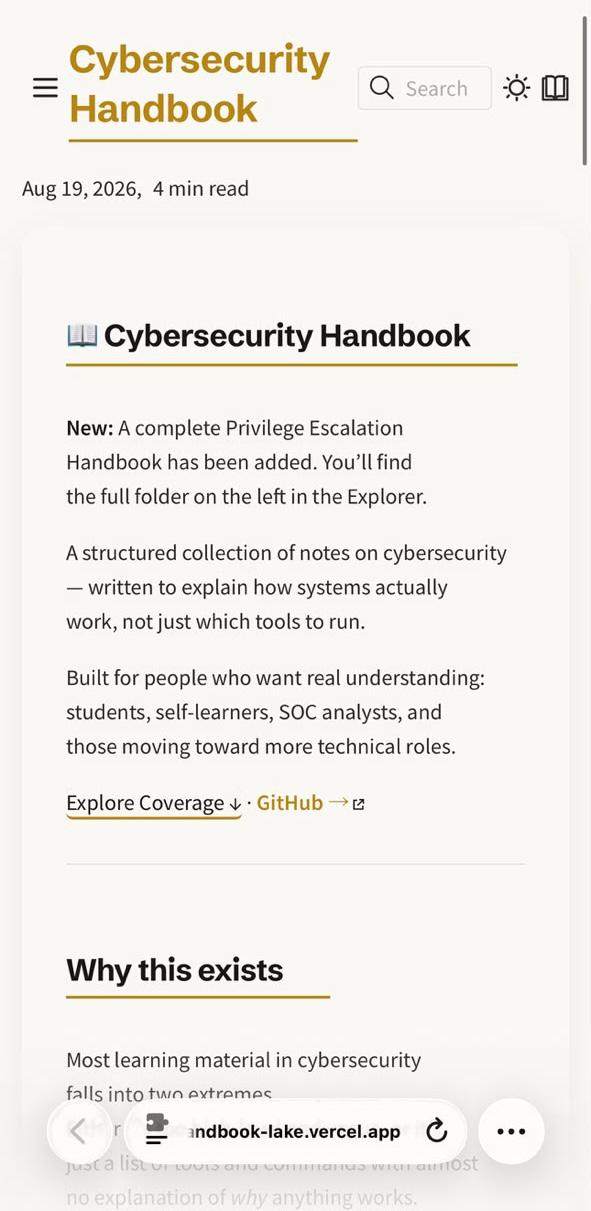
📱 Mobile View
Fully responsive — access from any device, anywhere.
Why I Built This
I've been in the same place you probably are right now — reading through forums, watching YouTube tutorials, trying to piece together what actually matters in cybersecurity.
Most resources I found were either:
- Too shallow — just a list of tools with no explanation of why they work.
- Too scattered — good content spread across 20 different blogs and paid courses.
- Too expensive — not everyone can afford a $500 course just to get started.
So I started writing my own notes. Notes that actually explain how things work, not just what commands to run. Over time, those notes grew into this handbook.
I'm not a guru. I don't have all the answers. But I do believe that anyone can learn this stuff if it's explained clearly and practically.
If this handbook saves you even one late-night Google rabbit hole, it was worth the effort.
You're not alone in this. Let's learn together.
What This Handbook Offers
This is a free, open-source collection of cybersecurity notes.
It's built with Quartz — so you can search through everything instantly, see how topics connect visually, and navigate easily. The content covers real-world threats, tools, and defense strategies, and it's maintained by people who work in the field.
No ads. No paywalls. Just clear explanations of how things work.
Key Features
There's a lot here — over 400 notes covering OSINT, cryptography, cloud security, and everything in between.
You can search through everything instantly. See how topics connect visually with the knowledge graph. Read in dark mode or light mode, on your phone or your laptop.
And everything is built around first-principles learning.
No fluff. No filler. Just the information you actually need.
Quick Start
Get the handbook running locally in under 2 minutes.
Prerequisites
- Node.js (v18 or later)
- npm or yarn
Installation & Run
Linux/macOS (bash/zsh)
git clone https://github.com/priyanshu-rawa/Cybersecurity-Handbook.git
cd Cybersecurity-Handbook
npm install
npm run quartz:dev
Windows (PowerShell)
# Clone the repository
git clone https://github.com/priyanshu-rawa/Cybersecurity-Handbook.git
cd Cybersecurity-Handbook
# Install dependencies
npm install
# Start the development server
npm run quartz:dev
Build for Production
# Build static site
npm run quartz:build
# Preview the build locally
npm run quartz:serve
📖 What's Covered
🖥️ Operating Systems – Linux, Windows, networking basics like TCP/IP, DNS, VPNs, and firewalls.
⚔️ Offensive Security – OWASP Top 10, SQL injection, XSS, scanning, exploitation, and post‑exploitation.
🛡️ Defensive Security – SOC, incident response, SIEM, log analysis, threat hunting, and digital forensics.
☁️ Cloud & Infrastructure – AWS, Azure, GCP, Zero Trust, Docker, Kubernetes, DevSecOps, and IAM.
💻 Programming & Automation – Python, Bash, PowerShell, scripting, CI/CD, and Git.
🔐 Cryptography – Symmetric and asymmetric encryption, AES, RSA, hashing (SHA‑256, MD5), PKI, TLS, and certificates.
Philosophy
Understanding the technology is the foundation of everything else.
This handbook explains operating systems, networking, protocols, memory, authentication, and processes – how they work and what they do. Every topic focuses on clear definitions and practical explanations.
Because if you understand what's happening under the hood, everything else follows.
Contributing
I welcome contributions of all kinds — from fixing a typo to adding an entire new topic. First time contributing to open source? No worries — I'll guide you through it.
Quick Steps
- Fork the repository
- Create a branch:
git checkout -b feature/your-feature-name - Make your changes and commit:
git commit -m "Add: brief description" - Push to your fork:
git push origin feature/your-feature-name - Open a Pull Request against the
mainbranch
Ways to Help
- 📝 Content – Add new topics, fix errors, improve explanations
- 🎨 Design – Improve visuals, add diagrams, enhance layout
- 💻 Code – Fix bugs, improve the Quartz setup, add features
- 📚 Documentation – Improve clarity, formatting, cross-references
- 👥 Community – Report issues, suggest improvements, help others
Quick Guide
| Step | Action |
|---|---|
| 1 | Fork the repository — click the "Fork" button at the top right |
| 2 | Clone your fork locally: git clone https://github.com/your-username/Cybersecurity-Handbook.git |
| 3 | Create a branch for your changes: git checkout -b feature/your-feature-name |
| 4 | Make your changes — add notes, fix typos, update content |
| 5 | Stage your changes: git add . |
| 6 | Commit with a clear message: git commit -m "Add: New section on ransomware defense" |
| 7 | Push to your fork: git push origin feature/your-feature-name |
| 8 | Open a Pull Request — go to the original repo and click "Compare & pull request" |
Where to Put Files
| Type | Location |
|---|---|
| 📝 Cybersecurity notes | content/ (in the relevant category folder) |
| 🖼️ Images | assets/images/ |
| 📊 Diagrams | assets/diagrams/ |
| 🧪 Labs | content/ (in the relevant lab folder) |
Support & Sponsorship
This handbook is — and will always be — completely free and open source.
If it's helped you in any way, here are some simple ways to give back.
"Open source is built by people who care. Every contribution — no matter how small — makes a difference."
How You Can Support
| ⭐ Star the repo | Adds a star to the project on GitHub. Increases visibility and discoverability. |
| 📢 Share the handbook | Post it on LinkedIn, Twitter, Reddit, Discord. Drives organic growth of the community. |
| 🖊️ Contribute content | Add new topics, fix typos, sharpen explanations. Makes the content better for everyone. |
| 💬 Give feedback | Open an issue or start a discussion. Guides future improvements and priorities. |
| 🤝 Tell a friend | Share with someone learning cybersecurity. Expands the network of learners and practitioners. |
| 🐛 Report bugs | Let me know if something is broken or unclear. Keeps the handbook accurate and reliable. |
| 📖 Use it daily | Reference it in your learning or work. The best support is using it. |
Say Thanks
A simple "thank you" or "this helped me" goes a long way. If this handbook made a difference in your learning journey, I'd love to hear about it.
- 📧 Email:
[email protected]
Spread the Word
The best way to support this project is to share it with others who might find it useful.
Copy this and share it:
"I found this free Cybersecurity Handbook with 400+ notes, built with Obsidian + Quartz. Check it out: https://github.com/priyanshu-rawa/Cybersecurity-Handbook"
Join the Community
- Star on GitHub: https://github.com/priyanshu-rawa/Cybersecurity-Handbook
- Visit the live site: https://cybersecurity-handbook-lake.vercel.app
- Start a discussion: Open an issue or start a conversation
Thank you for being part of this journey. Every star, share, and contribution matters.
License
This project is licensed under the MIT License — see the LICENSE file for details.
You are free to use, modify, distribute, and even commercialize this work, as long as you retain the copyright notice. We encourage you to contribute back improvements!
Star, Fork, Share
If you find this handbook useful:
- Star the repository to show your appreciation and increase visibility.
- Fork it to customize or contribute back.
- Share it with your network — on Twitter, LinkedIn, or any cybersecurity community.
Every star, fork, and share helps someone discover this resource.
Cybersecurity Handbook
A continuously evolving knowledge base built through documentation, experimentation, and practical learning.
Always Learning · Always Documenting · Always Improving
If this helped you, drop a star — it keeps me motivated to build more. ⭐