priyanshu-rawa/cybersecurity-handbook
Open-source cybersecurity knowledge base with 400+ notes, labs, and cheat sheets covering offense, defense, cryptography, cloud, and forensics.

<div align="center">
<img src="https://capsule-render.vercel.app/api?type=waving&color=0:0F2027,50:2C5364,100:4D6BFE&height=200%C2%A7ion=header&text=Cybersecurity%20Handbook&fontSize=48&fontColor=ffffff&fontAlignY=38&desc=Learn.%20Defend.%20Master%20the%20Craft.&descAlignY=58&descSize=18&animation=fadeIn" width="100%"/>
<a href="https://cybersecurity-handbook-lake.vercel.app">
<img src="https://readme-typing-svg.demolab.com/?lines=Open-source+Cybersecurity+Knowledge+Base;400++Notes+%C2%B7+Labs+%C2%B7+Interactive+Graph;Built+by+the+Community,+for+the+Community;From+First+Principles+to+Advanced+Concepts&font=Fira+Code%C2%A2er=true&width=650&height=45&color=4D6BFE&vCenter=true&size=22&pause=1800" alt="Typing SVG" />
</a>
</div>
<h1 align="center">📚 Cybersecurity Handbook</h1>
<p align="center">
An open-source cybersecurity knowledge base for students, professionals, and
self-learners — built as structured notes, hands-on labs, and real-world
concepts you can search and navigate visually.
</p>
<p align="center">
Built with <b>Quartz</b> • Powered by <b>Markdown</b> • Community Driven • MIT Licensed
</p>
<p align="center">
<a href="https://cybersecurity-handbook-lake.vercel.app">
<img src="https://img.shields.io/badge/%F0%9F%8C%90_Live_Website-Visit_Now-4D6BFE?style=for-the-badge&labelColor=0D1117" alt="Live Website">
</a>
<a href="#quick-start">
<img src="https://img.shields.io/badge/%F0%9F%9A%80_Getting_Started-Guide-2EA44F?style=for-the-badge&labelColor=0D1117" alt="Getting Started">
</a>
<a href="#contributing">
<img src="https://img.shields.io/badge/%F0%9F%A4%9D_Contributions-Welcome-FF8C00?style=for-the-badge&labelColor=0D1117" alt="Contributions">
</a>
</p>
<p align="center">
<img src="https://img.shields.io/github/stars/priyanshu-rawa/Cybersecurity-Handbook?style=for-the-badge&logo=github&color=F5C518&labelColor=0D1117" alt="Stars">
<img src="https://img.shields.io/github/forks/priyanshu-rawa/Cybersecurity-Handbook?style=for-the-badge&logo=github&color=4D6BFE&labelColor=0D1117" alt="Forks">
<img src="https://img.shields.io/github/contributors/priyanshu-rawa/Cybersecurity-Handbook?style=for-the-badge&color=2EA44F&labelColor=0D1117" alt="Contributors">
</p>
<p align="center">
<img src="https://img.shields.io/github/issues/priyanshu-rawa/Cybersecurity-Handbook?style=flat-square&logo=github&color=red&labelColor=0D1117" alt="Issues">
<img src="https://img.shields.io/github/last-commit/priyanshu-rawa/Cybersecurity-Handbook?style=flat-square&logo=git&color=orange&labelColor=0D1117" alt="Last Commit">
<img src="https://img.shields.io/github/license/priyanshu-rawa/Cybersecurity-Handbook?style=flat-square&color=blueviolet&labelColor=0D1117" alt="License">
<img src="https://img.shields.io/badge/Built_With-Quartz-7C3AED?style=flat-square&labelColor=0D1117" alt="Quartz">
<img src="https://img.shields.io/badge/Docs-Markdown-000000?style=flat-square&logo=markdown&labelColor=0D1117" alt="Markdown">
<img src="https://img.shields.io/badge/PRs-Welcome-brightgreen?style=flat-square&logo=git&labelColor=0D1117" alt="PRs Welcome">
<img src="https://visitor-badge.laobi.icu/badge?page_id=priyanshu-rawa.Cybersecurity-Handbook&style=flat-square&color=4D6BFE" alt="Visitors">
</p>
<p align="center">
<img src="https://img.shields.io/badge/Linux-FCC624?style=flat-square&logo=linux&logoColor=black" alt="Linux">
<img src="https://img.shields.io/badge/Windows-0078D6?style=flat-square&logo=windows&logoColor=white" alt="Windows">
<img src="https://img.shields.io/badge/Docker-2496ED?style=flat-square&logo=docker&logoColor=white" alt="Docker">
<img src="https://img.shields.io/badge/Kubernetes-326CE5?style=flat-square&logo=kubernetes&logoColor=white" alt="Kubernetes">
<img src="https://img.shields.io/badge/Python-3776AB?style=flat-square&logo=python&logoColor=white" alt="Python">
<img src="https://img.shields.io/badge/Node.js-339933?style=flat-square&logo=node.js&logoColor=white" alt="Node.js">
<img src="https://img.shields.io/badge/Vercel-000000?style=flat-square&logo=vercel&logoColor=white" alt="Vercel">
</p>
<img src="https://capsule-render.vercel.app/api?type=rect&color=0:4D6BFE,100:7C3AED&height=3&width=1000" width="100%"/>
<blockquote align="center">
<b>Learn cybersecurity with clarity — from fundamentals to advanced concepts, in one searchable, open-source handbook.</b>
</blockquote>
<div align="center">
<table>
<tr>
<th>📝 Notes</th>
<th>🧪 Labs</th>
<th>🔍 Search</th>
<th>⚡ Performance</th>
<th>👥 Community</th>
</tr>
<tr>
<td align="center">400+ and growing</td>
<td align="center">Hands-on learning</td>
<td align="center">Instant, full-text</td>
<td align="center">Powered by Quartz</td>
<td align="center">Open source</td>
</tr>
</table>
</div>
<img src="https://capsule-render.vercel.app/api?type=rect&color=0:4D6BFE,100:7C3AED&height=3&width=1000" width="100%"/>
<details>
<summary><b>📑 Table of Contents</b></summary>
<br>
- [Preview](#preview)
- [Why I built this](#why-i-built-this)
- [What you get](#what-you-get)
- [Quick start](#quick-start)
- [What's covered](#whats-covered)
- [Contributing](#contributing)
- [Support this project](#support-this-project)
- [License](#license)
</details>
---
## Preview
<p align="center">
<img src="https://assets.kitploit.com/production/public/readmes/49884/97f1107561b7ada1ec096bafa59b13ded790e711ab7652874841ba86848c59c5.png" alt="Homepage" width="48%">
<img src="https://assets.kitploit.com/production/public/readmes/49884/83c04c2a4fff672d1ce57498459d4f2a3528aa5830116aa4c18c8f82847ba5b4.png" alt="Interactive Graph" width="48%">
</p>
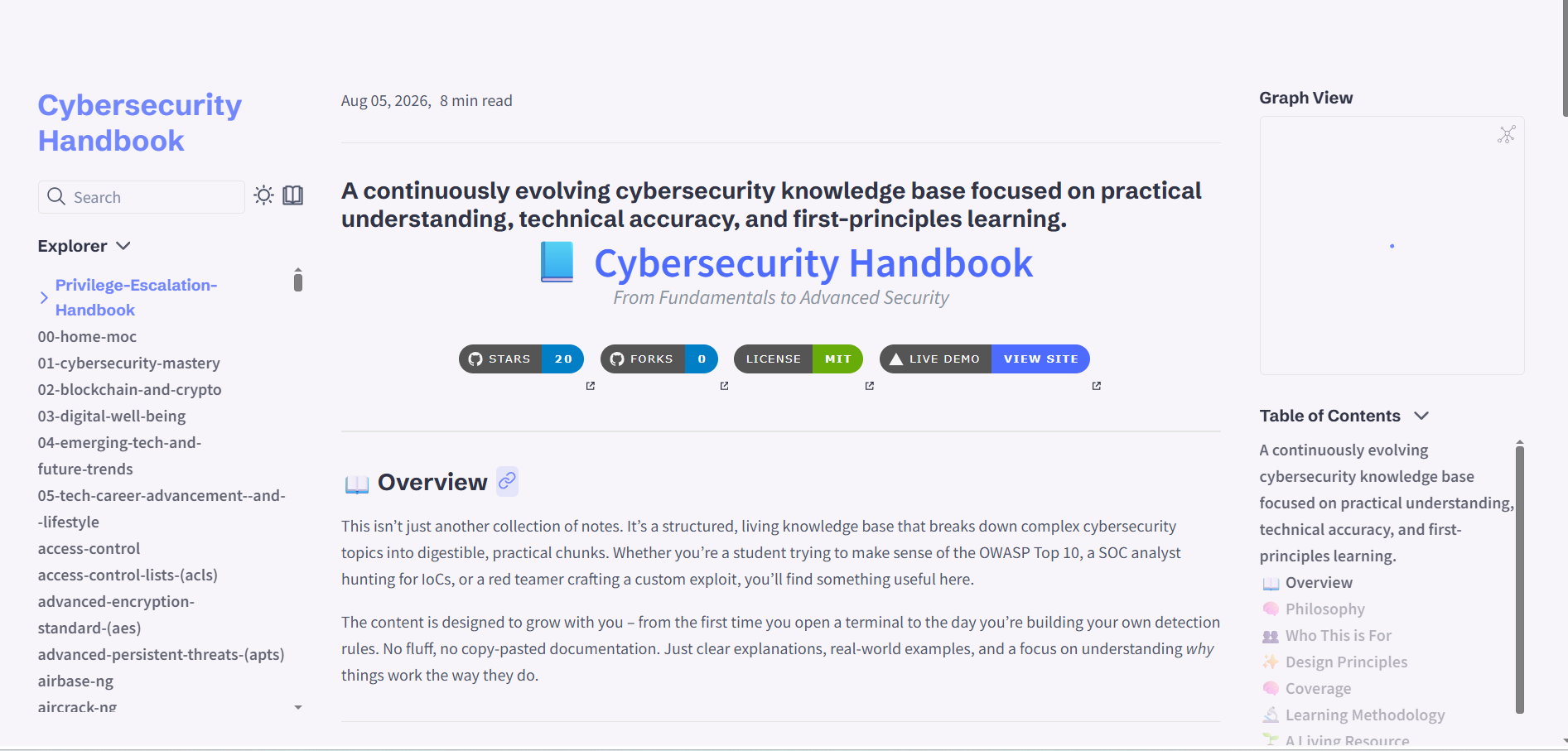
<p align="center"><sub>Homepage · Interactive knowledge graph — every note links to related concepts</sub></p>
<p align="center">
<img src="https://assets.kitploit.com/production/public/readmes/49884/b5c7fbc8fbc5b6b052743554c93e7999a2fa3bef29c8493dcad968d157197fc3.png" alt="Reader Mode" width="48%">
<img src="https://assets.kitploit.com/production/public/readmes/49884/92659e0599ff8c44cc45f95063ee04177e803df0a7ef84c8af2f5d88c4ab51b4.png" alt="Dark Mode" width="48%">
</p>
<p align="center"><sub>Reader mode · Dark mode (Catppuccin Mocha)</sub></p>
<p align="center">
<img src="https://raw.githubusercontent.com/priyanshu-rawa/cybersecurity-handbook/main/assets/images/Phone-view-v2.jpeg" alt="Mobile View" width="280">
</p>
<p align="center"><sub>Fully responsive on mobile</sub></p>
<img src="https://capsule-render.vercel.app/api?type=rect&color=0:7C3AED,100:4D6BFE&height=3&width=1000" width="100%"/>
## Why I built this
I've spent a lot of nights doing exactly what you're probably doing right now — reading forums, watching tutorials, trying to piece together what actually matters in security.
Most of what I found fell into one of three buckets: too shallow (a list of tools with no explanation of why they work), too scattered (good content spread across a dozen blogs and paid courses), or priced like a $500 course was the only way in.
So I started writing my own notes — the kind that explain *how things work*, not just which commands to paste. Over time, those notes grew into this handbook.
I don't have all the answers, but I do think this stuff is learnable when it's explained clearly. If this saves you one late-night rabbit hole, it did its job.
<div align="right"><a href="#cybersecurity-handbook">⬆ back to top</a></div>
## What you get
- 🔍 **Instant search** across 400+ notes
- 🕸️ **Interactive graph** — see how topics connect
- 🌗 **Light & dark mode**, including Catppuccin Mocha
- 📱 **Works on any device** — phone, tablet, or laptop
- 🎯 **First-principles explanations**, not just command lists
- 🚫 No ads, no paywalls, no login required
<img src="https://capsule-render.vercel.app/api?type=rect&color=0:4D6BFE,100:7C3AED&height=3&width=1000" width="100%"/>
## Quick start
Get it running locally in under 2 minutes.
**Prerequisites:** Node.js v18+ and npm or yarn.
<details>
<summary><b>🐧 Linux / macOS</b></summary>
```bash
git clone https://github.com/priyanshu-rawa/Cybersecurity-Handbook.git
cd Cybersecurity-Handbook
npm install
npm run quartz:dev
```
</details>
<details>
<summary><b>🪟 Windows (PowerShell)</b></summary>
```powershell
git clone https://github.com/priyanshu-rawa/Cybersecurity-Handbook.git
cd Cybersecurity-Handbook
npm install
npm run quartz:dev
```
</details>
**Build for production:**
```bash
npm run quartz:build # build the static site
npm run quartz:serve # preview the build locally
```
---
## What's covered
| Area | Topics |
|---|---|
| 🖥️ Operating systems & networking | Linux, Windows, TCP/IP, DNS, VPNs, firewalls |
| ⚔️ Offensive security | OWASP Top 10, SQL injection, XSS, scanning, exploitation, post-exploitation |
| 🛡️ Defensive security | SOC, incident response, SIEM, log analysis, threat hunting, digital forensics |
| ☁️ Cloud & infrastructure | AWS, Azure, GCP, Zero Trust, Docker, Kubernetes, DevSecOps, IAM |
| 💻 Programming & automation | Python, Bash, PowerShell, scripting, CI/CD, Git |
| 🔐 Cryptography | Symmetric/asymmetric encryption, AES, RSA, hashing (SHA-256, MD5), PKI, TLS, certificates |
A rough learning path, if you're starting from zero:
```mermaid
graph LR
A[Fundamentals & Networking] --> B[Offensive Security]
A --> C[Defensive Security]
B --> D[Cloud & Infrastructure]
C --> D
D --> E[Automation & Scripting]
E --> F[Cryptography]
```
<img src="https://capsule-render.vercel.app/api?type=rect&color=0:7C3AED,100:4D6BFE&height=3&width=1000" width="100%"/>
## Contributing
Contributions of all sizes are welcome, from fixing a typo to adding a whole new topic. First time contributing to open source? Happy to walk you through it, just open an issue.
**Ways to help:**
- 📝 Content — new topics, corrections, clearer explanations
- 🎨 Design — diagrams, layout, visual polish
- 💻 Code — bug fixes, Quartz config, new features
- 📚 Docs — formatting, cross-references, clarity
- 👥 Community — reporting issues, answering questions
**Steps:**
| Step | Action |
|:---:|---|
| 1 | Fork the repo (button top right) |
| 2 | Clone your fork: `git clone https://github.com/your-username/Cybersecurity-Handbook.git` |
| 3 | Create a branch: `git checkout -b feature/your-feature-name` |
| 4 | Make your changes |
| 5 | Stage them: `git add .` |
| 6 | Commit: `git commit -m "Add: new section on ransomware defense"` |
| 7 | Push: `git push origin feature/your-feature-name` |
| 8 | Open a Pull Request against `main` |
**Where things go:**
| Type | Location |
|---|---|
| 📝 Notes | `content/` (relevant category folder) |
| 🧪 Labs | `content/` (relevant lab folder) |
| 🖼️ Images | `assets/images/` |
| 📊 Diagrams | `assets/diagrams/` |
<div align="right"><a href="#cybersecurity-handbook">⬆ back to top</a></div>
## Support this project
This handbook is free and always will be. If it's helped you, here's what actually makes a difference:
| | |
|---|---|
| ⭐ Star the repo | Helps other people find it |
| 📢 Share it | LinkedIn, X, Reddit, Discord — wherever your network is |
| 🖊️ Contribute | Fix a typo, add a topic, sharpen an explanation |
| 💬 Give feedback | Open an issue or a discussion |
| 🐛 Report bugs | Tells me what's broken or unclear |
Want to share it? Feel free to copy this:
> *"Found this free Cybersecurity Handbook with 400+ notes, built with Obsidian + Quartz: https://github.com/priyanshu-rawa/Cybersecurity-Handbook"*
If this handbook made a difference for you, a quick note is genuinely appreciated: `[email protected]`
<div align="center">
**Star History**
<a href="https://star-history.com/#priyanshu-rawa/Cybersecurity-Handbook&Date">
<img src="https://api.star-history.com/svg?repos=priyanshu-rawa/Cybersecurity-Handbook&type=Date" alt="Star History Chart" width="600">
</a>
</div>
<img src="https://capsule-render.vercel.app/api?type=rect&color=0:4D6BFE,100:7C3AED&height=3&width=1000" width="100%"/>
## License
MIT License — see [LICENSE](https://github.com/priyanshu-rawa/cybersecurity-handbook/blob/main/LICENSE.txt) for details. Use, modify, distribute, or commercialize freely, as long as the copyright notice stays intact. Contributions back are always welcome.
<img src="https://capsule-render.vercel.app/api?type=waving&color=0:4D6BFE,50:2C5364,100:0F2027&height=150%C2%A7ion=footer" width="100%"/>
<div align="center">
**Cybersecurity Handbook** — a knowledge base built through documentation, experimentation, and practical learning.
*If this helped you, a star keeps me motivated to keep building.* ⭐
Also check out CyberTimeline — 35 real cyberattacks across five decades, in an interactive timeline.
</div>
</div>