<img width="1200" height="628" alt="Titus - 高性能密钥扫描器,适用于源代码、git 历史和二进制文件" src="https://assets.kitploit.com/production/public/readmes/11969/d2f6b99d686a073185db1b7299fa5f033067b057000062cf592a4ae15a796034.png" />
# Titus:高性能密钥扫描器
[](https://go.dev)
[](LICENSE)
[](https://github.com/praetorian-inc/titus/actions)
**Titus** 是一款高性能密钥扫描器,可检测源代码、文件和 git 历史中的凭据、API 密钥和令牌。它内置 487 条检测规则,覆盖数百种服务和凭据类型,规则源自 [NoseyParker](https://github.com/praetorian-inc/noseyparker) 和 [Kingfisher](https://github.com/mongodb/kingfisher)。Titus 可作为 CLI、Go 库、Burp Suite 扩展和 Chrome 浏览器扩展运行——它们共享同一套检测引擎和规则集。
Titus 专为安全工程师、渗透测试人员和 DevSecOps 团队打造,将 [Hyperscan](https://github.com/intel/hyperscan)/[Vectorscan](https://github.com/VectorCamp/vectorscan) 加速的正则匹配与实时凭据验证相结合,在整个代码库中查找并验证泄露的密钥。
## 目录
- [为什么选择 Titus?](#why-titus)
- [安装](#installation)
- [快速开始](#quick-start)
- [扫描选项](#scanning-options)
- [发现评分](#finding-scoring)
- [Go 库](#go-library-for-secrets-detection)
- [Burp Suite 扩展](#burp-suite-extension-for-secret-scanning)
- [浏览器扩展](#chrome-browser-extension-for-secret-scanning)
- [从源码构建](#building-from-source)
- [贡献](#contributing)
- [许可证](#license)
## 为什么选择 Titus?
- **快速密钥扫描**:在可用时由 [Hyperscan](https://github.com/intel/hyperscan)/[Vectorscan](https://github.com/VectorCamp/vectorscan) 加速正则匹配,并提供纯 Go 回退方案,以便在任何平台上移植。
- **广泛的凭据检测覆盖**:487 条规则可检测 AWS、GCP、Azure、GitHub、Slack、数据库、CI/CD 系统以及数百种其他服务的 API 密钥、令牌和凭据。
- **实时密钥验证**:检测到的密钥会与其来源 API 进行核对,以确认是否仍然有效,从而减少误报并优先安排修复。
- **基于风险的严重性评分**:每个发现都会获得数值评分(0–100)和严重性等级(info → critical)。评分根据静态规则元数据、代码可访问性上下文以及衡量凭据真实影响范围的实时 API 调用进行调整——因此最危险的发现始终会最先呈现。
- **容器镜像扫描**:可直接从任何注册表、tarball 或 OCI 布局目录扫描 Docker 和 OCI 镜像——无需 Docker 守护进程或二进制文件。
- **适配各种工作流的多重接口**:可从 CLI 扫描、作为 Go 库嵌入、在 Burp Suite 中被动扫描 HTTP 流量,或在应用安全测试期间在 Chrome 中扫描网页。
- **二进制文件提取**:从 Office 文档、PDF、归档文件(zip、tar、7z)、移动应用(APK、IPA)、浏览器扩展等中提取并扫描密钥。
## 安装
从 [Releases](../../releases) 页面下载预编译二进制文件,或从源码构建:
```bash
make build
```
二进制文件将位于 `dist/titus`。
## 快速开始
```bash
# Scan a file for secrets
titus scan path/to/file.txt
# Scan a directory for leaked credentials
titus scan path/to/directory
# Scan a public GitHub repository (no token needed)
titus scan github.com/org/repo
# Scan a public GitLab project (no token needed)
titus scan gitlab.com/namespace/project
# Scan git history for secrets in past commits
titus scan --git path/to/repo
# Scan a Docker / OCI image (pulled from a registry — no docker daemon required)
titus scan --docker alpine:latest
# Validate detected secrets against source APIs
titus scan path/to/code --validate
```
结果会写入数据存储(默认为 `titus.ds`)并打印到控制台。
### 子命令
<!-- BEGIN generated: cli-subcommands -->
Titus 将其功能组织为以下专注的子命令:
```bash
titus analyze # Analyze a credential on demand — detect type, validate, score, and enumerate resources
titus enum # Enumerate remote services for secrets
titus explore # Interactively explore scan results
titus report # Generate a report from scan results
titus rules # Manage detection rules
titus scan # Scan a target for secrets
titus serve # Run as streaming server for Burp extension integration
titus version # Show version information
```
<!-- END generated: cli-subcommands -->
每个子命令都接受 `--help` 以查看其自身的标志。早于 `titus enum <provider>` 的顶层 `titus <provider>` 形式仍然可用,但它们是被隐藏且已弃用的,而非别名,因此它们被列在生成的参考文档中,而不是此处。
<!-- BEGIN generated: cli-aliases -->
完整参考——包括每个子命令、别名和标志,以及从 `--help` 中隐藏的那些——已生成到 [docs/CLI.md](https://github.com/praetorian-inc/titus/blob/main/docs/CLI.md)。
<!-- END generated: cli-aliases -->
## 扫描选项
### GitHub 与 GitLab 扫描
直接通过 URL 扫描公共仓库——无需 API 令牌:
```bash
# Scan a GitHub repository
titus scan github.com/kubernetes/kubernetes
# Scan a GitLab project
titus scan gitlab.com/gitlab-org/cli
# Full URLs work too
titus scan https://github.com/org/repo
titus scan https://gitlab.com/namespace/project.git
```
对于组织范围或用户范围的扫描,请使用专用子命令:
```bash
# Scan all public repos in a GitHub org
titus github --org kubernetes
# Scan all repos in a GitHub org with a token (private repos + higher rate limits)
titus github --org kubernetes --token $GITHUB_TOKEN
# Scan all repos for a GitHub user
titus github --user octocat
# Scan all projects in a GitLab group
titus gitlab scan --group mygroup --token $GITLAB_TOKEN
# Scan a single repo with git history (finds deleted secrets)
titus github scan owner/repo --git
```
对于公共仓库,令牌是可选的。设置 `GITHUB_TOKEN` 或 `GITLAB_TOKEN`(或使用 `--token`)以访问私有仓库并获得更高的 API 速率限制。
### Docker / OCI 镜像扫描
直接扫描容器镜像——无需 docker 守护进程,也无需 `docker` 二进制文件。Titus 通过 HTTPS 直接从任意 OCI 注册表拉取镜像(使用 `~/.docker/config.json` 中的凭据),或从本地 `docker save` 压缩包或 OCI 镜像布局目录读取镜像。随后它会扫描镜像清单/配置元数据以及每一层中的每个常规文件,包括被后续层删除的低层文件(因为机密信息仍可能从镜像历史中恢复)。
```bash
# Pull from a registry and scan
titus scan --docker alpine:latest
titus scan docker://ghcr.io/owner/repo:tag
# Scan an image saved to a tarball:
# docker save my-app:latest -o my-app.tar
# podman save my-app:latest -o my-app.tar
titus scan --docker ./my-app.tar
# Scan an OCI image layout directory:
# docker buildx build --output type=oci,dest=./img/ .
# skopeo copy docker://my-app:latest oci:./img:latest
titus scan --docker ./img/
```
身份验证使用你现有的 Docker / Podman 配置(`~/.docker/config.json`、`${XDG_RUNTIME_DIR}/containers/auth.json`)。需要重新登录的私有镜像仓库应先用 `docker login`(或 `podman login`,或 `crane auth login`)进行身份验证——titus 不会提示输入凭据。
### 查看扫描结果
使用 `report` 重新读取之前扫描的发现结果:
```bash
# Human-readable summary of detected secrets
titus report
# JSON output for programmatic processing
titus report --format json
# SARIF output for CI/CD integration with GitHub Advanced Security
titus report --format sarif
# Report from a specific datastore
titus report --datastore path/to/titus.ds
# Only findings from one repository (host-qualified as recorded, or without the host)
titus report --repo github.com/acme/api
# Repeat a selector, or combine selectors; a location matching any value is kept
titus report --namespace github.com/acme --namespace gitlab.example.com/acme --path src/config.yaml
# List the repository, namespace and path values that select current findings
titus report sources
# List every recorded source, including sources with no findings
titus report sources all
```
你还可以在扫描时使用 `--format` 控制输出格式:
```bash
titus scan path/to/code --format json
```
### 验证检测到的密钥
在扫描期间传入 `--validate`,以针对其源 API 检查检测到的密钥:
```bash
titus scan path/to/code --validate
```
验证会并发运行(默认 4 个 worker,可通过 `--validate-workers` 配置),并将每个发现标记为已确认、已否认或未知。
### 过滤检测规则
```bash
# List all available detection rules
titus rules list
# Scan with only specific rules (e.g., AWS and GCP credentials)
titus scan path/to/code --rules-include "aws,gcp"
# Exclude rules by pattern
titus scan path/to/code --rules-exclude "kingfisher.generic"
# Use a custom rules file for organization-specific secrets
titus scan path/to/code --rules path/to/custom-rules.yaml
# Opt in to rules marked noisy: true (high false-positive rate, off by default)
titus scan path/to/code --include-noisy
```
标记为 `visible: false` 的规则是辅助规则,用于为其他规则捕获上下文,例如客户端 ID、账户名或主机,而不是密钥。这些规则的模式仍会运行,但无论通过 CLI 还是 Go 库,其匹配结果都不会被报告,即使显式选择了该规则也是如此。
### 从二进制文件中提取密钥
Titus 可以从二进制文件格式中提取文本,并扫描其中的内容以查找密钥:
```bash
# Extract and scan all supported binary formats
titus scan path/to/files --extract=all
# Target specific formats
titus scan path/to/files --extract=xlsx,docx,pdf,zip
```
支持的格式包括 Office 文档(xlsx、docx、pptx、odp、ods、odt)、PDF、Jupyter notebook、SQLite 数据库、电子邮件(eml、rtf)以及归档文件(zip、tar、tar.gz、jar、war、ear、apk、ipa、crx、xpi、7z)。归档文件会被递归解压,并受可配置的深度和大小限制约束。
```bash
# Tune extraction limits for large codebases
titus scan path/to/files --extract=all \
--extract-max-size 10MB \
--extract-max-total 100MB \
--extract-max-depth 5
```
对于 SQLite 数据库,Titus 会从所有表中提取文本(默认每张表 1000 行)。使用 `--sqlite-row-limit` 进行调整:
```bash
# Full dump of all SQLite tables (no row limit)
titus scan path/to/files --extract=all --sqlite-row-limit 0
# Custom row limit per table
titus scan path/to/files --extract=all --sqlite-row-limit 5000
```
## 发现评分
Titus 生成的每个发现都带有 0–100 的数值评分和严重性等级:
| 评分 | 严重性 |
|-------|----------|
| 0–20 | info |
| 21–40 | low |
| 41–60 | medium |
| 61–80 | high |
| 81–100 | critical |
评分从规则的 `base_score` 开始,并通过**修饰符**进行调整——这些条件会根据已知的凭据信息提高或降低评分:
```bash
# Score findings using static rule metadata only (no network calls)
titus scan path/to/code
# Score findings AND make live API calls to verify credential blast radius
# (calls AWS STS/IAM and GitHub API for supported credential types)
titus scan path/to/code --score-scope
# Override the accessibility context (default: auto-detected from git remote)
titus scan path/to/code --accessibility public # no penalty for public repos
titus scan path/to/code --accessibility private # -25 penalty (default for local scans)
```
Titus 内置了针对 AWS 凭证、GitHub PAT 和 Slack 令牌的 YAML 评分器,以及基于 Go 的 SDK 评分器;当启用 `--score-scope` 时,这些评分器会执行实时 IAM 策略枚举(AWS)和仓库权限检查(GitHub 细粒度 PAT)。
完整参考请见 [docs/scoring.md](https://github.com/praetorian-inc/titus/blob/main/docs/scoring.md):严重性等级、修饰符类型、内置评分器详情,以及如何编写你自己的 YAML 或 Go 评分器。
## 用于密钥检测的 Go 库
Titus 可作为 Go 库导入,以便为你自己的工具和流水线添加密钥检测功能。
```bash
go get github.com/praetorian-inc/titus
```
```go
package main
import (
"fmt"
"log"
"github.com/praetorian-inc/titus"
)
func main() {
// Initialize the secrets scanner with default rules
scanner, err := titus.NewScanner()
if err != nil {
log.Fatal(err)
}
defer scanner.Close()
// Scan a string for API keys, tokens, and credentials
matches, err := scanner.ScanString(`aws_access_key_id = AKIADEADBEEFDEADBEEF`)
if err != nil {
log.Fatal(err)
}
for _, match := range matches {
fmt.Printf("%s (rule: %s) at line %d\n",
match.RuleName, match.RuleID,
match.Location.SourceSpan.Start.Line,
)
}
}
```
该库还支持扫描字节和文件、验证检测到的密钥,以及加载自定义规则:
```go
// Scan a file for leaked credentials
matches, err := scanner.ScanFile("/path/to/config.json")
// Enable validation to check if detected secrets are live
scanner, err := titus.NewScanner(titus.WithValidation())
// Load custom detection rules for organization-specific secrets
rules, err := titus.LoadRulesFromFile("/path/to/rules.yaml")
scanner, err := titus.NewScanner(titus.WithRules(rules))
```
完整的 API 参考、并发模式以及更多示例,请参阅 [docs/library-usage.md](https://github.com/praetorian-inc/titus/blob/main/docs/library-usage.md)。
## 用于密钥扫描的 Burp Suite 扩展
该 Burp 扩展在代理流量和主动渗透测试期间扫描 HTTP 响应中的密钥。
### 设置
#### Linux / macOS(从源码构建)
```bash
# Build the CLI and Burp extension JAR, install CLI to ~/.titus/
make install-burp
```
然后在 Burp Suite 中通过 Extensions > Add 加载 `dist/titus-burp-1.0.0-all.jar`。
#### Windows(从 Releases 下载)
1. 从 [Releases](../../releases) 下载 `titus-windows-amd64.exe` 和 `titus-burp-<version>.jar`
2. 创建 Titus 目录并安装二进制文件:
```powershell
mkdir %USERPROFILE%\.titus
copy titus-windows-amd64.exe %USERPROFILE%\.titus\titus.exe
```
3. 在 Burp Suite 中通过 Extensions > Add 加载该 JAR
#### Linux / macOS(从 Releases 下载)
1. 从 [Releases](../../releases) 下载适用于你平台的二进制文件以及 `titus-burp-<version>.jar`:
- Linux 使用 `titus-linux-amd64` 或 `titus-linux-arm64`
- macOS 使用 `titus-darwin-amd64` 或 `titus-darwin-arm64`
2. 安装该二进制文件:
```bash
mkdir -p ~/.titus
cp titus-<platform> ~/.titus/titus
chmod +x ~/.titus/titus
```
3. 在 Burp Suite 中通过 Extensions > Add 加载该 JAR
该扩展会在后台启动一个 `titus serve` 进程,并通过 stdin/stdout 使用 NDJSON 进行通信。检测规则在启动时加载一次。
### Burp 扩展功能
- **被动密钥扫描**:在代理流量流经 Burp 时自动扫描
- **主动密钥扫描**:通过右键上下文菜单扫描选定的请求
- **去重**:同一密钥在每个测试任务中仅报告一次
- **快速路径过滤**:跳过二进制内容、图像和非文本响应
- **实时凭据验证**:对照源 API 检查检测到的密钥以确认其是否有效
- **误报管理**:将发现标记为误报以过滤噪声
- **严重性分类**:发现按风险等级进行颜色编码(高/中/低)
- **导出**:将发现保存为 JSON 以便生成报告
### Burp 扩展界面
该扩展在 Burp 中添加了一个 **Titus** 标签页,包含三个子标签页:
**Secrets**:所有检测到的密钥,可按类型、主机和验证状态进行过滤。
Titus Burp Suite 扩展的 secrets 标签页,显示检测到的 API 密钥和凭据及其验证状态
- **验证状态**:显示密钥是否已被检查(Active/Inactive/Unknown)
- **过滤**:点击 Type、Host 或 Status 按钮按特定值过滤;使用搜索框进行文本和正则匹配
- **批量操作**:选择多行以批量验证或标记为误报
- **Secret Details 面板**:选择一个发现以查看:
- **Details**:规则信息、类别、完整密钥值、首次发现时间戳
- **URLs**:该密钥被发现的所有位置
- **Validation**:验证结果及详细信息(例如 AWS 账户 ID、ARN)
- **Request/Response**:完整 HTTP 流量,密钥已高亮显示
**Statistics**:按类型和主机分组的密钥聚合视图。
<img width="1964" height="848" alt="Titus Burp Suite 扩展的 statistics 标签页,显示按类型和主机分类的密钥" src="https://assets.kitploit.com/production/public/readmes/11969/4a3d6f997049bb8bba621ceb8511b9a41c63867a5c1e8add6065c483706ac36a.png" />
- **Summary**:唯一密钥总数、已扫描主机数、验证明细(有效与无效)以及误报数量
- **Secrets by Type**:每种密钥类型的数量及类别分类
- **Secrets by Host**:每个主机发现的密钥数量
**Settings**:配置扫描选项、验证和严重性映射。
Titus Burp Suite 扩展的 settings 标签页,包含扫描配置选项
- **Scan Settings**:
- *Passive scanning*:自动扫描所有代理流量(默认启用)
- *Request body scanning*:同时扫描应用程序发送的请求体中的密钥
- *Validation*:启用后对照源 API 检查密钥(会发出站请求并可能触发告警)
- **Scan Parameters**:工作线程数、最大文件大小、上下文片段长度
- **Severity Configuration**:按密钥类别自定义严重性级别
- **Actions**:清除缓存、重置设置、将发现保存/导出为 JSON
在 Burp 中查看任何请求时,如果检测到密钥,响应检查器中会出现一个 **Titus** 标签页,无需切换到主 Titus 标签页即可快速访问发现。
Burp Suite 响应检查器中的 Titus 标签页,高亮显示 HTTP 响应中检测到的密钥
## 用于密钥扫描的 Chrome 浏览器扩展
该 Chrome 扩展在 Web 应用程序安全评估期间扫描网页中的密钥。
### 设置
```bash
make build-extension
```
1. 导航至 `chrome://extensions/`
2. 启用 **开发者模式**
3. 点击 **加载已解压的扩展程序**,然后选择 `extension/` 目录
### 浏览器扩展功能
- 扫描内联和外部 JavaScript 及样式表,查找 API 密钥和令牌
- 扫描 localStorage 和 sessionStorage,查找泄露的凭据
- 可选的网络响应捕获,用于全面的机密检测
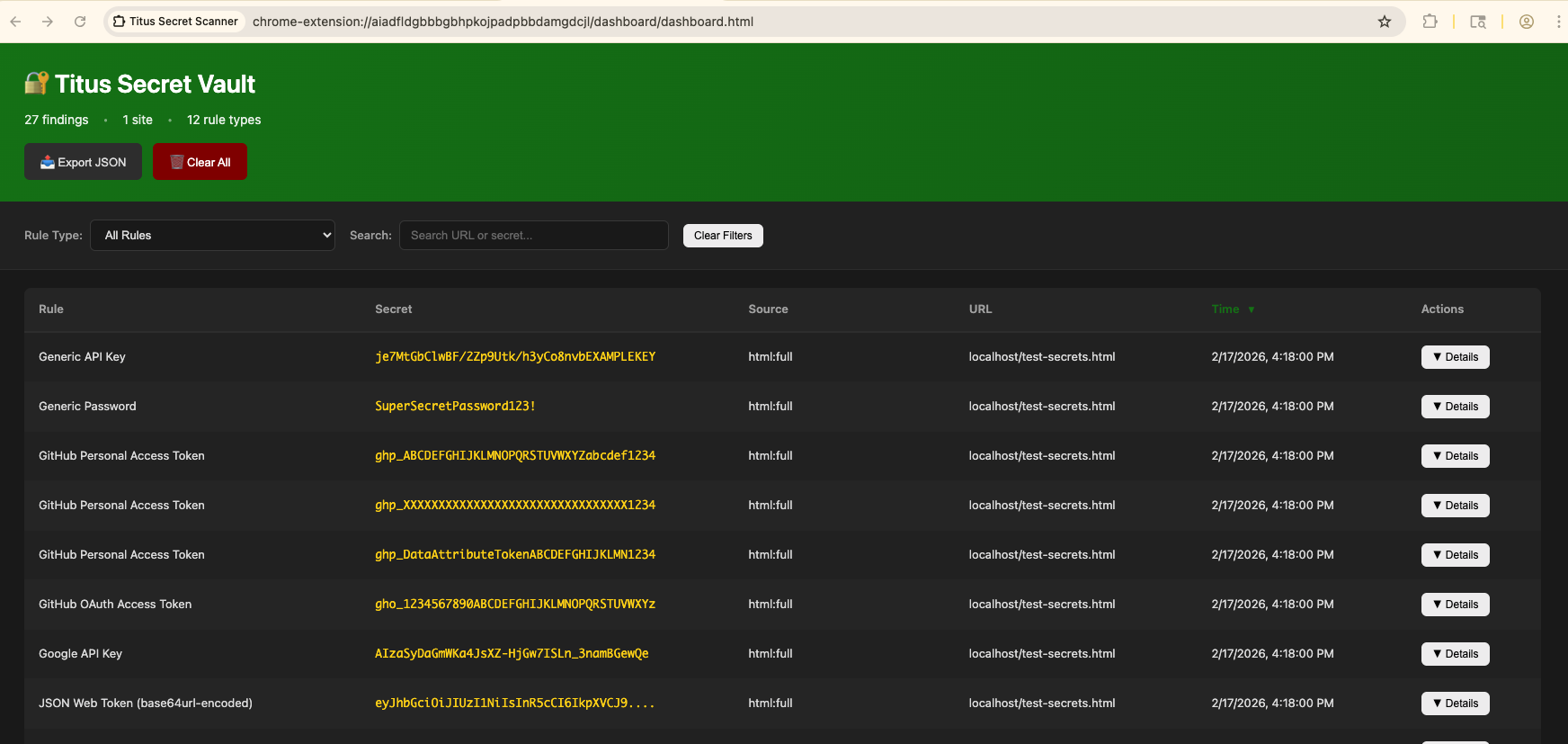
- 结果显示在弹出窗口和仪表板中
<img width="1719" height="958" alt="Titus Chrome 扩展弹出窗口,显示在网页上检测到的机密" src="https://assets.kitploit.com/production/public/readmes/11969/057a24e2746412ceabe1aac0292a2de463de1efee5bca2489ca34b59d8b0dc2c.png" />
<img width="1744" height="827" alt="Titus Chrome 扩展仪表板,显示聚合的机密检测结果" src="https://assets.kitploit.com/production/public/readmes/11969/265d972fadcc7f212944d7a1d8fd58a43446e7199d1209900e83b96a546ffb00.png" />
### 安全提示
该浏览器扩展会从访问的页面中移除内容安全策略(Content Security Policy)和 CORS 头,以扫描外部资源。在扩展启用期间,这会削弱你所访问站点的安全态势。**仅在主动安全测试期间启用。**
## 从源码构建
### 标准构建(Vectorscan 加速)
默认情况下,Titus 使用 [Vectorscan](https://github.com/VectorCamp/vectorscan)(ARM)/ [Hyperscan](https://github.com/intel/hyperscan)(x86)进行编译,以实现 SIMD 加速的正则匹配。这需要 CGO、C 库以及 `pkg-config`(cgo 用它来定位库)。`make build` 会检查这些依赖,并尝试通过 Homebrew / apt / dnf 安装任何缺失的组件:
```bash
# Build the CLI binary with vectorscan acceleration (outputs to dist/titus)
make build
# Build the Burp Suite extension JAR
make build-burp
# Build the Chrome browser extension
make build-extension
# Run unit tests
make test
# Run integration tests
make integration-test
```
启动时,当加速引擎处于活动状态,你会看到 `[vectorscan] N/N rules compiled for Hyperscan`。
若要自行安装 C 库而不依赖自动安装:
```bash
# macOS (Homebrew)
brew install pkg-config vectorscan
# Ubuntu/Debian
sudo apt-get install pkg-config libhyperscan-dev
# Fedora/RHEL
sudo dnf install pkgconf-pkg-config vectorscan-devel
# Or build vectorscan from source:
git clone --depth 1 --branch vectorscan/5.4.11 https://github.com/VectorCamp/vectorscan.git
cd vectorscan && cmake -B build -DCMAKE_INSTALL_PREFIX=/usr/local && cmake --build build && sudo cmake --install build
```
如果直接调用 `go build`(例如在嵌入 Titus 时),请传入该标签并启用 CGO:
```bash
# macOS (Homebrew) — adjust PKG_CONFIG_PATH to your installed version
CGO_ENABLED=1 PKG_CONFIG_PATH="$(brew --prefix vectorscan)/lib/pkgconfig" \
go build -tags vectorscan -o dist/titus ./cmd/titus
# Linux (system-installed)
CGO_ENABLED=1 go build -tags vectorscan -o dist/titus ./cmd/titus
```
### 纯 Go 构建(无 C 依赖)
如果你无法安装 C 库——或者想要一个完全可移植的静态二进制文件——请改为构建纯 Go 引擎。当未编译进 vectorscan 时,Titus 会在运行时自动回退到它:
```bash
# Portable pure-Go binary (no CGO, no vectorscan)
make build-pure
# Fully static binary
make build-static
```
#### 自动 Hyperscan 数据库缓存
Titus 会自动将每个成功编译的 Hyperscan 数据库序列化到标准用户缓存中。之后具有完全相同有序规则和标志的扫描器实例会加载该数据库,而不是重新编译它。缓存文件是 Hyperscan 的 `hs_serialize_database` 生成的未经修改的字节流,Titus 使用 `hs_deserialize_database` 加载它。
`TITUS_CACHE_DIR` 可以覆盖缓存位置。缓存写入是原子且尽力而为的:不可用或只读的缓存不会阻止扫描。缺失、损坏、不兼容或指纹不同的数据库会触发正常编译,并在可能时刷新缓存。
序列化数据库特定于架构、CPU 特性和 Hyperscan 版本。Titus 在反序列化时检测不兼容的条目,并用为当前运行时编译的数据库替换它们。
## 贡献
欢迎贡献!有关如何为 Titus 贡献的指南,请参阅 [CONTRIBUTING.md](https://github.com/praetorian-inc/titus/blob/main/CONTRIBUTING.md)。
## 许可证
Apache License 2.0 — 请参阅 [LICENSE](https://github.com/praetorian-inc/titus/blob/main/LICENSE)。
检测规则源自 [NoseyParker](https://github.com/praetorian-inc/noseyparker)(Praetorian Security, Inc.)和 [Kingfisher](https://github.com/mongodb/kingfisher)(MongoDB, Inc.),两者均根据 Apache 2.0 许可。完整归属信息请参阅 [NOTICE](https://github.com/praetorian-inc/titus/blob/main/NOTICE)。