
Skip to content
KitploitKITPLOIT
도구익스플로잇블로그
Log in
제출
도구익스플로잇블로그
제출

해킹, 침투 테스트 및 사이버 보안 도구를 당신의 보안 무기고에!

Kitploit은 해킹, 사이버 보안 및 침투 테스트 도구 디렉토리입니다. 최신 프로젝트 업데이트를 발견하여 취약점을 찾고, 시스템을 분석하고, 테스트를 자동화하고, 보안을 강화하세요.

피드문의개인정보© 2026 Kitploit

도구 디렉토리

카테고리

모든 카테고리 보기
Loading categories
TornadoC2 — Pull-based C2 framework with ten native transports, concurrent multi-profile handlers, ECDSA-signed tasking, and a multi-operator team server with RBAC and Qt/CLI consoles. | Kitploit
도구/GitHubGitHub/kamalx06/tornadoc2
Penetration Testing FrameworksPersistence MechanismsIDS/IPS EvasionLateral MovementPost-ExploitationWireless SecurityCryptographyPenetration TestingCommand and ControlRed TeamingPayload DevelopmentRemote Access Trojan
341013114일 전Kitploit 검토 완료
GitHubkamalx06/tornadoc2

TornadoC2

Pull-based C2 framework with ten native transports, concurrent multi-profile handlers, ECDSA-signed tasking, and a multi-operator team server with RBAC and Qt/CLI consoles.

저장소 보기
공유
요청한 언어로 콘텐츠를 사용할 수 없습니다. 영어 버전을 표시합니다.

TornadoC2

A pull-based C2 with ten native transports, concurrent multi-profile handlers, and an honest threat model. The agent is a single Go binary with every behavioural property baked in at build time — no runtime config file, no environment variable, no command-line arguments. Tasks and results are ECDSA-signed end to end. The transports are HTTPS, QUIC/HTTP/3, WebSocket, DNS TXT, DNS-over-HTTPS, ICMP, WireGuard, SMB-pivot, TCP-bind, and TCP-reverse.


Legal Notice

Use this software only on systems you own or on systems where you hold explicit written authorization. You are solely responsible for compliance with applicable laws and organizational policies. The authors and contributors accept no liability for misuse, data loss, or legal consequences arising from the use of this project.


Table of Contents
  • Introduction
  • Why TornadoC2 Exists
    • What that shaped
    • What it is not
    • What comes next
  • Capability summary
  • Key Features
  • Design Philosophy
    • Compile-time configuration
    • Startup-time configuration
    • Queue-based execution
    • Artifact discipline on the target
    • Graceful degradation
    • Encryption without loss of auditability
    • Contribution paths with no core coupling
    • Concurrent multi-profile handlers
    • Profile paths as first-class routing
  • Operational Security
  • Threat Model
  • Architecture
  • Transports
  • Pivot Transports
  • Requirements & Installation
    • Go build bootstrap
    • Dependency installers
  • Quick Start
  • Deployment Playbook
  • Build Config File
  • Staged Payloads
  • Remote Build
  • Operator Reference
  • GUI Operator Console
  • AI Operator Console and MCP Server
  • In-Memory Execution
  • BOF Registry
  • C2 Profile Catalogue
  • Profile Validation (shapecheck)
  • SOCKS5 Pivoting
  • Migration
  • Scheduled Tasks
  • Task Queue Introspection
  • Bulk Operations
  • Beacon Aliases and Tags
  • Beacon Viewers
  • Credential Vault
  • Engagement and Per-Beacon Notes
  • Webhook Notifications
  • Session Graph
  • Desktop Notifications
  • Wire Protocol
  • Native Commands
  • Cryptography
  • Key Management
  • Backup and Recovery
  • Self-Update
  • OPSEC Profiles
  • C2 Profiles
    • Concurrent multi-profile handlers
    • Placeholders
    • Encoding
    • Placement
    • Status codes
    • Cookie name
    • Response headers
    • DNS label shaping
    • Stager path
  • Extending TornadoC2
    • Adding a transport
    • Adding a C2 profile
    • Adding a WASM extension
    • The contribution-path summary
  • Beacon Extensions
  • Server Hardening
  • Team Chat
  • Loot Store
  • Dead-man's Switch
  • Session Logging
  • Troubleshooting
  • TLS & mTLS Configuration
  • License

Introduction

TornadoC2 is a pull-based C2. The agent does not hold a live socket; it wakes on its own schedule, checks in with the server, retrieves queued work, executes it, and goes back to sleep. The operator queues commands; the beacon picks them up on its next check-in.

This design trades immediacy for resilience. A live shell dies when the network flaps; a beacon reconnects on its next wake-up and resumes. A live shell leaves a persistent footprint on the wire; a beacon's traffic pattern is bounded by its sleep interval. The framework is built for long-haul engagements where the implant has to survive reboots, retry on failure, and self-destruct on a schedule.

The implant is a single Go binary, cross-compiled from the operator machine. There is no runtime configuration file, no environment variable, no registry key. The callback URL, sleep interval, kill date, C2 profile, and evasion set are all baked in at build time. A captured binary contains everything it needs to run, and nothing the operator did not put there.

The framework is compiled for Linux and Windows today, on amd64 and arm64. macOS support is on the near-term list, along with additional native commands and additional evasion primitives. The Capability summary below lists what is available in the current version.
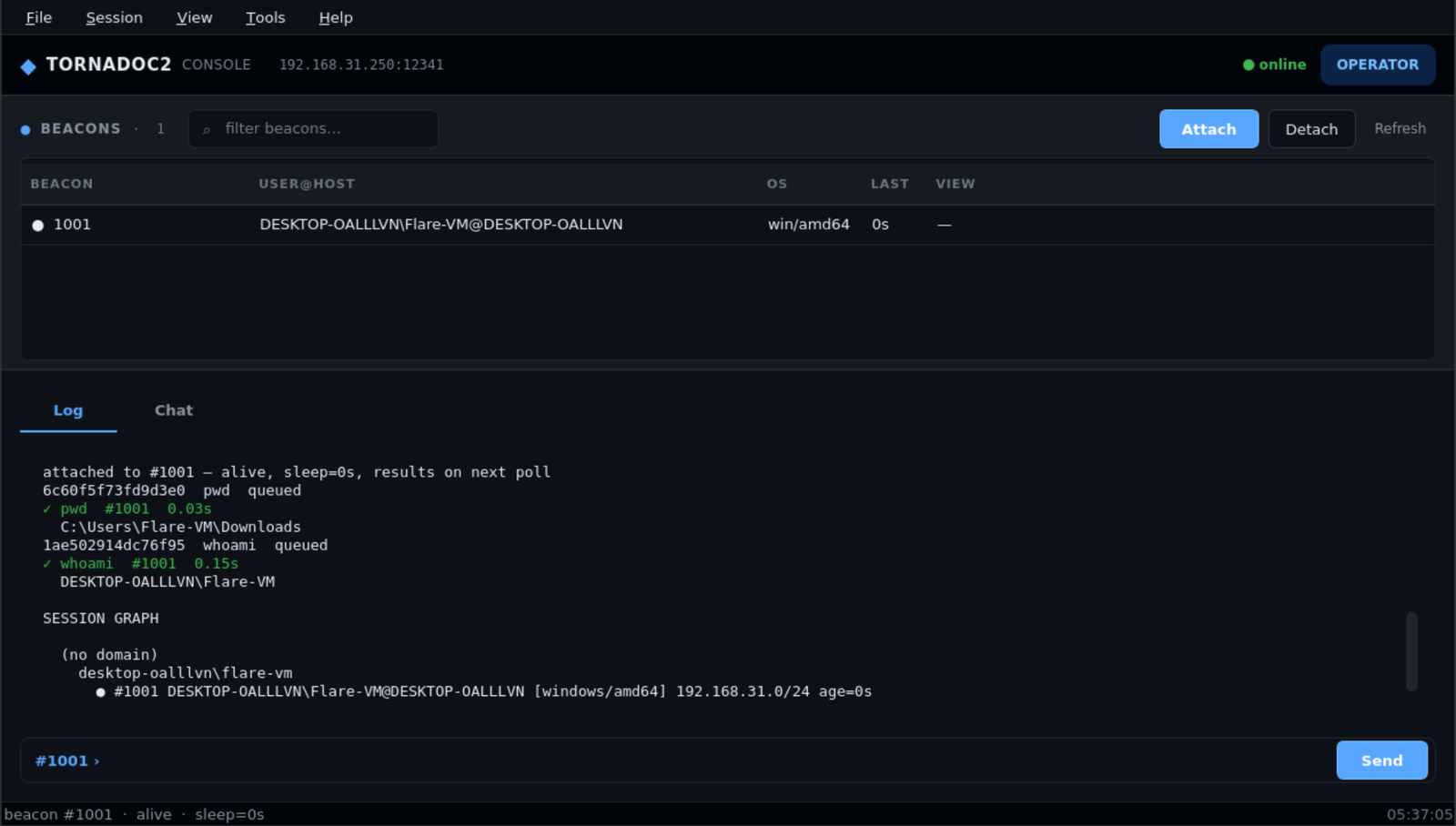

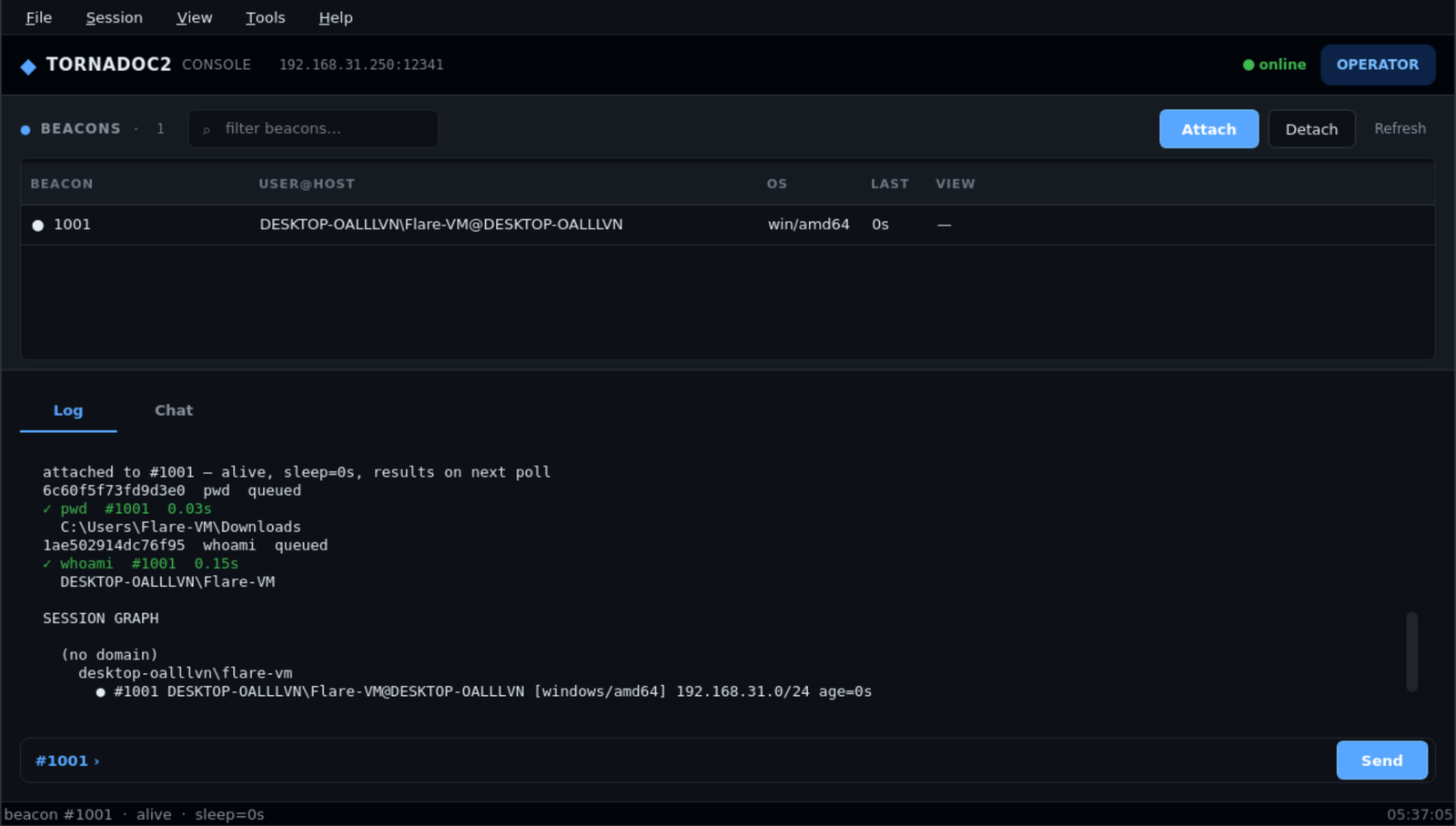
TornadoC2 operator console — beacon table above, log and chat tabs below

The PySide6 operator console. Beacon table on top, log and chat on the bottom, one command bar for both. The terminal REPL is the reference implementation; the GUI is a presentation layer over the same Client methods.


Why TornadoC2 Exists

I used Sliver for a year. It is a good tool — that needs saying before anything else, because what follows is not a criticism of it. The problem was that I could not change the agent's shape. A Sliver beacon looks like a Sliver beacon: one fingerprint, one polling schedule, one protocol family, one runtime configuration that sits on disk. I could point it at a different URL. I could not make it something else. That is the right trade for engagements where a generalist shape is fine. It was the wrong trade for the networks I was working on.

I tried Mythic. The modularity is genuine and the community work behind it is impressive. I could not work in it. Every interaction went through a browser tab. I spend eight hours a day in a console, and the tool was not in the console. I stopped after a week.

I looked at Cobalt Strike and Brute Ratel. Both are excellent and both are priced for teams and institutions. I am one person. I do not have a team budget.

도구 다운로드

인기

모두 보기 →

커뮤니티에서 가장 많이 사용되는 도구를 찾아보세요.

  • 1

    OsintHunter

    letox4/osinthunter

    🎯 궁극의 OSINT 툴킷: 조사 그래프, 신뢰도 점수 산정, 별칭 패밀리, 지도, 타임라인 및 보고서. 49개 모듈, 400개 이상 사이트, API 키 불필요.

    576
  • 2

    ghostlock-app

    yukonga/ghostlock-app

    # GhostLock 원탭 실행 앱 (CVE-2026-43499)

    477
  • 3

    ARTEX

    baarai/artex

    LLM 멀티 에이전트 자율 침투 테스트 플랫폼으로, 플래너/워커 에이전트, 자산 및 탐색 그래프, MITM 트래픽 기록, 취약점 재테스트 기능을 제공합니다.

    388
  • 4

    redforge

    cybersecurity91/redforge

    브라우저 측 레드 팀 툴킷으로, 정찰, 페이로드 생성, 자격 증명 공격, 암호화, 인코딩 및 참여 보고를 위한 102개의 오프라인 도구를 제공합니다.

    330
  • 5

    CyberStrikeAI

    ed1s0nz/cyberstrikeai

    AI 네이티브 사이버보안을 위한 행동 체계—의도가 통제된 실행이 되고, 증거가 운영 메모리가 되며, 모든 운영이 다음 운영을 개선하는 곳.

    255
  • 6

    antifox

    antifox-ai/antifox

    정찰, 공격 표면 탐색, 익스플로잇 검증, 증거 기반 보고서 전달을 수행하는 AI 멀티 에이전트 자율 침투 테스트 플랫폼입니다.

    247

모든 도구 탐색

도구 컬렉션을 둘러보세요

모든 도구 보기 →






