Curated reverse-engineering tools and learning resources for binaries, apps, firmware, formats, and protocols.
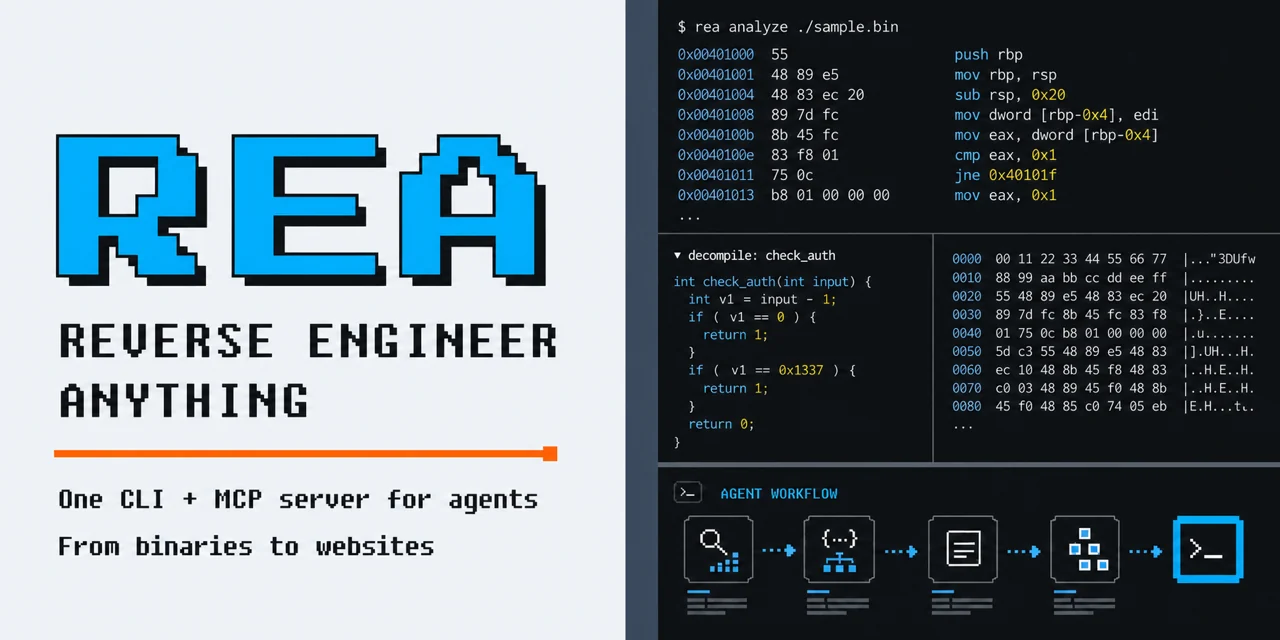
# Awesome Reverse Engineering [](https://awesome.re) > **Featured: [REA](https://github.com/morluto/rea)** — Agent-oriented reverse-engineering tools, from application behavior to native binaries. By the creators of awesome-reverse-engineering. [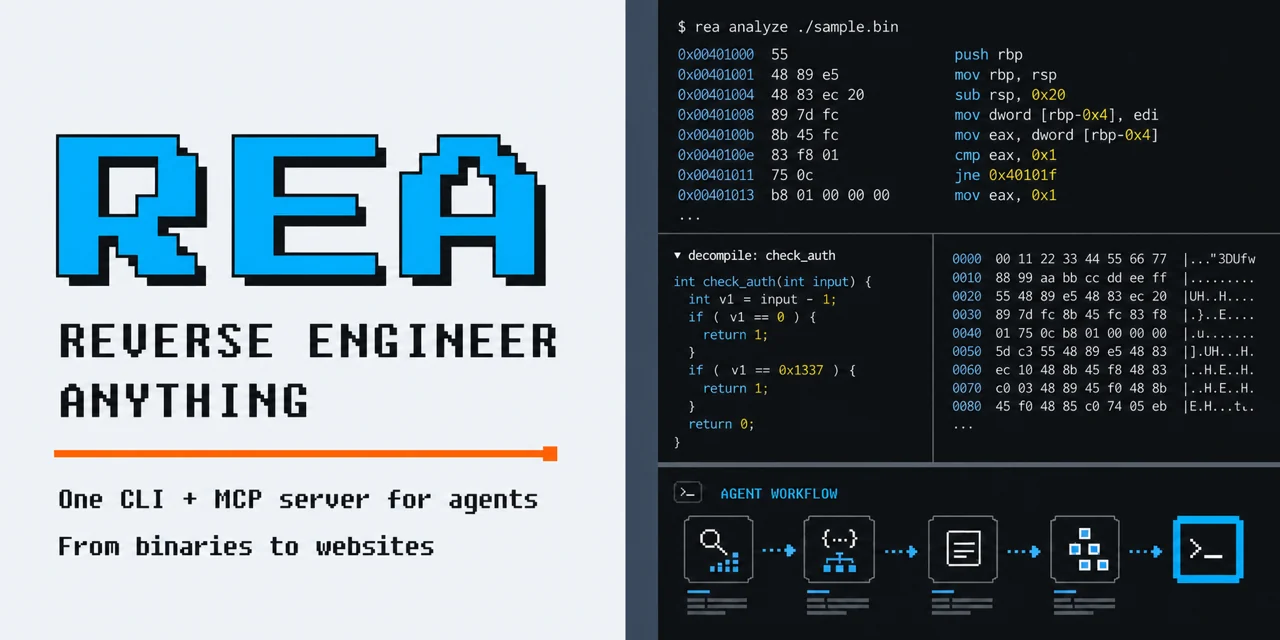](https://github.com/morluto/rea) A curated starting point for understanding binaries, applications, firmware, file formats, and protocols. Find a tool by the work you need to do. Each entry describes its purpose; commercial tools are marked **commercial**. This is an initial selection, open to additions and corrections. ## Start here | Your task | Start with | | --- | --- | | Learn assembly and reversing fundamentals | [Learning](#learning) | | Identify an executable and its capabilities | [File identification and triage](#file-identification-and-triage) | | Read native code or step through it | [Native analysis](#native-analysis) and [Debuggers](#debuggers) | | Trace calls or instrument a running program | [Dynamic instrumentation and tracing](#dynamic-instrumentation-and-tracing) | | Bypass anti-debugging, unpack or rebuild imports | [Deobfuscation and anti-analysis](#deobfuscation-and-anti-analysis) | | Examine a suspicious file, process, or memory image | [Malware analysis](#malware-analysis) | | Inspect an APK, .NET assembly, or Java program | [Android and managed code](#android-and-managed-code) | | Inspect an iOS app, macOS binary, or Apple firmware | [iOS and macOS](#ios-and-macos) | | Unpack a Python, Go, Flutter, or Hermes binary | [Language runtimes and packagers](#language-runtimes-and-packagers) | | Understand browser behavior or an undocumented protocol | [Web and protocols](#web-and-protocols) | | Extract firmware or inspect a binary format | [Firmware and hardware](#firmware-and-hardware) and [File formats](#file-formats) | | Reconstruct game memory structures, assets, or bytecode | [Game reverse engineering](#game-reverse-engineering) | | Compare builds or audit binary diffs | [Binary diffing and patch analysis](#binary-diffing-and-patch-analysis) | | Solve constraints, explore states, or lift semantics | [Symbolic execution and formal analysis](#symbolic-execution-and-formal-analysis) and [Instruction lifting and semantics](#instruction-lifting-and-semantics) | | Accelerate an investigation with AI agents | [AI-assisted analysis](#ai-assisted-analysis) | ## Contents - [Learning](#learning) - [Books](#books) - [File identification and triage](#file-identification-and-triage) - [Native analysis](#native-analysis) - [Debuggers](#debuggers) - [Dynamic instrumentation and tracing](#dynamic-instrumentation-and-tracing) - [Deobfuscation and anti-analysis](#deobfuscation-and-anti-analysis) - [Malware analysis](#malware-analysis) - [Android and managed code](#android-and-managed-code) - [iOS and macOS](#ios-and-macos) - [Language runtimes and packagers](#language-runtimes-and-packagers) - [Web and protocols](#web-and-protocols) - [Firmware and hardware](#firmware-and-hardware) - [File formats](#file-formats) - [Game reverse engineering](#game-reverse-engineering) - [Binary diffing and patch analysis](#binary-diffing-and-patch-analysis) - [Symbolic execution and formal analysis](#symbolic-execution-and-formal-analysis) - [Instruction lifting and semantics](#instruction-lifting-and-semantics) - [AI-assisted analysis](#ai-assisted-analysis) - [Practice and communities](#practice-and-communities) - [Related lists](#related-lists) - [Contributing and maintenance](#contributing-and-maintenance) - [License](#license) ## Learning  - [Azeria Labs](https://azeria-labs.com/writing-arm-assembly-part-1/) - ARM assembly tutorials with exercises for learning registers, memory, and calling conventions. - [Compiler Explorer](https://godbolt.org/) - Compiles code in the browser with many compilers and shows the generated assembly, for seeing how source constructs and optimization levels translate to machine code. - [Corkami](https://github.com/corkami/pics) - Visual references and posters explaining binary formats and file structures, including executable-format layouts. - [Corkami PoCs](https://github.com/corkami/pocs) - Minimal and unusual executable and document samples for studying file-format edge cases and parser behavior. - [Hextree](https://www.hextree.io/) - Hands-on mobile and hardware reverse-engineering courses and interactive labs; **Commercial**, with some free content. - [Malware Analysis Training](https://github.com/hasherezade/malware_training_vol1) - Windows malware-analysis course with programming, Windows-internals, and reversing exercises; labs need a suitable Windows analysis environment. - [Malware Unicorn RE101](https://malwareunicorn.org/workshops/re101.html) - Introductory Windows malware-reversing workshop covering x86 assembly, triage, and debugging; its VM-based lab instructions use older software images. - [Nightmare](https://guyinatuxedo.github.io/) - Course built from annotated CTF challenges, progressing from assembly and reversing basics to binary exploitation. - [OpenSecurityTraining2](https://ost2.fyi/) - Structured courses in assembly, architecture, debugging, and reverse engineering. - [pwn.college](https://pwn.college/) - Free courses with hands-on challenges in Linux, assembly, reverse engineering, and binary exploitation, run in a browser-accessible environment. - [Reverse Engineering by Kevin Thomas](https://github.com/mytechnotalent/Reverse-Engineering) - Annotated assembly and reverse-engineering lessons across x86, x64, ARM, AVR, and RISC-V, with lesson-specific toolchain and hardware requirements. - [Reverse Engineering for Beginners](https://beginners.re/) - Free book connecting compiled C and C++ examples to assembly across several architectures. - [RPISEC Modern Binary Exploitation](https://github.com/RPISEC/MBE) - Course materials and labs covering reverse engineering, memory corruption, and exploitation; no commits since December 2021, so labs may need older toolchains. ### Books <!-- TODO: section art for this heading. Add .github/section-art/books.png (320x213, 8-bit palette PNG in the style of the existing illustrations) and reference it here with alt text. --> - [Hacking the Xbox](https://www.bunniestudios.com/blog/2013/releasing-free-pdf-of-hacking-the-xbox-in-honor-of-aaron-swartz/) - Introduction to hardware reverse engineering through the original Xbox's security design; free PDF edition released by the author. - [Practical Binary Analysis](https://nostarch.com/binaryanalysis) - Covers ELF and PE internals, disassembly, binary instrumentation, taint analysis, and symbolic execution, with tools built in the exercises. - [Practical Malware Analysis](https://nostarch.com/malware) - Hands-on introduction to static and dynamic Windows malware analysis with lab exercises; published in 2012, so some tooling chapters are dated. - [The Ghidra Book](https://nostarch.com/ghidra-book-2e) - Guide to Ghidra's disassembler, decompiler, scripting, and extension APIs; the 2026 second edition covers BSim and PyGhidra. ## File identification and triage  - [capa](https://github.com/mandiant/capa) - Identifies capabilities in executable files using rules over static or dynamic analysis results. - [checksec](https://github.com/slimm609/checksec) - Checks ELF security properties such as PIE, RELRO, stack canaries, and non-executable stacks; mitigation flags are not a vulnerability verdict. - [Detect It Easy](https://github.com/horsicq/Detect-It-Easy) - Identifies executable formats, compilers, packers, and other file characteristics. - [FLOSS](https://github.com/mandiant/flare-floss) - Recovers obfuscated strings, including strings constructed on the stack. - [hexvero](https://github.com/maximilianfeix/hexvero) - Statically triages Electron archives and JavaScript bundles for IPC channels, preload bridges, and window settings, plus ELF/Mach-O/PE imports and hardening; its CLI, MCP server, and local web UI require Node.js 22.12+, and pattern-based JavaScript analysis can miss indirect code. - [LIEF](https://github.com/lief-project/LIEF) - Parses and modifies executable formats such as PE, ELF, and Mach-O from code. - [Malcat](https://malcat.fr/) - Hex editor and disassembler for triaging unknown files, with 50+ format parsers, embedded-file extraction, YARA scanning, and Python scripting. **Commercial**, with a free Lite edition for non-professional use. - [PE-bear](https://github.com/hasherezade/pe-bear) - Graphical PE viewer and editor for a quick first look at headers, sections, imports, and resources, including malformed files. - [pestudio](https://www.winitor.com/) - Flags suspicious imports, strings, resources, and other indicators in Windows executables for initial assessment. **Commercial**, with a free basic edition for private use. ## Native analysis  - [Binary Ninja](https://binary.ninja/) - Interactive disassembler and decompiler with intermediate representations and scripting APIs. **Commercial**, with a free edition. - [Cutter](https://github.com/rizinorg/cutter) - Graphical reverse-engineering interface built on Rizin. - [Decompiler Explorer](https://dogbolt.org/) - Web service that runs an uploaded binary through several decompilers and shows their output side by side. - [Ghidra](https://github.com/NationalSecurityAgency/ghidra) - Disassembly, decompilation, scripting, and headless analysis for native binaries. - [IDA](https://hex-rays.com/ida-pro) - Interactive disassembler and decompiler with processor modules and a plugin ecosystem. **Commercial**, with a free edition. - [radare2](https://github.com/radareorg/radare2) - Command-line toolkit for disassembly, binary inspection, debugging, and scripting. - [REDasm](https://github.com/redasm-dev/redasm) - Native disassembler and analysis GUI with legacy-format support; Windows and Linux are the primary tested hosts, while other platform builds have lower support tiers. - [RESX](https://github.com/Ryftenius/RESX) - Windows-focused Rust toolkit for PE call graphs, selected hashed or dynamically resolved APIs, and bounded driver IOCTL analysis; SDK headers supply WinAPI argument names, and inferred behavior requires manual validation. - [RetDec](https://github.com/avast/retdec) - Retargetable LLVM-based decompiler for ELF, PE, Mach-O, and other formats; in limited maintenance mode, with little new development. - [rev.ng](https://github.com/revng/revng) - LLVM- and QEMU-based binary-analysis framework and decompiler for inspecting and transforming native code; source builds need its documented toolchain. - [Rizin](https://github.com/rizinorg/rizin) - Reverse-engineering framework with command-line analysis and reusable libraries. - [Rubber Room](https://binarybacktrace.com/tools/rubber_room) - Browser PE workbench with x86-64 disassembly, partial Win32 API emulation and experimental C-like pseudocode that may omit program logic; alpha. ## Debuggers  - [GDB](https://www.sourceware.org/gdb/) - Native debugger with scripting and remote-debugging support. - [GEF](https://github.com/hugsy/gef) - Single-file GDB extension that adds context views, heap inspection, and commands for exploit development and binary analysis. - [LLDB](https://lldb.llvm.org/) - LLVM debugger for native programs, including macOS and iOS development workflows. - [pwndbg](https://github.com/pwndbg/pwndbg) - Debugger extensions for inspecting memory, assembly, and runtime state during binary analysis. - [rr](https://github.com/rr-debugger/rr) - Records and replays Linux process execution for repeatable debugging. - [WinDbg](https://learn.microsoft.com/en-us/windows-hardware/drivers/debugger/) - Microsoft debugger for Windows user-mode and kernel debugging, crash dump analysis, and Time Travel Debugging; version 1.2610.1001.0 and later include the official [WinDbg MCP](https://learn.microsoft.com/en-us/windows-hardware/drivers/debuggercmds/set-up-windbg-mcp) server. - [x64dbg](https://github.com/x64dbg/x64dbg) - Windows user-mode debugger for inspecting native executables and libraries. ## Dynamic instrumentation and tracing <!-- TODO: section art for this heading. Add .github/section-art/instrumentation.png (320x213, 8-bit palette PNG in the style of the existing illustrations) and reference it here with alt text. --> - [bpftrace](https://github.com/bpftrace/bpftrace) - Linux eBPF tracing language for observing kernel and user-space functions; available probes and permissions depend on the host kernel. - [DynamoRIO](https://github.com/DynamoRIO/dynamorio) - Dynamic binary instrumentation platform for building tools that observe or modify instructions at runtime, with bundled tracing and memory-checking tools. - [Frida](https://github.com/frida/frida) - Injects scripts into running processes to trace calls, inspect data, and change behavior. - [Intel Pin](https://www.intel.com/content/www/us/en/developer/articles/tool/pin-a-dynamic-binary-instrumentation-tool.html) - Dynamic binary instrumentation framework for writing analysis tools for x86 and x86-64 programs on Linux and Windows; closed source, free for any use. - [QBDI](https://github.com/QBDI/QBDI) - LLVM-based dynamic binary instrumentation framework for x86, x86-64, ARM, and AArch64, with C, C++, and Python APIs and Frida integration. - [r2frida](https://github.com/nowsecure/r2frida) - radare2 plugin for Frida-backed process inspection and instrumentation; requires a compatible radare2 build and a working Frida session with the target. - [strace](https://github.com/strace/strace) - Linux system-call tracer for inspecting process I/O, signals, syscall arguments, and return values. - [Sysinternals Suite](https://learn.microsoft.com/en-us/sysinternals/) - Microsoft utilities, including Process Monitor, Process Explorer, and Autoruns, for observing process, file, registry, and network activity on Windows. - [System Informer](https://github.com/winsiderss/systeminformer) - Windows 10+ process and system inspector for handles, memory, services, and related kernel information; some views require elevated access. - [TinyTracer](https://github.com/hasherezade/tiny_tracer) - Intel Pin tool for tracing execution and selected function or API calls; use the documented platform build and a matching Pin kit. - [uftrace](https://github.com/namhyung/uftrace) - Linux function-call tracer for C/C++, Rust, and Python, with call graphs and timing data; native-code coverage depends on instrumentation or supported dynamic tracing. ## Deobfuscation and anti-analysis <!-- TODO: section art for this heading. Add .github/section-art/deobfuscation.png (320x213, 8-bit palette PNG in the style of the existing illustrations) and reference it here with alt text. --> - [Al-Khaser](https://github.com/ayoubfaouzi/al-khaser) - Windows proof-of-concept suite for exercising anti-debugging, anti-VM, anti-hooking, and other analysis-environment checks. - [de4dot](https://github.com/de4dot/de4dot) - .NET deobfuscator and unpacker for assemblies protected by common obfuscators; archived in 2020 and no longer updated. - [HollowsHunter](https://github.com/hasherezade/hollows_hunter) - Windows process scanner using PE-sieve to find and dump injected or modified code across running processes; findings require manual investigation. - [PE-sieve](https://github.com/hasherezade/pe-sieve) - Scans a running process for injected or modified code, such as hollowed modules, hooks, and shellcode, and dumps what it finds. - [Scylla](https://github.com/NtQuery/Scylla) - Windows x86/x64 import-table reconstruction tool for dumped PE files; upstream documents older Windows versions, so current-host compatibility needs checking. - [ScyllaHide](https://github.com/x64dbg/ScyllaHide) - Windows x86/x64 user-mode anti-anti-debugging library with x64dbg, OllyDbg, and IDA integrations; debugger and plugin versions must match. ## Malware analysis <!-- TODO: section art for this heading. Add .github/section-art/malware-analysis.png (320x213, 8-bit palette PNG in the style of the existing illustrations) and reference it here with alt text. --> Run samples only in isolated, disposable environments, and follow your organization's handling procedures. - [CAPE Sandbox](https://github.com/kevoreilly/CAPEv2) - Automated sandbox derived from Cuckoo that runs samples in virtual machines and records behavior, unpacked payloads, and malware configurations. - [Didier Stevens Suite](https://github.com/DidierStevens/DidierStevensSuite) - Python utilities for inspecting PDF, OLE, scripts, and other suspicious document inputs; dependencies and input support vary by script. - [Dumpulator](https://github.com/mrexodia/dumpulator) - Emulates selected user-mode code from Windows minidumps for tasks such as string decryption and unpacking; dump completeness and supported execution context limit what can run. - [FakeNet-NG](https://github.com/mandiant/flare-fakenet-ng) - Intercepts traffic and emulates network services for dynamic analysis; supports Windows and selected Linux modes, with platform-specific setup and traffic-redirection privileges. - [FLARE-VM](https://github.com/mandiant/flare-vm) - Installation scripts that turn a Windows virtual machine into a malware-analysis and reverse-engineering workstation. - [Malduck](https://github.com/CERT-Polska/malduck) - Python library of cryptography, compression, and memory-model helpers with a YARA-driven framework for writing your own malware configuration extractors; it does not ship family extractors. - [MemProcFS](https://github.com/ufrisk/MemProcFS) - Exposes memory dumps and live memory as a virtual file system and Python, C, and Rust APIs, with process and forensic views for Windows targets; mounting requires Dokany, FUSE, or macFUSE. - [mwemu](https://github.com/mwemuorg/mwemu) - Emulates x86/x64 and AArch64 code for PE, ELF, and Mach-O investigations, with Windows API models and kernel-driver memory-lifetime checks; Windows-focused, with growing Linux/macOS support and Rust 1.95+ required to build the reviewed source. - [oletools](https://github.com/decalage2/oletools) - Python tools for inspecting Office, OLE, and RTF files and extracting macros, embedded objects, and other document artifacts. - [REMnux](https://remnux.org/) - Linux toolkit for analyzing malicious executables, documents, scripts, and network traffic, available as a virtual machine, container, or installer. - [Speakeasy](https://github.com/mandiant/speakeasy) - Windows emulation framework for PE files, drivers, and shellcode that produces API reports within a modeled runtime. - [Volatility 3](https://github.com/volatilityfoundation/volatility3) - Memory forensics framework for extracting processes, modules, network connections, and other artifacts from memory images. - [YARA](https://github.com/VirusTotal/yara) - Identifies and classifies files with rules over strings, byte patterns, and file properties; in maintenance mode, with YARA-X as its successor. - [YARA-X](https://github.com/VirusTotal/yara-x) - Rust-based rule-scanning engine with CLI and language bindings; check its documented differences before migrating YARA rules. ## Android and managed code  - [Androguard](https://github.com/androguard/androguard) - Python tooling for analyzing Android applications, bytecode, and call relationships. - [Apktool](https://github.com/iBotPeaches/Apktool) - Decodes Android resources and Smali code, and rebuilds APKs after edits. - [AsmResolver](https://github.com/Washi1337/AsmResolver) - Library for reading, modifying, and rebuilding native and managed PE files, including .NET metadata and application bundles. - [CFR](https://github.com/leibnitz27/cfr) - Java class and JAR decompiler for inspecting managed code; requires a Java runtime, and the latest release (0.152, December 2021) omits `sealed`/`permits` from Java 17 class files unless run with `--sealed true`. - [dnSpyEx](https://github.com/dnSpyEx/dnSpy) - .NET debugger and assembly editor maintained as a continuation of dnSpy. - [ILSpy](https://github.com/icsharpcode/ILSpy) - .NET assembly browser and decompiler with GUI and command-line interfaces. - [JADX](https://github.com/skylot/jadx) - Android DEX decompiler with code navigation and search in a graphical interface or CLI. - [JEB](https://www.pnfsoftware.com/jeb/) - Android decompiler and analysis platform with edition-dependent native analysis and official MCP capabilities that vary by version; **commercial**. - [Medusa](https://github.com/Ch0pin/medusa) - Frida-based modular mobile runtime-analysis framework; documented hosts are Linux and macOS, with limited Windows functionality and target-side instrumentation prerequisites. - [MobSF](https://github.com/MobSF/Mobile-Security-Framework-MobSF) - Automated static and dynamic analysis of Android, iOS, and Windows mobile apps, with a web interface and REST API. - [OWASP MASTG](https://mas.owasp.org/MASTG/) - Mobile security testing guidance with Android and iOS reverse-engineering techniques. - [Recaf](https://github.com/Col-E/Recaf) - Java bytecode analysis and editing environment. - [Vineflower](https://github.com/Vineflower/vineflower) - Java decompiler focused on modern language features and readable output; requires Java 17 or newer to run current releases. ## iOS and macOS <!-- TODO: section art for this heading. Add .github/section-art/ios-macos.png (320x213, 8-bit palette PNG in the style of the existing illustrations) and reference it here with alt text. --> - [class-dump](https://github.com/nygard/class-dump) - Generates Objective-C headers from Mach-O binaries; unmaintained since 2019 and without Swift support, so `ipsw class-dump` is a maintained alternative. - [Hopper](https://www.hopperapp.com/) - macOS disassembler and decompiler with Objective-C and Swift support, LLDB and GDB debugging, and scripting. **Commercial**, with a free demo. - [ipsw](https://github.com/blacktop/ipsw) - Command-line toolkit for downloading and examining iOS and macOS firmware, dyld shared caches, kernelcaches, and Mach-O binaries. - [LLDB scripts by Derek Selander](https://github.com/DerekSelander/LLDB) - LLDB commands, aliases, and Python helpers for Apple-platform investigations; individual scripts have architecture and debugger-version limits. - [objection](https://github.com/sensepost/objection) - Frida-based toolkit for exploring iOS and Android apps at runtime, including class inspection, method hooking, and certificate-pinning bypass. - [pymobiledevice3](https://github.com/doronz88/pymobiledevice3) - CLI and Python API for iOS device services, including logs, crash reports, packet capture, and developer tooling with version-dependent tunnel requirements. ## Language runtimes and packagers <!-- TODO: section art for this heading. Add .github/section-art/language-runtimes.png (320x213, 8-bit palette PNG in the style of the existing illustrations) and reference it here with alt text. --> - [Blutter](https://github.com/worawit/blutter) - Flutter AOT analysis tool for recent Android arm64 libapp.so files, producing annotated assembly, object-pool dumps, and Frida templates. - [GoReSym](https://github.com/mandiant/GoReSym) - Recovers function names, types, and build metadata from Go binaries, including stripped ones. - [Heimdall](https://github.com/Jon-Becker/heimdall-rs) - EVM bytecode-analysis toolkit for disassembly, decompilation, and contract inspection; inferred source, types, and signatures require validation. - [hermes-dec](https://github.com/P1sec/hermes-dec) - Parses, disassembles, and decompiles React Native Hermes bytecode into register-based pseudo-code with incomplete JavaScript semantics; HBC 98 and 99 load with an unsupported-version warning. - [Hermit](https://github.com/xV4L3x/hermit) - Interactive toolkit for inspecting, disassembling, decompiling, and structurally patching React Native Hermes bytecode; supports HBC 94, 95, and 96, with HBC 98 unsupported. - [pycdc](https://github.com/zrax/pycdc) - Disassembles and decompiles Python bytecode from `.pyc` files; decompilation of recent Python versions can be incomplete. - [pyinstxtractor](https://github.com/extremecoders-re/pyinstxtractor) - Extracts the contents of PyInstaller executables, including the bytecode needed for decompilation; the [pyinstxtractor-ng](https://github.com/pyinstxtractor/pyinstxtractor-ng) fork uses xdis so the host Python need not match the build version and supports PyInstaller archive decryption when the embedded key can be recovered, but neither tool decompiles bytecode. - [PyLingual](https://github.com/syssec-utd/pylingual) - Model-assisted CPython 3.6+ bytecode decompiler that recompiles its output and flags mismatched code objects for manual review; requires Python 3.12+ to run and downloads large per-version models. - [r2flutter](https://github.com/radareorg/r2flutter) - radare2 plugin and CLI for recovering Dart AOT snapshot metadata from Flutter binaries; requires radare2 6.2.2+, primarily targets AArch64, and depends on snapshot layout. - [Redress](https://github.com/goretk/redress) - Recovers compiler metadata, packages, types, and symbols from stripped Go executables; target Go-version compatibility depends on the selected release and GoRE parser. - [reFlutter](https://github.com/Impact-I/reFlutter) - Flutter mobile-analysis framework that instruments matching engine builds and produces method or type information; Android/iOS architecture and engine-version support varies. - [WhatsABI](https://github.com/shazow/whatsabi) - TypeScript library for inferring Ethereum ABI entries and resolving proxy metadata from bytecode; inferred signatures and types are not original-source recovery. ## Web and protocols  - [boofuzz](https://github.com/jtpereyda/boofuzz) - Python framework for describing a protocol's message fields and sending mutated messages to a target, useful for testing a reconstructed protocol against a live service; crash detection needs a process monitor or restart callback. - [Burp Suite](https://portswigger.net/burp) - Intercepting proxy and toolkit for inspecting, replaying, and modifying HTTP and WebSocket traffic. **Commercial**, with a free Community Edition. - [Chrome DevTools](https://developer.chrome.com/docs/devtools/) - Browser tools for stepping through JavaScript, inspecting network requests, and examining runtime state. - [HTTP Toolkit](https://httptoolkit.com/) - Intercepts and inspects HTTP(S) traffic from browsers, desktop applications, Android devices, and containers with automated interception setup. **Commercial**, with a free open-source edition. - [mitmproxy](https://github.com/mitmproxy/mitmproxy) - Intercepts, inspects, and modifies HTTP traffic with interactive tools and Python scripts. - [Netzob](https://github.com/netzob/netzob) - Python protocol-inference library for exploring fields, messages, and state models from captures; installation needs native dependencies and the documented Python environment. - [Protobuf Decoder](https://github.com/pawitp/protobuf-decoder) - Web application that decodes Protobuf messages without a schema and shows field numbers, wire types, and possible value interpretations. - [Scapy](https://github.com/secdev/scapy) - Python packet framework for dissecting and constructing protocols, reading PCAPs, and scripting network experiments. - [WABT](https://github.com/WebAssembly/wabt) - WebAssembly utilities for converting, inspecting, validating, and decompiling modules. - [wasm-tools](https://github.com/bytecodealliance/wasm-tools) - Bytecode Alliance tools for inspecting, validating, and transforming WebAssembly modules, components, and WIT interfaces. - [webcrack](https://github.com/j4k0xb/webcrack) - Deobfuscates JavaScript and unpacks common bundler output to make code easier to inspect. - [Wireshark](https://www.wireshark.org/) - Captures and dissects network traffic for protocol investigation. ## Firmware and hardware  - [avatar2](https://github.com/avatartwo/avatar2) - Coordinates debuggers, emulators, and physical targets for embedded analysis; each endpoint needs its own compatible backend and any associated hardware. - [Binwalk](https://github.com/ReFirmLabs/binwalk) - Identifies embedded files and extracts content from firmware images. - [ChipWhisperer](https://github.com/newaetech/chipwhisperer) - Hardware and Python tooling for side-channel power analysis and fault-injection experiments; live capture and glitching require compatible capture and target hardware. - [EMBA](https://github.com/e-m-b-a/emba) - Firmware security analyzer that extracts images, runs static and emulation-based checks, and produces reports and SBOMs. - [esptool](https://github.com/espressif/esptool) - Serial bootloader utility for reading or flashing Espressif devices, with offline `image-info` inspection of firmware headers, segments, checksums, and SHA-256 hashes; requires Python 3.10+, and 5.6.0 returns exit code 0 for checksum/hash mismatches. - [Facedancer](https://github.com/greatscottgadgets/facedancer) - Python USB device-emulation and proxy framework for compatible hardware on GNU/Linux; 3.x does not support legacy scripts and backend capabilities vary. - [FACT](https://github.com/fkie-cad/FACT_core) - Linux firmware extraction, analysis, and comparison platform; the native installer has specific distribution and Python requirements, while the separate Docker route is unmaintained. - [FirmAE](https://github.com/pr0v3rbs/FirmAE) - Emulates Linux-based router and IP camera firmware for dynamic analysis, using heuristics that make full-system emulation succeed more often. - [flashrom](https://www.flashrom.org/) - Reads, writes, and verifies flash chips through supported programmers, for dumping or restoring firmware from hardware. - [Glasgow Interface Explorer](https://github.com/GlasgowEmbedded/glasgow) - Programmable hardware interface explorer with applets for probing and interacting with digital buses; requires Glasgow hardware. - [HALucinator](https://github.com/halucinator/halucinator) - Firmware-rehosting framework that replaces selected hardware-abstraction-layer calls with models; requires its emulation toolchain and target-specific handlers or configuration. - [OFRAK](https://github.com/redballoonsecurity/ofrak) - Framework for unpacking, analyzing, modifying, and repacking binary artifacts. - [OpenOCD](https://openocd.org/) - Connects to hardware debug interfaces for on-chip debugging and flash access. --- [Read more](https://github.com/morluto/awesome-reverse-engineering)