
Skip to content
KitploitKITPLOIT
OutilsExploitsBlog
Log in
Soumettre
OutilsExploitsBlog
Soumettre

Outils de Hacking, PenTest et Cybersécurité pour votre Arsenal de Sécurité !

Kitploit est un répertoire d'outils de hacking, de cybersécurité et de pentesting. Découvrez les dernières mises à jour des projets pour trouver des vulnérabilités, analyser des systèmes, automatiser les tests et renforcer votre sécurité.

FluxContactConfidentialité© 2026 Kitploit

Répertoire d'outils

Catégories

Voir toutes les catégories
Loading categories
dep-scan — Next-generation dependency vulnerability scanner with reachability analysis, SBOM generation, license audit, and container image scanning for CI/CD integration. | Kitploit
Outils/GitHubGitHub/owasp-dep-scan/dep-scan
Vulnerability ScannersContainer SecurityDevSecOpsSupply Chain Security
GitHubowasp-dep-scan/dep-scan

dep-scan

Next-generation dependency vulnerability scanner with reachability analysis, SBOM generation, license audit, and container image scanning for CI/CD integration.

Voir le dépôt
1.3k13758il y a 12h 16mVérifié par Kitploit
Site web
Partager
Contenu non disponible dans la langue demandée. Affichage de la version anglaise.

Introduction

OWASP dep-scan is a next-generation security and risk audit tool based on known vulnerabilities, advisories, and license limitations for project dependencies. Both local repositories and container images are supported as the input, and the tool is ideal for integration with ASPM/VM platforms and in CI environments.

SBOM release

Contents

  • Features
    • Precise reachable data-flows
    • Reachability matrix
    • Rust reachability (via rusi)
    • Go reachability (via golem)
    • .NET reachability (via dosai)
    • JVM, JavaScript, Python, and PHP reachability (via atom)
    • Vulnerability Data sources
    • Linux distros
  • Quick Start
    • Scanning projects locally (Python version)
    • Homebrew (macOS and Linux)
    • Standalone binaries (no Python or Node.js required)
    • Scanning containers locally (Python version)
    • Scanning projects locally (Docker container)
    • Server mode
  • Local development
  • Documentation (depscan.readthedocs.io)
  • License

Features

  • Scan most application code (local repos, Linux container images, Kubernetes manifests, and OS) to identify known CVEs with prioritization
  • Perform advanced reachability analysis for multiple languages (see the reachability matrix below)
  • Package vulnerability scanning is performed locally and is quite fast. No server is used
  • Generate Software Bill-of-Materials (SBOM) with Vulnerability Disclosure Report (VDR) information
  • Generate a Common Security Advisory Framework (CSAF) 2.0/2.1 VEX document (check out the CSAF Readme)
  • Perform deep packages risk audit for dependency confusion attacks and maintenance risks (see the risk audit docs)

Precise Reachable data-flows

Detailed data flows to identify both reachable and non-reachable paths in your application based on the full context.
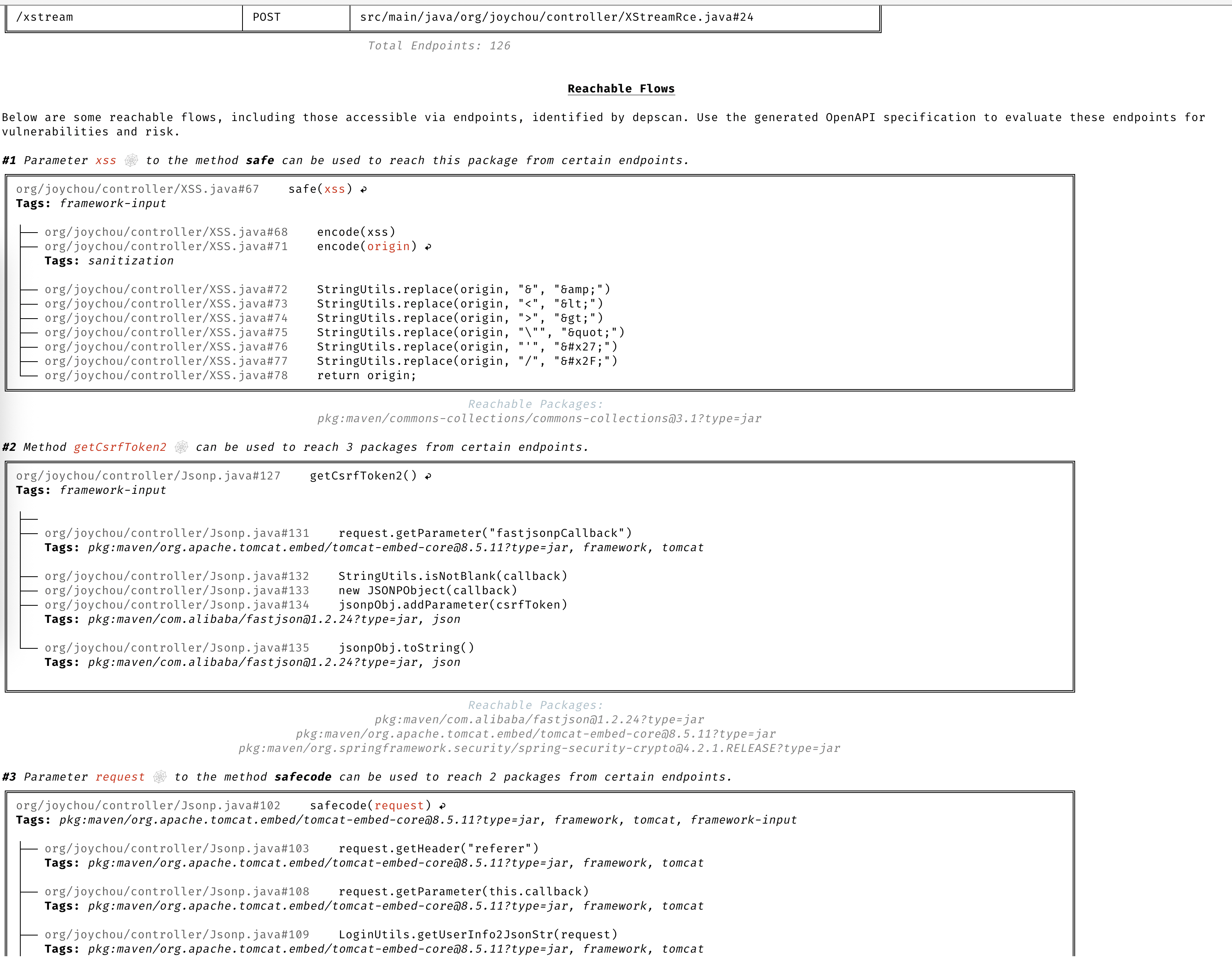
Reachable Flows

Reachability matrix

dep-scan computes reachability for seven language ecosystems through four slicers. A vulnerable package whose code is actually on an executed path is marked Reachable, while a package that is merely declared in the BOM but never called is not. Every slicer feeds the same shared, purl-keyed reachability engine, so the behavior is uniform across languages. Reachability is on by default (--reachability-analyzer FrameworkReachability); SemanticReachability additionally attributes reached services, endpoints, and post-build (binary/container) reachability.

Language / ecosystemReachability engineDefault analyzer
Java / JVM (Groovy, Kotlin, Scala)atomFrameworkReachability
JavaScript / TypeScriptatomFrameworkReachability
PythonatomFrameworkReachability
PHPatomFrameworkReachability
RustrusiFrameworkReachability
GogolemFrameworkReachability
.NET (C#, VB, F#, R)dosaiFrameworkReachability

For the concepts behind reachability and prioritization, read the reachability model and prioritization chapters. For per-language worked examples, see the Language Guides. For the compliance story (VDR and CSAF VEX), see the VDR guide and the CSAF VEX guide.

Reachability is on by default: dep-scan asks cdxgen for its research BOM profile, which writes the slices the analyzers read. The commands below are enough to get started; the per-language guides cover binary resolution, backend and network safety, restore requirements, and worked examples on the in-repo fixtures.

Rust (rusi). cdxgen runs rusi and persists its report, which dep-scan converts into the shared pipeline, so a crate that is actually called (for example time::now() for RUSTSEC-2020-0071) is Reachable while one merely present is not. See the Rust reachability guide.

depscan scan ./my-rust-app -o ./reports --bom-profile research

Go (golem). dep-scan invokes golem directly for Go projects (needs go on PATH), marking a module Reachable when its functions are on a traced path. golem runs with cgo off, so packages that need cgo are not loaded and their reachability is missing; pass --go-analyzer-cgo for trusted input. Use --go-analyzer-network offline for untrusted repos with a warm module cache. See the Go reachability guide.

depscan scan ./my-go-app -o ./reports -t go

.NET (dosai). cdxgen runs dosai, which emits an explicit per-package reachability verdict (PackageReachability with ReachabilityKind and Confidence) that dep-scan treats as authoritative, so a NuGet package actually called (for example JsonConvert.DeserializeObject on a controlled input) is Reachable. Scan a restored tree for versioned purls. See the .NET reachability guide.

depscan scan ./my-dotnet-app -o ./reports -t dotnet

JVM, JavaScript/TypeScript, Python, and PHP (atom). These four ecosystems share the atom slicer, which builds a language-agnostic intermediate representation and performs static slicing. See the JVM, JS, Python, and PHP reachability guide.

depscan scan ./my-java-app --bom-profile research -t java -o ./reports --explain

Télécharger l’outil

Populaires

Voir tout →

Découvrez les outils les plus utilisés par notre communauté.

  • 1

    OsintHunter

    letox4/osinthunter

    🎯 La boîte à outils OSINT ultime : graphe d'enquête, notation de confiance, familles d'alias, carte, chronologie et rapports. 49 modules, plus de 400 sites, aucune clé API requise.

    565
  • 2

    ghostlock-app

    yukonga/ghostlock-app

    # Application d'exécution en un clic GhostLock (CVE-2026-43499)

    478
  • 3

    ARTEX

    baarai/artex

    Plateforme autonome de tests d'intrusion multi-agents basée sur des LLM, avec agents planificateur/ouvrier, graphes d'actifs et d'exploration, enregistrement du trafic MITM et retest des vulnérabilités.

    383
  • 4

    redforge

    cybersecurity91/redforge

    Boîte à outils red team côté navigateur avec 102 outils hors ligne pour la reconnaissance, la génération de payloads, les attaques par identifiants, la cryptographie, l'encodage et le reporting d'engagement.

    327
  • 5

    estorides

    grisuno/estorides

    Agrège plus de 99 sources OSINT gratuites en parallèle, résout les entités dans un graphe de connaissances et exporte en STIX 2.1, MISP ou GraphML avec une analyse assistée par LLM.

    258
  • 6

    CyberStrikeAI

    ed1s0nz/cyberstrikeai

    Le système d'action pour la cybersécurité native IA—où l'intention devient une exécution gouvernée, les preuves deviennent une mémoire opérationnelle, et chaque opération améliore la suivante.

    256

Explorer tous les outils

Parcourez notre collection d'outils

Voir tous les outils →





