mahgal/nginx-http2-rce-check
Répondez à « suis-je exposé à la RCE Nginx HTTP/2 ? » en une seule commande — vérifiez votre version de nginx et votre configuration HTTP/2 par rapport à CVE-2026-123007 / CVE-2026-123633 (divulguées le 2026-11-18, CVSS 9.2).

Répondez à « mon nginx est-il exposé à la paire de RCE HTTP/2 ? » en 0,06 seconde — une seule commande, zéro appel réseau, zéro dépendance.
Un CLI Python uniquement basé sur la bibliothèque standard qui vérifie les deux éléments qui déterminent si un hôte est exposé à CVE-2026-123007 et CVE-2026-123633 : la version de nginx, et si HTTP/2 est activé dans la configuration. Une vérification réelle prend une médiane de 0,062 s (7 exécutions, mesurées le 2026-11-19 sur cette machine) — plus rapide que l'ouverture de la page de l'avis. Aucune charge utile, aucun scan réseau, aucun code d'exploitation : uniquement un outil de vérification défensif.
Le 2026-11-18, Wiz, Ikotas Labs, Metnir, Rapid7 et Xint ont divulgué deux failles d'exécution de code à distance non authentifiées dans la gestion de HTTP/2 par nginx — CVE-2026-123007 (sous-dépassement d'entier dans le contrôle de flux HTTP/2) et CVE-2026-123633 (utilisation après libération HTTP/2 sur les connexions proxy). Les deux sont CVSS 4.0 9.2 (CVSS 3.1 8.1) ; nginx.org classe 123007 « majeure » et 123633 « moyenne ». L'affaire a atteint la #1 sur Hacker News le 2026-11-19 (~1 152 points), et nginx propulse plus de 225 M de sites web — la fenêtre de correctif se compte donc en heures, pas en semaines.
Ce qui a été vérifié à partir des sources ci-dessous :
http2 off est une mesure provisoire pour ces deux-là, pas un substitut à la mise à jour.Sources : article de Wiz · explication de deploybase · résumé de l'avis IFIN · avis de sécurité de nginx.org
git clone https://github.com/Mahgal/nginx-http2-rce-check.git
cd nginx-http2-rce-check
python3 nginx_http2_check.py              # check this machine
Aucune installation pip, aucune dépendance — Python 3 uniquement. Essayez-le sans nginx installé :
python3 nginx_http2_check.py --demo      # labelled fixtures: 1 vulnerable, 1 patched
python3 nginx_http2_check.py --version 1.31.8 --config examples/nginx-http2-on.conf
python3 nginx_http2_check.py --version 1.30.7 --config examples/nginx-http2-on.conf
python3 nginx_http2_check.py --nginx-path examples/fake-nginx-vulnerable.sh --config examples/nginx-http2-on.conf
python3 nginx_http2_check.py --json      # machine-readable output for CI
Vérifié à partir d'une copie propre (nouveau checkout dans /tmp, 2026-11-19) : --demo s'exécute et la suite de tests complète passe, 40/40, code de sortie 0.
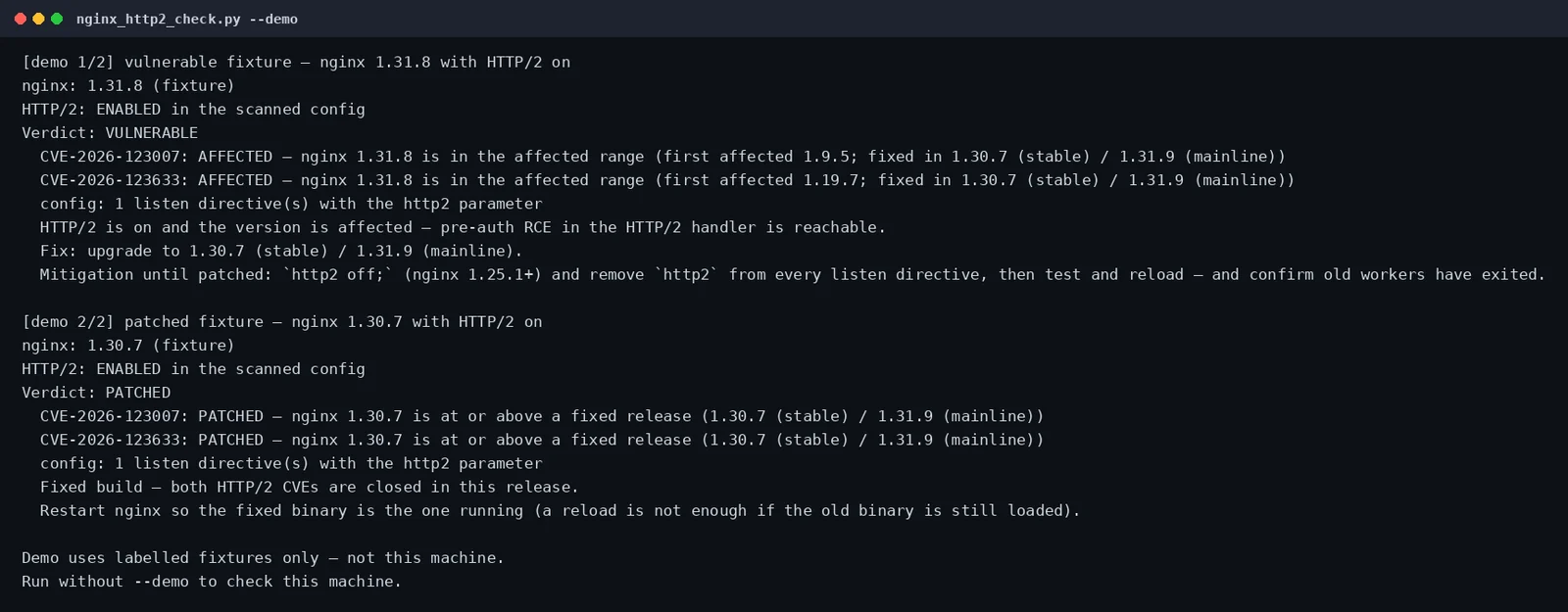
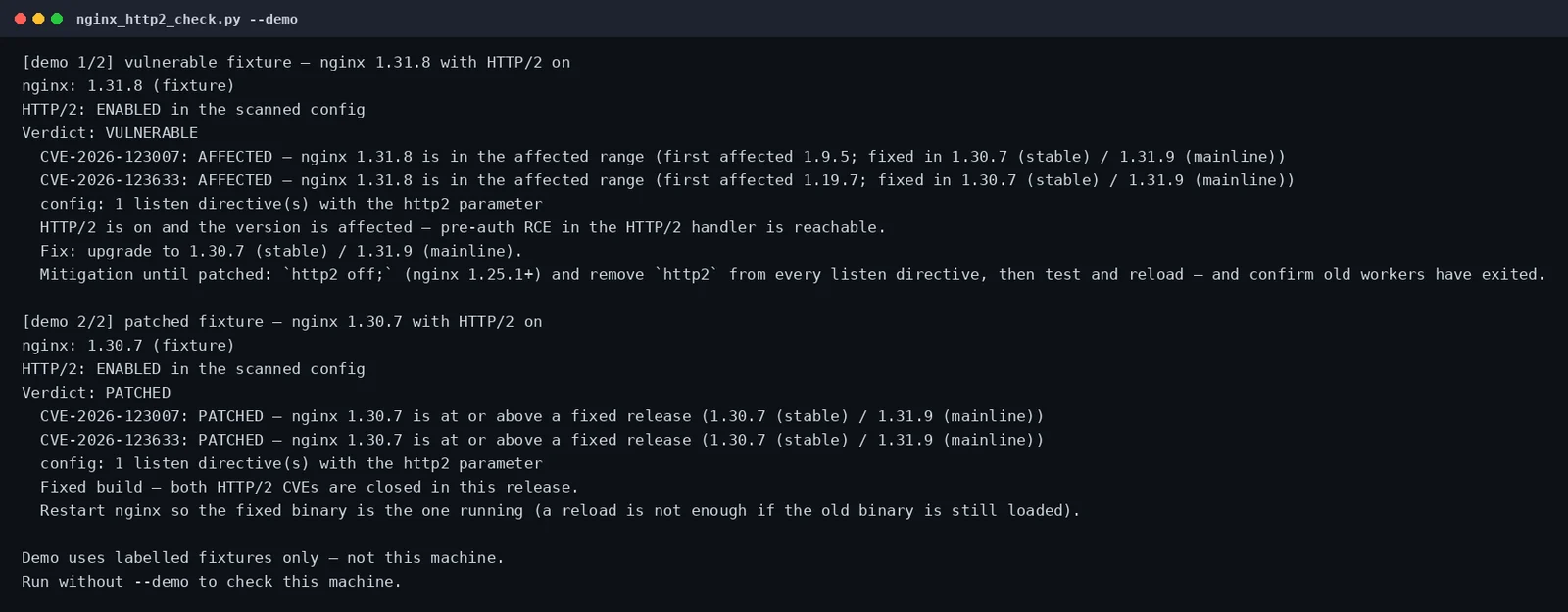
Sortie réelle de python3 nginx_http2_check.py --demo (capturée mot pour mot dans demo.txt ; les ré-exécutions la reproduisent octet pour octet, sha256 e6a50babb87a98a704b802b3bbab6d5db6da256b45a45b9628ab1a930eae7f27) :
[demo 1/2] vulnerable fixture — nginx 1.31.8 with HTTP/2 on
nginx: 1.31.8 (fixture)
HTTP/2: ENABLED in the scanned config
Verdict: VULNERABLE
  CVE-2026-123007: AFFECTED — nginx 1.31.8 is in the affected range (first affected 1.9.5; fixed in 1.30.7 (stable) / 1.31.9 (mainline))
  CVE-2026-123633: AFFECTED — nginx 1.31.8 is in the affected range (first affected 1.19.7; fixed in 1.30.7 (stable) / 1.31.9 (mainline))
  config: 1 listen directive(s) with the http2 parameter
  HTTP/2 is on and the version is affected — pre-auth RCE in the HTTP/2 handler is reachable.
  Fix: upgrade to 1.30.7 (stable) / 1.31.9 (mainline).
  Mitigation until patched: `http2 off;` (nginx 1.25.1+) and remove `http2` from every listen directive, then test and reload — and confirm old workers have exited.

[demo 2/2] patched fixture — nginx 1.30.7 with HTTP/2 on
nginx: 1.30.7 (fixture)
HTTP/2: ENABLED in the scanned config
Verdict: PATCHED
  CVE-2026-123007: PATCHED — nginx 1.30.7 is at or above a fixed release (1.30.7 (stable) / 1.31.9 (mainline))
  CVE-2026-123633: PATCHED — nginx 1.30.7 is at or above a fixed release (1.30.7 (stable) / 1.31.9 (mainline))
  config: 1 listen directive(s) with the http2 parameter
  Fixed build — both HTTP/2 CVEs are closed in this release.
  Restart nginx so the fixed binary is the one running (a reload is not enough if the old binary is still loaded).

Demo uses labelled fixtures only — not this machine.
Run without --demo to check this machine.
Les mêmes cas avec de vrais drapeaux :
$ python3 nginx_http2_check.py --version 1.31.8 --config examples/nginx-http2-on.conf
Verdict: VULNERABLE        # exit 1 — HTTP/2 on, version affected
$ python3 nginx_http2_check.py --version 1.30.7 --config examples/nginx-http2-on.conf
Verdict: PATCHED           # exit 0 — same config, fixed build
$ python3 nginx_http2_check.py --version 1.31.8 --config examples/nginx-http2-off.conf
Verdict: NOT_AFFECTED      # exit 0 — HTTP/2 off closes both flaws
$ python3 nginx_http2_check.py --version 1.24.0-0ubuntu1 --config examples/nginx-http2-on.conf
Verdict: UNKNOWN           # exit 3 — distro package: version string says nothing
1.30.7 est corrigé, mais 1.31.0–1.31.8 restent vulnérables. Une vérification naïve — « version ≥ 1.30.7 signifie sûr » — déclarerait 1.31.8 sûr. Ce n'est pas le cas. Cet outil compare à des plages explicites par branche, jamais à un simple seuil numérique :
| Version | CVE-2026-123007 | CVE-2026-123633 |
|---|---|---|
| < 1.9.5 | non affectée | non affectée |
| 1.9.5 – 1.19.6 | affectée | non affectée |
| 1.19.7 – 1.30.6 | affectée | affectée |
| 1.30.7 (correctif stable) | corrigée | corrigée |
| 1.31.0 – 1.31.8 | affectée | affectée |
| 1.31.9+ / 1.32.0+ (correctif mainline) | corrigée | corrigée |