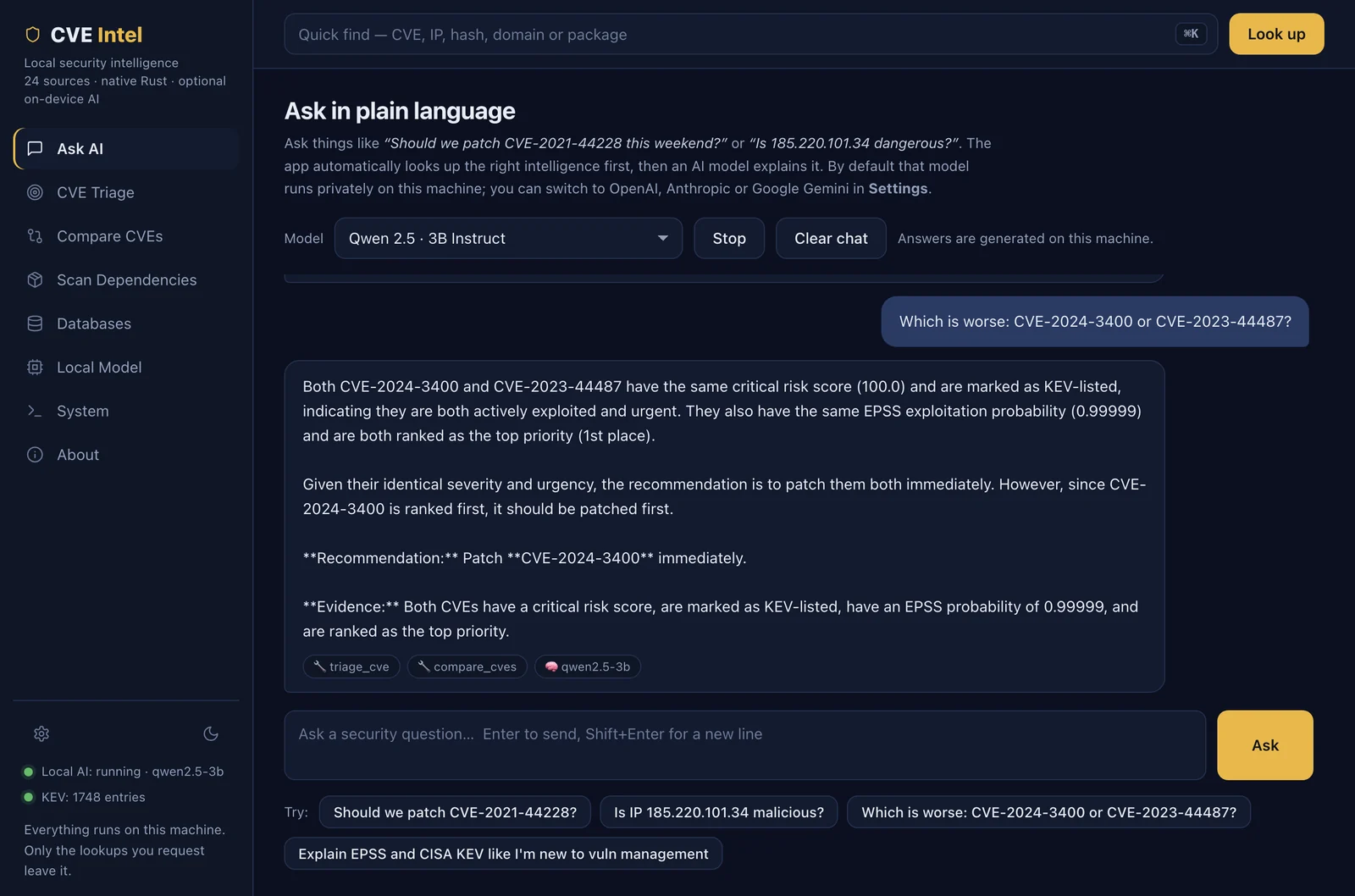
Local CVE triage engine aggregating 25 sources (NVD, EPSS, CISA KEV, OSV, Shodan) into 0-100 risk scores, with CLI, REST API, MCP server and on-device AI explanations.
Know which vulnerabilities matter, and what to do about them.
A private desktop app for vulnerability triage and scanning, written in native Rust, with a CLI, REST API and MCP server for developers and AI agents,
and a fleet mode that watches every server you run from one place.
42 MCP tools, 46 data sources, SBOMs in and out, on-device AI.




What it is · Getting started · Features · Fleet mode · Install · Local AI · Data sources · Developer notes · Citing
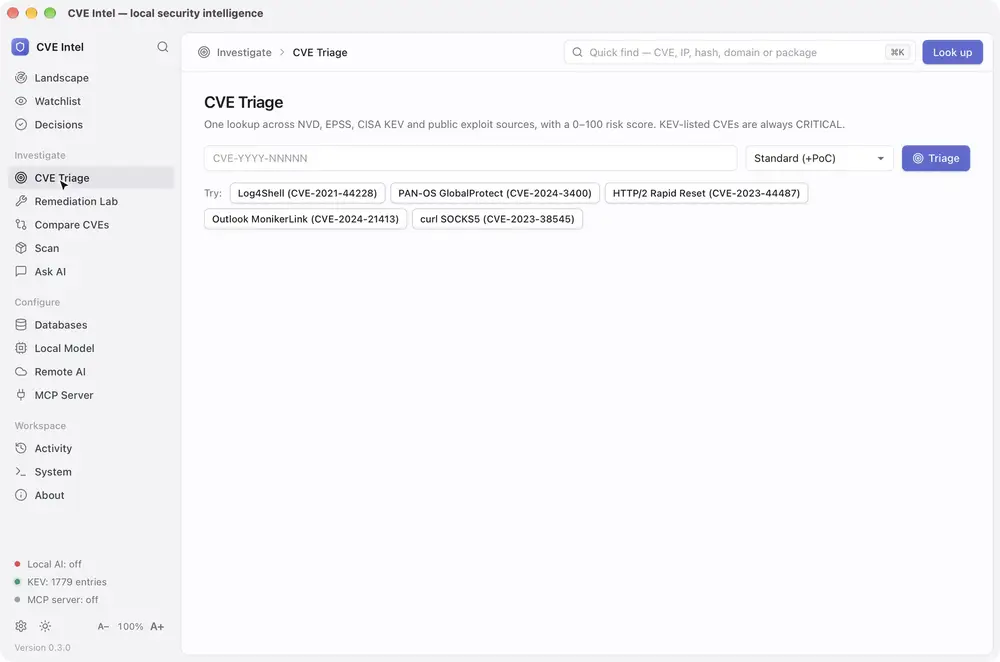
Sped-up demo on macOS (video, or the full-length recording): from a triage result to a remediation plan for what you run, its runbook, a mitigation tried in What if and saved as a decision, and Plan fix from a scan. A second demo, of the landscape, decisions, scans and the watchlist, is under Features.
Every known software vulnerability gets a public ID, such as CVE-2024-3400. For each one, security, IT and development teams face the same question: does this affect us, and do we fix it now or can it wait? Answering it usually means checking NVD, CISA, FIRST, GitHub and vendor advisories by hand, one browser tab at a time.
CVE publication keeps rising (48,185 in 2025, 20.6% more than 2024, and over 86,000 by 27 October 2026), and in April 2026 NIST said the National Vulnerability Database cannot keep up, so it will enrich CVEs in CISA's Known Exploited Vulnerabilities (KEV) catalog, federal-use software and critical software first, and move its unenriched backlog from before 1 March 2026 to "Not Scheduled". Meanwhile, Mandiant's M-Trends 2026 estimates the mean time to exploit at −7 days, so exploitation routinely begins before a patch is released, and exploits were the most common initial infection vector for the sixth year running (32% of intrusions).
Give CVE Intel a CVE ID, a project folder, a lockfile or SBOM, a container image, the software on this computer, your own domains, or a suspicious IP address, file hash or domain. It queries up to 46 public sources, including CISA KEV, FIRST's EPSS and ENISA's EU Vulnerability Database alongside NVD, and returns what the vulnerability is, a risk score from 0 to 100, whether attackers are already using it, the evidence behind each signal and what to do next. It also shows what changed this week across those sources, and watches the vendors, products and packages you run.
scan deps . --format cyclonedx) writes
any scan as a CycloneDX 1.5 SBOM with the findings, their risk signals and
your recorded decisions.It is for security analysts, IT and operations teams, developers checking their dependencies, and anyone learning vulnerability management.
The desktop app checks the computer it runs on and whatever you give it. To watch your servers as well, run fleet mode: a small agent on each machine sends what is installed there to a CVE Intel server you run. That server checks every machine when its software changes and again every day, records what became new, riskier or fixed, and answers which of our machines have this CVE? The desktop app's Fleet view shows it all from your own computer.
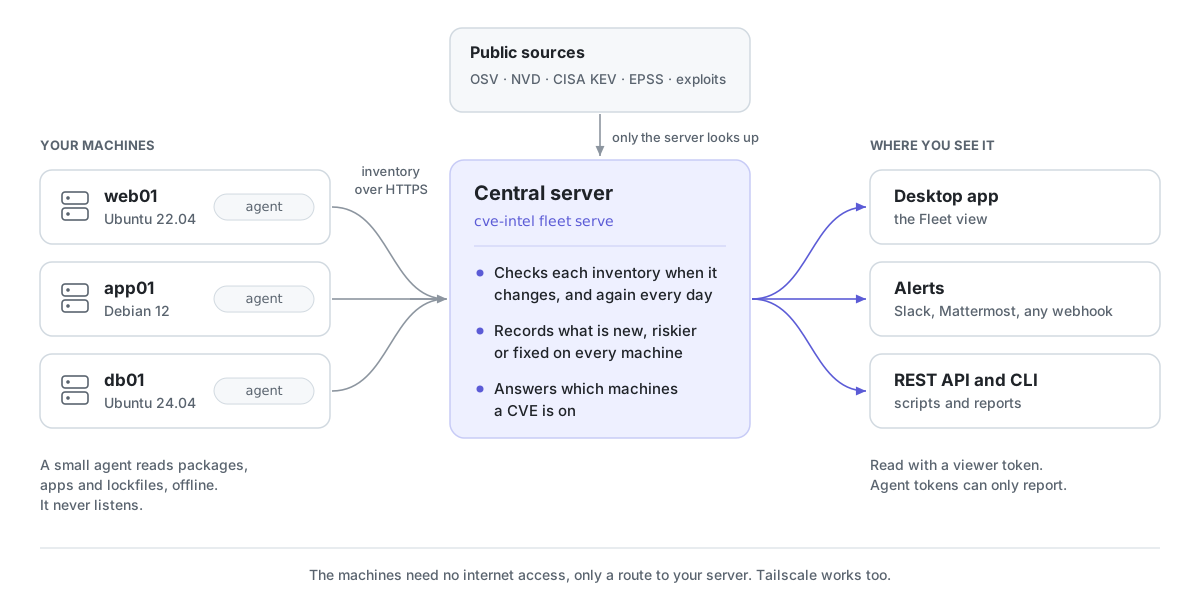
Fleet mode under Features has screenshots and a demo, and the fleet guide shows how to set it up.