 silentisvox/syscallrevenant
Clean Indirect Syscalls with Syscall Tampering.

SyscallRevenant is a new method of performing clean indirect syscalls.
The main component resolves System Service Numbers (SSNs) and syscall instruction addresses dynamically.
This is done by enabling the trap flag during execution.
The secondary component is tampering via parameter replacement before a syscall.
This combination is designed to bypass userland hooks during the subsequent syscall invocation while substituting the initially presented parameters.
Disclaimer: The purpose of this is for educational purposes and testing only. Do not use this on machines you do not have permission to use. Do not use this to leverage and communicate with machines that you do not have authorization to use.
Indirect syscalls is a method of executing syscall instructions in trusted userland space.
If a user finds a syscall instruction, they may jump to it indirectly.
An event enabled during a tracing session can reveal the return address immediately after the instruction.
This does not account for Endpoint Detection & Response (EDR) userland hooks.
An EDR may insert hooks into ntdll.dll, therefore deprecating the lookup process for SSNs and syscall instructions.
Entering a hook will benefit the owning thread, not raising a malicious score.
Observing an entry into a function and observing the resulting operation are different things.
RevenantSyscalls investigates that gap.
The following sections outline the project’s two main components.
The first component resolves function addresses from ntdll.dll loaded by the process.
A trap walk may then be performed if syscall information is needed.
The second component performs an indirect jump to the saved function information.
Reading from the segment register can retrieve the Process Environment Block (PEB).
The LoaderData is a field in the PEB that contains data loaded with each process.
LoaderData contains information about modules loaded alongside each process.
Module names and base addresses exist in module entries.
A Dynamically Linked Library (DLL)’s export information describes the symbols it exports. Export metadata supports locating exported symbols. The index of a function applies only to names and name ordinals. Hashing a function name is the best for low memory environments.
A vectored exception handler is an exception handling mechanism that catches exceptions from anywhere within a process.
Enabling the trap flag causes an EXCEPTION_SINGLE_STEP exception on the next instruction executed.
A custom vectored exception handler can inspect the RIP and check for a syscall.
By repeatedly resetting the trap flag, the syscall address will be discovered and SSN saved.
Syscall Lookup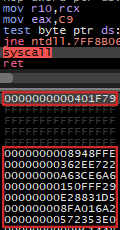
|
Syscall Execution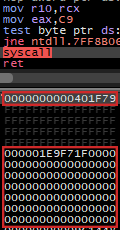
|
Each syscall has the initial syscall information lookup; Hooks will be entered to retrieve syscall information. Proceeding, an indirect jump will be made to the syscall. There will be an assoicated RIP spoof (from original entry). With re-entry, the initial parameters have been tampered.
From an Event Tracing for Windows (ETW) perspective, the events possibly emitted are: SysEnter, SysExit, and StackWalk for either.
If an EDR builds similar, comparable events, these will look nearly identical.
The only differences will lie in durastically different Query Performance Counter (QPC) time stamps.
src/AsmRevenant.asm REAL_RTN: DQ 0
FAKE_RTN: DQ 0
; If a syscall information lookup is in progress, the
; initial entry return address needs to be preserved.
MOV RAX, QWORD PTR [RSP]
MOV QWORD PTR [FAKE_RTN], RAX
; Once the re-entry is made, the real return is saved,
; and the current is spoofed with initial return.
MOV RAX, QWORD PTR [RSP]
MOV QWORD PTR [REAL_RTN], RAX
MOV RAX, QWORD PTR [FAKE_RTN]
MOV QWORD PTR [RSP], RAX
src/Revenant.cLONG VectoredExceptionHandler(EXCEPTION_POINTERS *BreakPoint) {
...
// If a syscall information lookup is being made, the
// syscall instruction address is saved, the SSN is
// saved, and the return is rerouted.
if (LookupInProgress && *(USHORT*)BreakPoint->Address == 0x050F) {
SyscallInstruction = BreakPoint->Address;
SyscallSSN = BreakPoint->Context->Rax;
BreakPoint->Context->Rip = SyscallExit;
}
// When re-entered, if the previous instruction was
// a syscall, reset return address, and exit.
if (!LookupInProgress && *(USHORT*)(BreakPoint->Address - 2) == 0x050F) {
*(VOID**)BreakPoint->Context->Rsp = REAL_RTN;
BreakPoint->Context->Rip = SyscallExit;
}
...
}
