
Skip to content
KitploitKITPLOIT
ToolsBlog
Submit
ToolsBlog
Submit

Hacking, PenTest, and Cybersecurity Tools for Your Security Arsenal!

Kitploit is a directory of hacking, cybersecurity, and pentesting tools. Discover the latest project updates to find vulnerabilities, analyze systems, automate testing, and strengthen your security.

··Feeds·Contact·Privacy·© 2026 Kitploit

Tool Directory

Categories

View all categories
Loading categories
hassh — HASSH is a network fingerprinting standard which can be used to identify specific Client and Server SSH implementations. The fingerprints can be easily stored, searched and shared in the form of a small MD5 fingerprint. | Kitploit
Tools/GitHubGitHub/salesforce/hassh
Indicator of Compromise (IOC) ManagementIoT SecurityForensicsNetwork SecurityThreat IntelligenceIntrusion DetectionIncident ResponseAnomaly DetectionArchived
GitHubsalesforce/hassh

hassh

HASSH is a network fingerprinting standard which can be used to identify specific Client and Server SSH implementations. The fingerprints can be easily stored, searched and shared in the form of a small MD5 fingerprint.


554771 year agoReviewed by Kitploit

Most Popular

View all →

Discover the most used tools by our community.

Explore all tools

Browse our collection of tools

View all tools →
Share
View Repository

"HASSH" - a Profiling Method for SSH Clients and Servers.

"HASSH" is a network fingerprinting standard which can be used to identify specific Client and Server SSH implementations. The fingerprints can be easily stored, searched and shared in the form of an MD5 fingerprint.

HASSH was invented at Salesforce in 2018. However, the project is no longer being actively maintained by Salesforce. Its original creator, Ben Reardon maintains the active fork at Corelight

License: BSD 3-Clause License

What can HASSH help with:

  • Use in highly controlled, well understood environments, where any fingerprints outside of a known good set are alertable.
  • It is possible to detect, control and investigate brute force or Cred Stuffing password attempts at a higher level of granularity than IP Source - which may be impacted by NAT or botnet-like behaviour. The hassh will be a feature of the specific Client software implementation being used, even if the IP is NATed such that it is shared by many other SSH clients.
  • Detect covert exfiltration of data within the components of the Client algorithm sets. In this case, a specially coded SSH Client can send data outbound from a trusted to a less trusted environment within a series of SSH_MSG_KEXINIT packets. In a scenario similar to the more known exfiltration via DNS, data could be sent as a series of attempted, but incomplete and unlogged connections to an SSH server controlled by bad actors who can then record, decode and reconstitute these pieces of data into their original form. Until now such attempts - much less the contents of the clear text packets - are not logged even by mature packet analyzers or on end point systems. Detection of this style of exfiltration can now be performed easily by using anomaly detection or alerting on SSH Clients with multiple different hassh
  • Use in conjunction with other contextual indicators, for example detect Network discovery and Lateral movement attempts by unusual hassh such as those used by Paramiko, Powershell, Ruby, Meterpreter, Empire.
  • Share malicious hassh as Indicators of Compromise.
  • Create an additional level of Client application control, for example one could block all Clients from connecting to an SSH server that are outside of an approved known set of hassh values.
  • Contribute to Non Repudiation in a Forensic context - at a higher level of abstraction than IPSource - which may be impacted by NAT, or where multiple IP Sources are used.
  • Detect Deceptive Applications. Eg a hasshServer value known to belong to the Cowrie/Kippo SSH honeypot server installation, which is purporting to be a common OpenSSH server in the Server String.
  • Detect devices having a hassh known to belong to IOT embedded systems. Examples may include cameras, mics, keyloggers, wiretaps that could be easily be hidden from view and communicating quietly over encrypted channels back to a control server.

How does HASSH work:

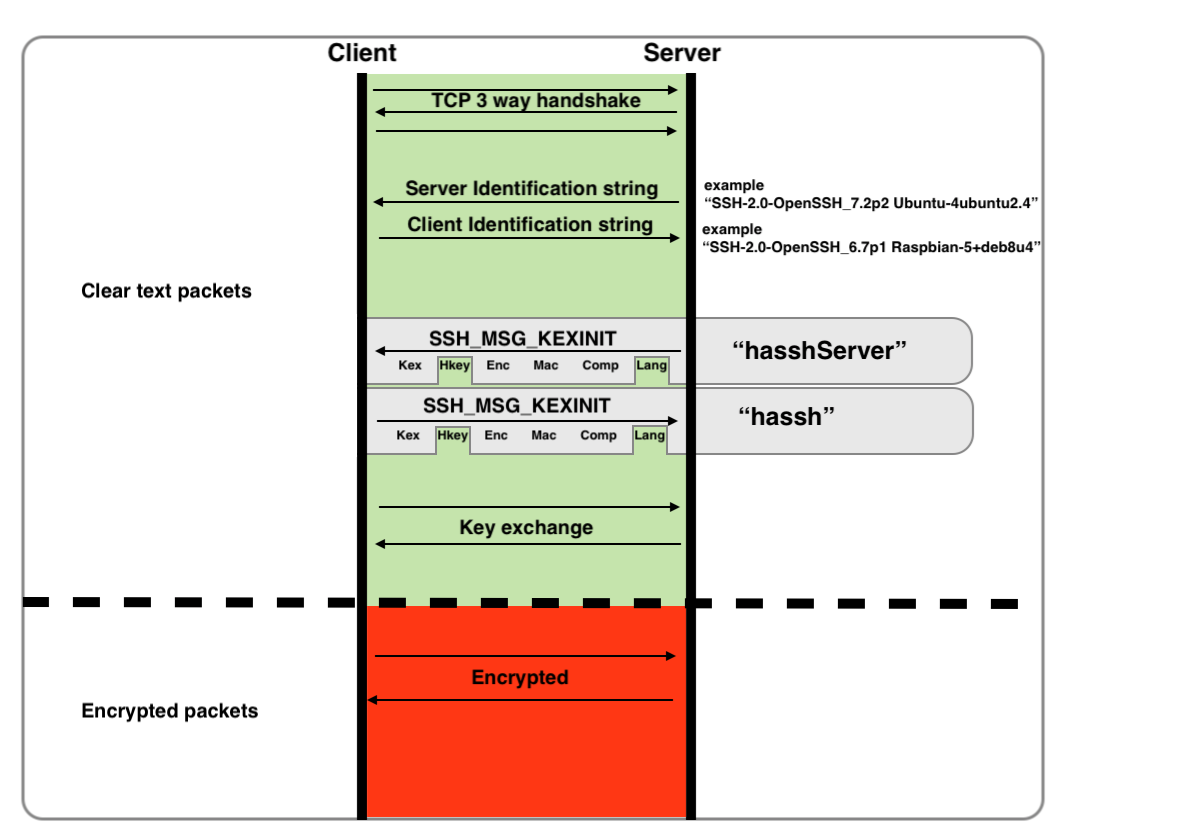
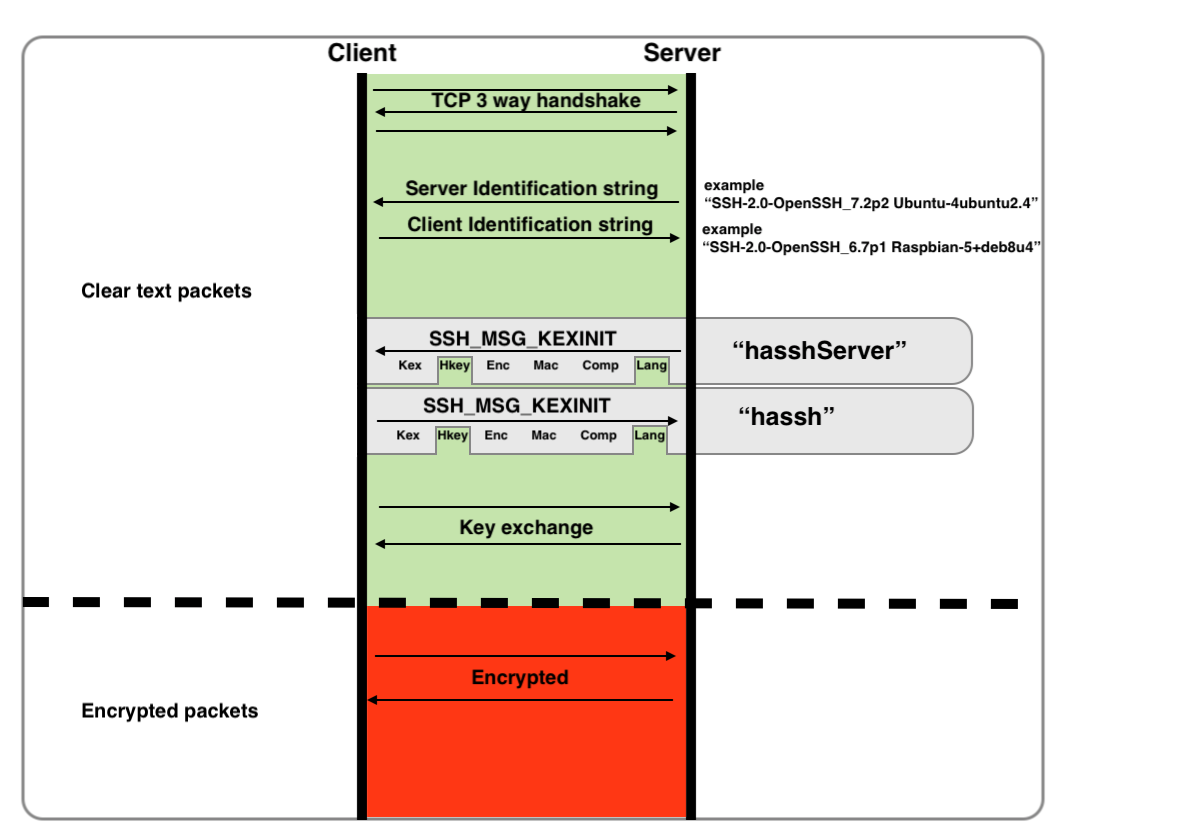
"hassh" and "hasshServer" are MD5 hashes constructed from a specific set of algorithms that are supported by various SSH Client and Server Applications. These algorithms are exchanged after the initial TCP three-way handshake as clear-text packets known as "SSH_MSG_KEXINIT" messages, and are an integral part of the setup of the final encrypted SSH channel. The existence and ordering of these algorithms is unique enough such that it can be used as a fingerprint to help identify the underlying Client and Server application or unique implementation, regardless of higher level ostensible identifiers such as "Client" or "Server" strings.
Example 1: Client Fingerprinting - the "hassh"

For the "Cyberduck" SFTP client (specifically SSH-2.0-Cyberduck/6.7.1.28683 (Mac OS X/10.13.6) (x86_64)" , the set of supported algorithms is as follows :

Concatenating these algorithms together with a delimiter of ";" gives the hasshAlgorithms, which is useful for detailed analysis.
[email protected],diffie-hellman-group-exchange-sha256,ecdh-sha2-nistp521,ecdh-sha2-nistp384,ecdh-sha2-nistp256,diffie-hellman-group-exchange-sha1,diffie-hellman-group1-sha1,diffie-hellman-group14-sha1,diffie-hellman-group14-sha256,diffie-hellman-group15-sha512,diffie-hellman-group16-sha512,diffie-hellman-group17-sha512,diffie-hellman-group18-sha512,[email protected],diffie-hellman-group15-sha256,[email protected],[email protected],diffie-hellman-group16-sha256,[email protected],[email protected],[email protected];aes128-cbc,aes128-ctr,aes192-cbc,aes192-ctr,aes256-cbc,aes256-ctr,blowfish-cbc,blowfish-ctr,cast128-cbc,cast128-ctr,idea-cbc,idea-ctr,serpent128-cbc,serpent128-ctr,serpent192-cbc,serpent192-ctr,serpent256-cbc,serpent256-ctr,3des-cbc,3des-ctr,twofish128-cbc,twofish128-ctr,twofish192-cbc,twofish192-ctr,twofish256-cbc,twofish256-ctr,twofish-cbc,arcfour,arcfour128,arcfour256;hmac-sha1,hmac-sha1-96,hmac-md5,hmac-md5-96,hmac-sha2-256,hmac-sha2-512;[email protected],zlib,none

Finally the hassh is simply the MD5 of hasshAlgorithms, and is used for storage, searching and sharing. Some examples follow:

de30354b88bae4c2810426614e1b6976 Powershell Renci.SshNet.SshClient.0.0.1 (used by Empire exploit modules) fafc45381bfde997b6305c4e1600f1bf Ruby/Net::SSH_5.0.2 x86_64-linux (used by Metasploit exploit modules) b5752e36ba6c5979a575e43178908adf Python Paramiko_2.4.1 (used by Metasploit exploit modules) 16f898dd8ed8279e1055350b4e20666c Dropbear_2012.55 (used in IOT embedded systems)
8a8ae540028bf433cd68356c1b9e8d5b CyberDuck Version 6.7.1 (28683)
06046964c022c6407d15a27b12a6a4fb OpenSSH_7.7p1 Ubuntu-4

Example 2: Server Fingerprinting - the "hasshServer"

For a standard SSH-2.0-OpenSSH_5.3 SSH server, the set of supported algorithms is as follows :

Concatenating these algorithms together with a delimiter of ";" gives the hasshServerAlgorithms, which is useful for detailed analysis.
diffie-hellman-group-exchange-sha256,diffie-hellman-group-exchange-sha1,diffie-hellman-group14-sha1,diffie-hellman-group1-sha1;aes128-ctr,aes192-ctr,aes256-ctr,arcfour256,arcfour128,aes128-cbc,3des-cbc,blowfish-cbc,cast128-cbc,aes192-cbc,aes256-cbc,arcfour,[email protected];hmac-md5,hmac-sha1,[email protected],hmac-ripemd160,[email protected],hmac-sha1-96,hmac-md5-96;none,[email protected]

Finally the hasshServer is simply the MD5 of hasshServerAlgorithms, some examples follow: c1c596caaeb93c566b8ecf3cae9b5a9e SSH-2.0-dropbear_2016.74 d93f46d063c4382b6232a4d77db532b2 SSH-2.0-dropbear_2016.72 2dd9a9b3dbebfaeec8b8aabd689e75d2 SSH-2.0-AWSCodeCommit
696e7f84ac571fdf8fa5073e64ee2dc8 SSH-2.0-FTP

References:

  • RFC4253 The Secure Shell (SSH) Transport Layer Protocol
  • Salesforce Engineering blog

Credits:

hassh and hasshServer were conceived and developed by Ben Reardon (@benreardon) within the Detection Cloud Team at Salesforce, with inspiration and contributions from Adel Karimi (@0x4d31) and the JA3 crew crew:John B. Althouse , Jeff Atkinson and Josh Atkins

Download Tool
FunctionAlgorithms seen in SSH_MSG_KEXINIT packets
Key Exchange methods[email protected],diffie-hellman-group-exchange-sha256,ecdh-sha2-nistp521,ecdh-sha2-nistp384,ecdh-sha2-nistp256,diffie-hellman-group-exchange-sha1,diffie-hellman-group1-sha1,diffie-hellman-group14-sha1,diffie-hellman-group14-sha256,diffie-hellman-group15-sha512,diffie-hellman-group16-sha512,diffie-hellman-group17-sha512,diffie-hellman-group18-sha512,[email protected],diffie-hellman-group15-sha256,[email protected],[email protected],diffie-hellman-group16-sha256,[email protected],[email protected],[email protected]
Encryptionaes128-cbc,aes128-ctr,aes192-cbc,aes192-ctr,aes256-cbc,aes256-ctr,blowfish-cbc,blowfish-ctr,cast128-cbc,cast128-ctr,idea-cbc,idea-ctr,serpent128-cbc,serpent128-ctr,serpent192-cbc,serpent192-ctr,serpent256-cbc,serpent256-ctr,3des-cbc,3des-ctr,twofish128-cbc,twofish128-ctr,twofish192-cbc,twofish192-ctr,twofish256-cbc,twofish256-ctr,twofish-cbc,arcfour,arcfour128,arcfour256
Message Authenticationhmac-sha1,hmac-sha1-96,hmac-md5,hmac-md5-96,hmac-sha2-256,hmac-sha2-512
Compression[email protected],zlib,none
Function
Algorithms seen in SSH_MSG_KEXINIT packets
Key Exchange methodsdiffie-hellman-group-exchange-sha256,diffie-hellman-group-exchange-sha1,diffie-hellman-group14-sha1,diffie-hellman-group1-sha1
Encryptionaes128-ctr,aes192-ctr,aes256-ctr,arcfour256,arcfour128,aes128-cbc,3des-cbc,blowfish-cbc,cast128-cbc,aes192-cbc,aes256-cbc,arcfour,[email protected]
Message Authenticationhmac-md5,hmac-sha1,[email protected],hmac-ripemd160,[email protected],hmac-sha1-96,hmac-md5-96
Compressionnone,[email protected]