
Skip to content
KitploitKITPLOIT
ToolsExploitsBlog
Log in
Submit
ToolsExploitsBlog
Submit

Hacking, PenTest, and Cybersecurity Tools for Your Security Arsenal!

Kitploit is a directory of hacking, cybersecurity, and pentesting tools. Discover the latest project updates to find vulnerabilities, analyze systems, automate testing, and strengthen your security.

FeedsContactPrivacy© 2026 Kitploit

Tool Directory

Categories

View all categories
Loading categories
Tools/GitHubGitHub/safebreach-labs/cloudminer
ExploitationCloud SecurityLearning & Education
GitHubsafebreach-labs/cloudminer

CloudMiner

Execute code using Azure Automation service without getting charged

View Repository
14021443 years agoReviewed by Kitploit
Share

CloudMiner

Execute code within Azure Automation service without getting charged

Description

CloudMiner is a tool designed to get free computing power within Azure Automation service. The tool utilizes the upload module/package flow to execute code which is totally free to use. This tool is intended for educational and research purposes only and should be used responsibly and with proper authorization.

  • This flow was reported to Microsoft on 3/23 which decided to not change the service behavior as it's considered as "by design". As for 3/9/23, this tool can still be used without getting charged.

  • Each execution is limited to 3 hours

Requirements

  1. Python 3.8+ with the libraries mentioned in the file requirements.txt
  2. Configured Azure CLI - https://learn.microsoft.com/en-us/cli/azure/install-azure-cli
    • Account must be logged in before using this tool

Installation

pip install .

Usage

usage: cloud_miner.py [-h] --path PATH --id ID -c COUNT [-t TOKEN] [-r REQUIREMENTS] [-v]

CloudMiner - Free computing power in Azure Automation Service

optional arguments:
  -h, --help            show this help message and exit
  --path PATH           the script path (Powershell or Python)
  --id ID               id of the Automation Account - /subscriptions/{subscriptionId}/resourceGroups/{resourceGroupName}/providers/Microsoft.Automation/a
                        utomationAccounts/{automationAccountName}
  -c COUNT, --count COUNT
                        number of executions
  -t TOKEN, --token TOKEN
                        Azure access token (optional). If not provided, token will be retrieved using the Azure CLI
  -r REQUIREMENTS, --requirements REQUIREMENTS
                        Path to requirements file to be installed and use by the script (relevant to Python scripts only)
  -v, --verbose         Enable verbose mode

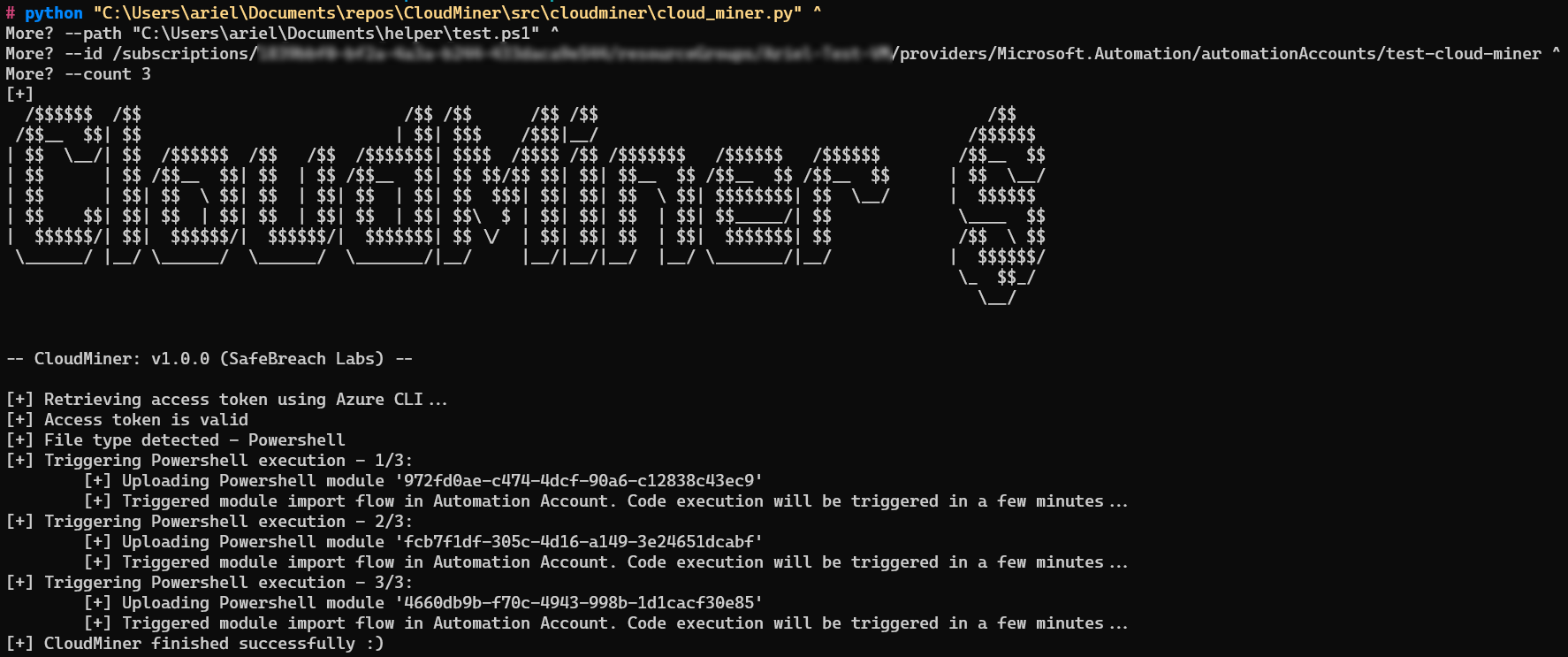
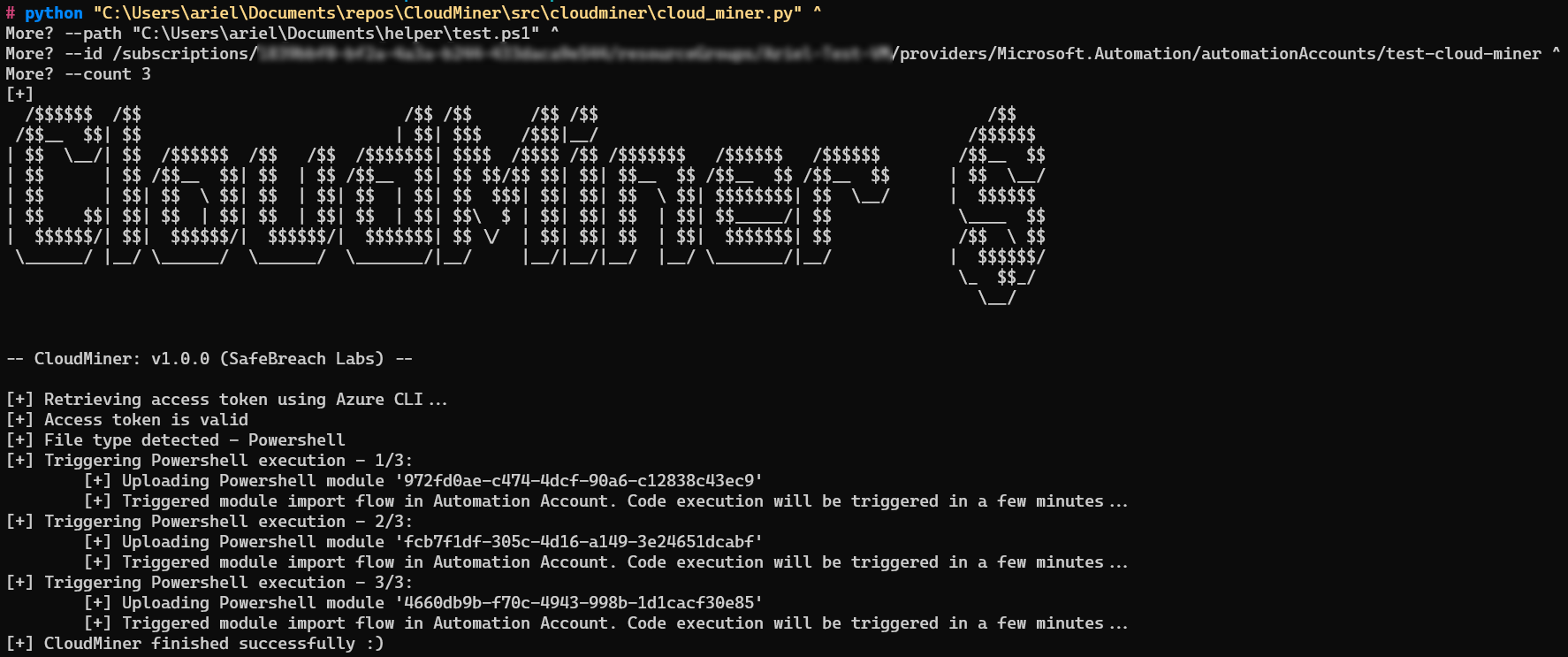
Example usage

Python

Alt text

Powershell

Alt text

License

CloudMiner is released under the BSD 3-Clause License. Feel free to modify and distribute this tool responsibly, while adhering to the license terms.


Author - Ariel Gamrian

  • LinkedIn - Ariel Gamrian
Download Tool

Most Popular

View all →

Discover the most used tools by our community.

  • 1

    OsintHunter

    letox4/osinthunter

    🎯 The ultimate OSINT toolkit: investigation graph, confidence scoring, alias families, map, timeline and reports. 49 modules, 400+ sites, no API keys required.

    837
  • 2

    ghostlock-app

    yukonga/ghostlock-app

    GhostLock One-Tap Execution App (CVE-2026-43499)

    536
  • 3

    ARTEX

    baarai/artex

    LLM multi-agent autonomous penetration testing platform with planner/worker agents, asset and exploration graphs, MITM traffic recording, and vulnerability retesting.

    424
  • 4

    redforge

    cybersecurity91/redforge

    Browser-side red team toolkit with 102 offline tools for recon, payload generation, credential attacks, crypto, encoding and engagement reporting.

    355
  • 5

    looking-glass

    anonghosty/looking-glass

    CSIRT platform that ingests Shadowserver reports into MongoDB and replays them as interactive maps, analysis, findings, advisories and executive dashboards.

    294
  • 6

    CyberStrikeAI

    ed1s0nz/cyberstrikeai

    The system of action for AI-native cybersecurity—where intent becomes governed execution, evidence becomes operational memory, and every operation improves the next.

    276

Explore all tools

Browse our collection of tools

View all tools →




