
Skip to content
KitploitKITPLOIT
ToolsExploitsBlog
Log in
Submit
ToolsExploitsBlog
Submit

Hacking, PenTest, and Cybersecurity Tools for Your Security Arsenal!

Kitploit is a directory of hacking, cybersecurity, and pentesting tools. Discover the latest project updates to find vulnerabilities, analyze systems, automate testing, and strengthen your security.

FeedsContactPrivacy© 2026 Kitploit

Tool Directory

Categories

View all categories
Loading categories
Tools/GitHubGitHub/rub-nds/johnny-you-are-fired
Vulnerability AnalysisPhishingCryptographySocial EngineeringPapers & ResearchEmail Security
GitHubrub-nds/johnny-you-are-fired

Johnny-You-Are-Fired

Artifacts for the USENIX publication.

View Repository
5614866 years agoReviewed by Kitploit
Share

Johnny-You-Are-Fired

Artifacts for the USENIX publication | Full paper here
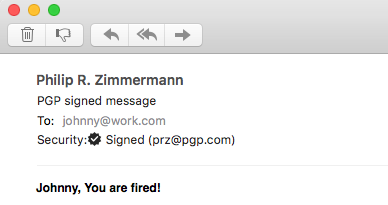
Forged PGP signature of Phil Zimmermann

Abstract

OpenPGP and S/MIME are the two major standards to encrypt and digitally sign emails. Digital signatures are supposed to guarantee authenticity and integrity of messages. In this work we show practical forgery attacks against various implementations of OpenPGP and S/MIME email signature verification in five attack classes: (1) We analyze edge cases in S/MIME's container format. (2) We exploit in-band signaling in the GnuPG API, the most widely used OpenPGP implementation. (3) We apply MIME wrapping attacks that abuse the email clients' handling of partially signed messages. (4) We analyze weaknesses in the binding of signed messages to the sender identity. (5) We systematically test email clients for UI redressing attacks.

Our attacks allow the spoofing of digital signatures for arbitrary messages in 14 out of 20 tested OpenPGP-capable email clients and 15 out of 22 email clients supporting S/MIME signatures. While the attacks do not target the underlying cryptographic primitives of digital signatures, they raise concerns about the actual security of OpenPGP and S/MIME email applications. Finally, we propose mitigation strategies to counter these attacks.

Attack classes

  1. CMS attacks. Cryptographic Message Syntax (CMS) is a versatile standard for signed and encrypted messages within the X.509 public-key infrastructure. We found flaws in the handling of emails with contradicting or unusual data structures.

  2. GPG API attacks. GnuPG is the most widely used OpenPGP implementation, but it only offers a very restricted command line interface for validating signatures. This interface was vulnerable to injection attacks.

  3. MIME attacks. The body of an email is conceptually a MIME tree, but typically the tree has only one leaf which is signed. We construct non-standard MIME trees that trick clients into showing an unsigned text while verifying an unrelated signature in another part.

  4. ID attacks. The goal of this attack class is to display a valid signature from the identity (ID) of a trusted communication partner located in the mail header, although the crafted email is actually signed by the attacker.

  5. UI attacks. Email clients indicate a valid signature by showing some security indicators in the user interface (UI), for example, a letter with a seal. However, several clients allow the mimicking of important UI elements by using HTML, CSS, and other embedded content.

Evaluation of OpenPGP-capable email clients

Evaluation of OpenPGP-capable email clients

Evaluation email clients supporting S/MIME

Evaluation email clients supporting S/MIME

Press and Reactions

2019/4/30

  • Bundesamt für Sicherheit in der Informationstechnik: Forscher finden Schwachstellen in E-Mail-Signaturprüfung
  • golem.de: Mailprogramme fallen auf falsche Signaturen herein (Hanno Böck)
  • gpg4win.org: Detecting spoofed email signatures
  • OpenPGP Working Group Mailing List: Discussion Thread
  • TheHackerNews: Over Dozen Popular Email Clients Found Vulnerable to Signature Spoofing Attacks

2019/05/01

  • heise online: S/MIME und PGP: E-Mail-Signaturprüfung lässt sich austricksen (Fabian A. Scherschel)
  • The Daily Swig: More than half of popular email clients are vulnerable to signature spoofing (John Leyden)
  • TechNadu: Popular Email Clients Are Vulnerable to Signature Spoofing Attacks (Bill Toulas)
  • security.nl: Onderzoekers vinden lek in controle van e-mailhandtekeningen
Download Tool

Most Popular

View all →

Discover the most used tools by our community.

  • 1

    OsintHunter

    letox4/osinthunter

    🎯 The ultimate OSINT toolkit: investigation graph, confidence scoring, alias families, map, timeline and reports. 49 modules, 400+ sites, no API keys required.

    867
  • 2

    ghostlock-app

    yukonga/ghostlock-app

    GhostLock One-Tap Execution App (CVE-2026-43499)

    544
  • 3

    ARTEX

    baarai/artex

    LLM multi-agent autonomous penetration testing platform with planner/worker agents, asset and exploration graphs, MITM traffic recording, and vulnerability retesting.

    385
  • 4

    redforge

    cybersecurity91/redforge

    Browser-side red team toolkit with 102 offline tools for recon, payload generation, credential attacks, crypto, encoding and engagement reporting.

    360
  • 5

    looking-glass

    anonghosty/looking-glass

    CSIRT platform that ingests Shadowserver reports into MongoDB and replays them as interactive maps, analysis, findings, advisories and executive dashboards.

    302
  • 6

    CyberStrikeAI

    ed1s0nz/cyberstrikeai

    The system of action for AI-native cybersecurity—where intent becomes governed execution, evidence becomes operational memory, and every operation improves the next.

    279

Explore all tools

Browse our collection of tools

View all tools →






