
Skip to content
KitploitKITPLOIT
ToolsExploitsBlog
Log in
Submit
ToolsExploitsBlog
Submit

Hacking, PenTest, and Cybersecurity Tools for Your Security Arsenal!

Kitploit is a directory of hacking, cybersecurity, and pentesting tools. Discover the latest project updates to find vulnerabilities, analyze systems, automate testing, and strengthen your security.

FeedsContactPrivacy© 2026 Kitploit

Tool Directory

Categories

View all categories
Loading categories
Tools/GitHubGitHub/maldev-academy/drmbinviaordinalimports
Reverse EngineeringMalware AnalysisBinary AnalysisPayload DevelopmentAdversarial Attack
GitHubmaldev-academy/drmbinviaordinalimports

DRMBinViaOrdinalImports

Create Anti-Copy DRM Malware

View Repository
7314362 years agoReviewed by Kitploit

Most Popular

View all →

Discover the most used tools by our community.

  • 1

    OsintHunter

    letox4/osinthunter

    🎯 The ultimate OSINT toolkit: investigation graph, confidence scoring, alias families, map, timeline and reports. 49 modules, 400+ sites, no API keys required.

    911
  • 2

    ghostlock-app

    yukonga/ghostlock-app

    GhostLock One-Tap Execution App (CVE-2026-43499)

    548
  • 3

    redforge

    cybersecurity91/redforge

    Browser-side red team toolkit with 102 offline tools for recon, payload generation, credential attacks, crypto, encoding and engagement reporting.

    366
  • 4

    ARTEX

    baarai/artex

    LLM multi-agent autonomous penetration testing platform with planner/worker agents, asset and exploration graphs, MITM traffic recording, and vulnerability retesting.

    362
  • 5

    looking-glass

    anonghosty/looking-glass

    CSIRT platform that ingests Shadowserver reports into MongoDB and replays them as interactive maps, analysis, findings, advisories and executive dashboards.

    311
  • 6

    CyberStrikeAI

    ed1s0nz/cyberstrikeai

    The system of action for AI-native cybersecurity—where intent becomes governed execution, evidence becomes operational memory, and every operation improves the next.

    287

Explore all tools

Browse our collection of tools

View all tools →
Share

DRMBinViaOrdinalImports - Create Anti-Copy DRM Malware

Quick Links

Maldev Academy Home

Maldev Academy Syllabus

Maldev Academy Pricing

Summary

This repository uses a technique to modify a program's Import Address Table (IAT) by replacing the imported function names with their corresponding ordinals, resulting in a binary that exclusively imports functions through ordinals.

This technique reduces the chances of the binary being successfully analyzed by sandbox systems due to the mismatch in ordinal values on the different systems. This contrast causes the Windows Loader to either fail to locate the correct function address or retrieve an incorrect function, leading to the binary being broken in the sandbox environment. Lastly, this technique makes it more challenging to reverse engineer the binary.

This repository includes two projects:

TechTestBuilder.exe

Reads a PE file from disk and overwrites its name-imported functions with their ordinal values. The generated program will only run on a system where the imported functions have the same ordinal values as the system that generated it.

  • Using the TechTestBuilder.exe program to generate mimikatzDRM.exe, which is mimikatz.exe but with ordinals-imported functions. DRM_1


  • Running mimikatzDRM.exe on a different system than the one used to generate it, will throw the following error. DRM_2


OrdinalDRMBin.exe

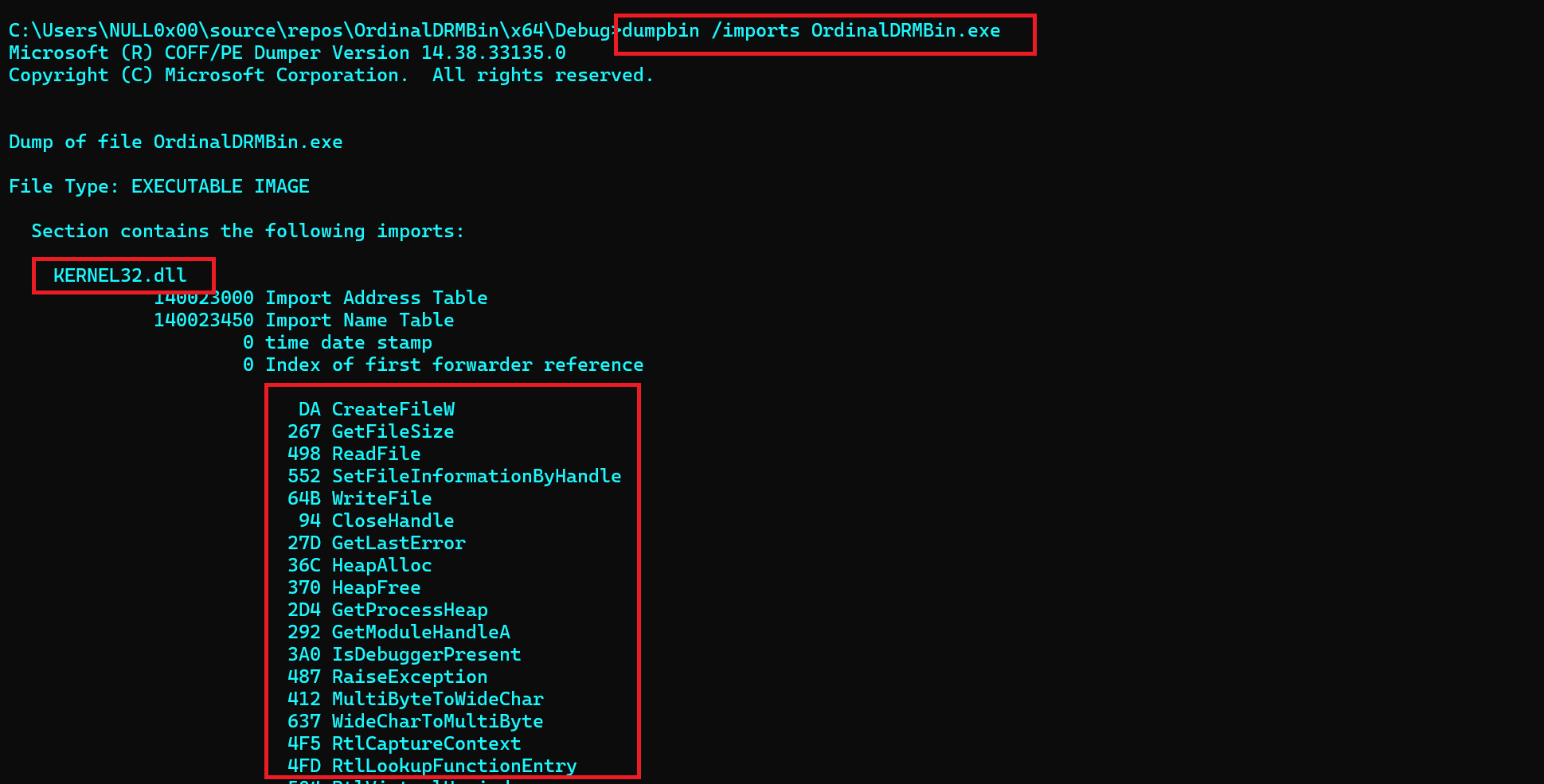
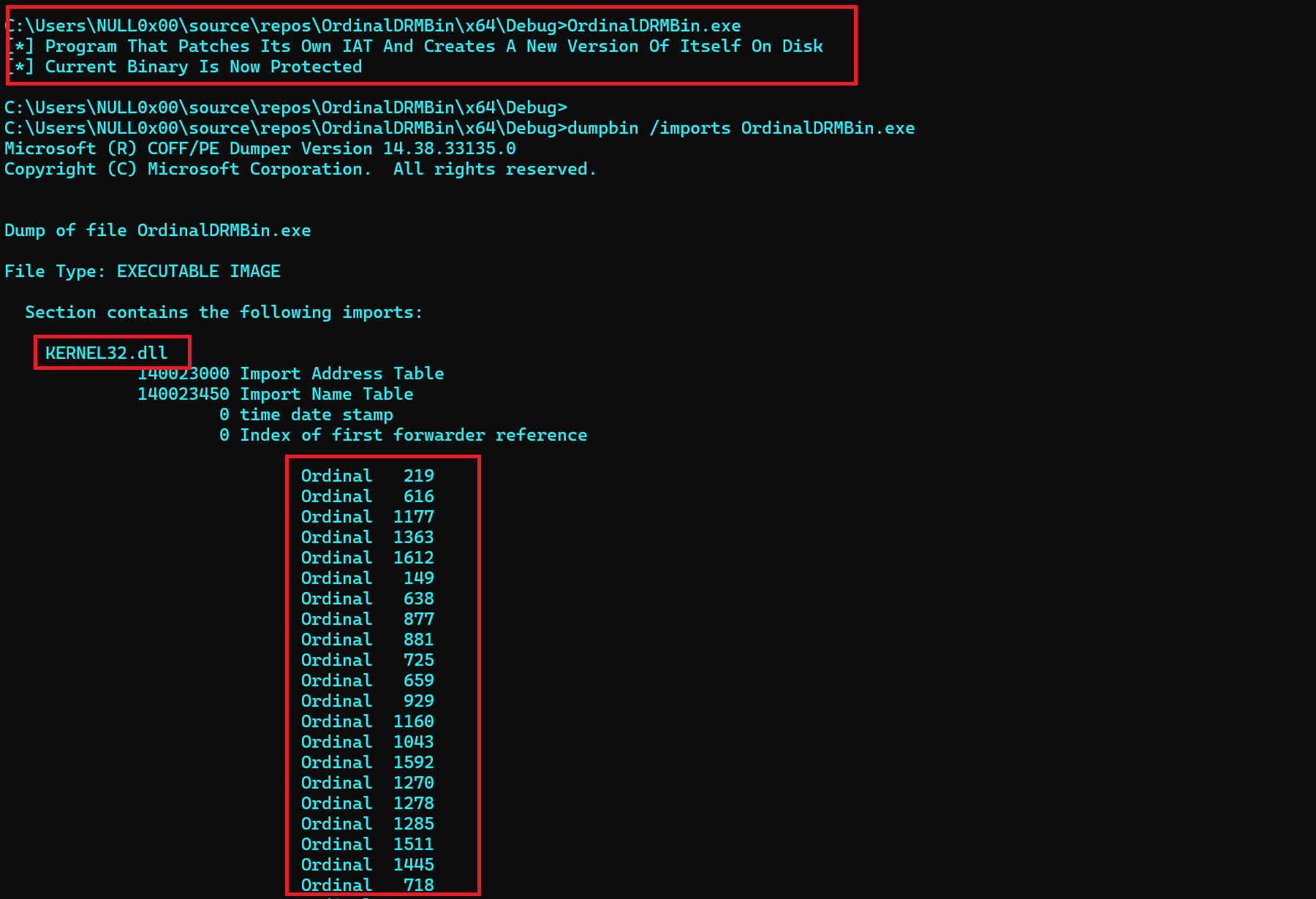
This project utilizes the DRM technique itself when first executed. This means that this binary cannot be executed on other machines as easily. OrdinalDRMBin.exe applies the following steps:

  1. Checks if the local program has any name-imported functions, if no, it will skip applying the IAT patch.

  2. Read itself from the disk, and convert all of the name-imported functions to be ordinal-imported.

  3. Delete itself from disk.

  4. Write the new image where all the functions are imported by ordinal.

  • The image below shows OrdinalDRMBin.exe without being executed. Notice the functions are imported by name. DRM 3

  • The image below shows OrdinalDRMBin.exe after being executed. Notice the functions are now imported by their ordinals. DRM 4
Note

As mentioned, systems with the exact ordinal values for all of the imported functions of the generated implementation will be able to run the protected binary. However, the chances of this happening can be reduced by importing functions from different DLLs. The same approach used in the IAT Camouflage module can be used for this purpose.


Download Tool





