Answer 'am I exposed to the Nginx HTTP/2 RCE?' in one command — check your nginx version and HTTP/2 config against CVE-2026-123007 / CVE-2026-123633 (disclosed 2026-11-18, CVSS 9.2).

Answer "is my nginx exposed to the HTTP/2 RCE pair?" in 0.06 seconds — one command, zero network calls, zero dependencies.
A stdlib-only Python CLI that checks the two things that decide whether a host is exposed to CVE-2026-123007 and CVE-2026-123633: the nginx version, and whether HTTP/2 is enabled in the config. A real check takes a median 0.062 s (7 runs, measured 2026-11-19 on this machine) — faster than opening the advisory page. No payloads, no network scanning, no exploit code: a defensive checker only.
On 2026-11-18, Wiz, Ikotas Labs, Metnir, Rapid7 and Xint disclosed two unauthenticated remote code execution flaws in nginx's HTTP/2 handling — CVE-2026-123007 (integer underflow in HTTP/2 flow control) and CVE-2026-123633 (HTTP/2 use-after-free on proxy connections). Both are CVSS 4.0 9.2 (CVSS 3.1 8.1); nginx.org rates 123007 "major" and 123633 "medium". The story hit Hacker News #1 on 2026-11-19 (~1,152 points), and nginx powers 225M+ websites — so the patch window is measured in hours, not weeks.
What was verified from the sources below:
http2 off is a stopgap for these two, not a substitute for upgrading.Sources: Wiz write-up · deploybase explainer · IFIN advisory summary · nginx.org security advisories
git clone https://github.com/Mahgal/nginx-http2-rce-check.git
cd nginx-http2-rce-check
python3 nginx_http2_check.py              # check this machine
No pip installs, no dependencies — Python 3 only. Try it without nginx installed:
python3 nginx_http2_check.py --demo      # labelled fixtures: 1 vulnerable, 1 patched
python3 nginx_http2_check.py --version 1.31.8 --config examples/nginx-http2-on.conf
python3 nginx_http2_check.py --version 1.30.7 --config examples/nginx-http2-on.conf
python3 nginx_http2_check.py --nginx-path examples/fake-nginx-vulnerable.sh --config examples/nginx-http2-on.conf
python3 nginx_http2_check.py --json      # machine-readable output for CI
Verified from a clean copy (fresh checkout in /tmp, 2026-11-19): --demo runs and the full test suite passes, 40/40, exit 0.
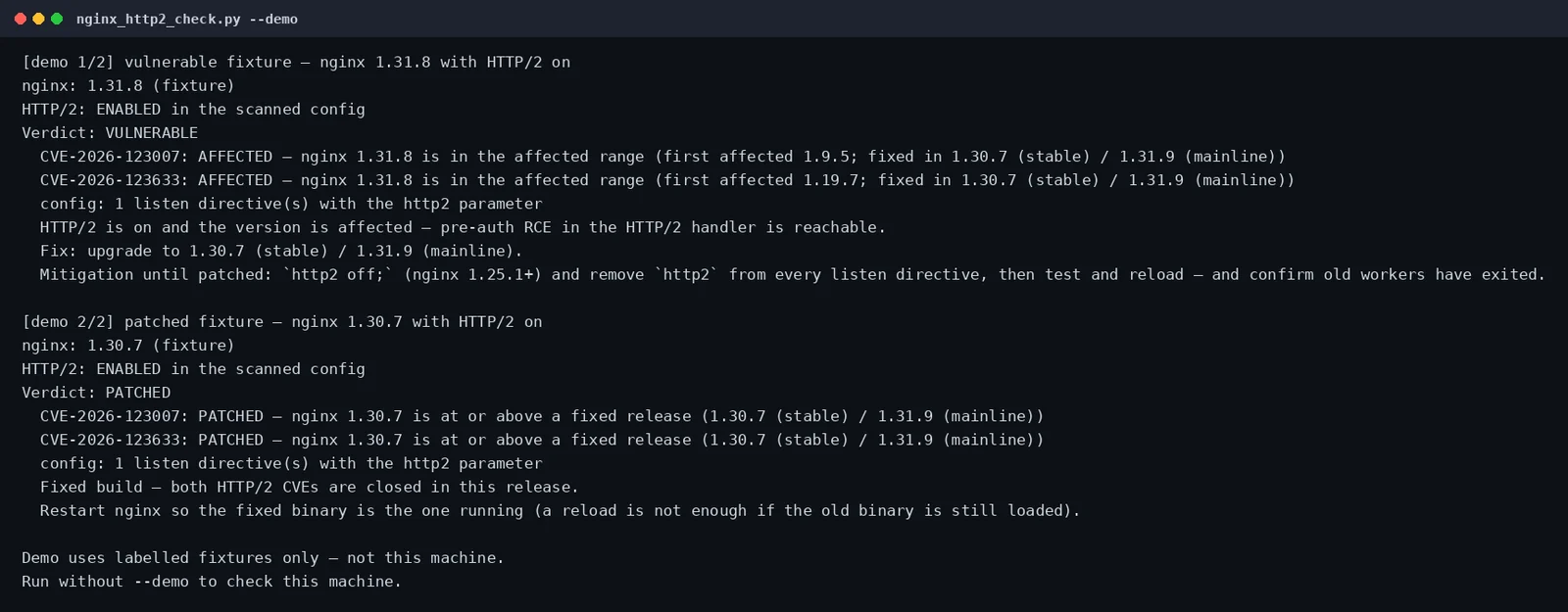
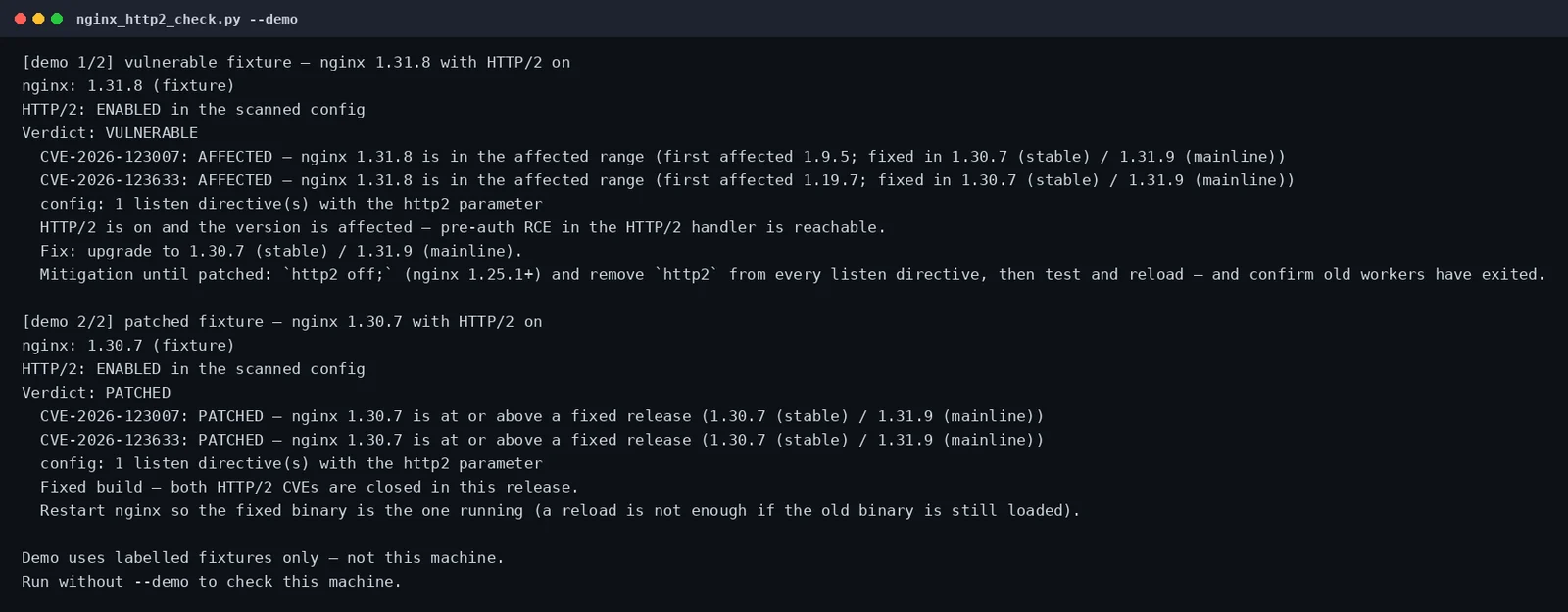
Real output of python3 nginx_http2_check.py --demo (captured verbatim to demo.txt; re-runs reproduce it byte-for-byte, sha256 e6a50babb87a98a704b802b3bbab6d5db6da256b45a45b9628ab1a930eae7f27):
[demo 1/2] vulnerable fixture — nginx 1.31.8 with HTTP/2 on
nginx: 1.31.8 (fixture)
HTTP/2: ENABLED in the scanned config
Verdict: VULNERABLE
  CVE-2026-123007: AFFECTED — nginx 1.31.8 is in the affected range (first affected 1.9.5; fixed in 1.30.7 (stable) / 1.31.9 (mainline))
  CVE-2026-123633: AFFECTED — nginx 1.31.8 is in the affected range (first affected 1.19.7; fixed in 1.30.7 (stable) / 1.31.9 (mainline))
  config: 1 listen directive(s) with the http2 parameter
  HTTP/2 is on and the version is affected — pre-auth RCE in the HTTP/2 handler is reachable.
  Fix: upgrade to 1.30.7 (stable) / 1.31.9 (mainline).
  Mitigation until patched: `http2 off;` (nginx 1.25.1+) and remove `http2` from every listen directive, then test and reload — and confirm old workers have exited.

[demo 2/2] patched fixture — nginx 1.30.7 with HTTP/2 on
nginx: 1.30.7 (fixture)
HTTP/2: ENABLED in the scanned config
Verdict: PATCHED
  CVE-2026-123007: PATCHED — nginx 1.30.7 is at or above a fixed release (1.30.7 (stable) / 1.31.9 (mainline))
  CVE-2026-123633: PATCHED — nginx 1.30.7 is at or above a fixed release (1.30.7 (stable) / 1.31.9 (mainline))
  config: 1 listen directive(s) with the http2 parameter
  Fixed build — both HTTP/2 CVEs are closed in this release.
  Restart nginx so the fixed binary is the one running (a reload is not enough if the old binary is still loaded).

Demo uses labelled fixtures only — not this machine.
Run without --demo to check this machine.
The same cases against real flags:
$ python3 nginx_http2_check.py --version 1.31.8 --config examples/nginx-http2-on.conf
Verdict: VULNERABLE        # exit 1 — HTTP/2 on, version affected
$ python3 nginx_http2_check.py --version 1.30.7 --config examples/nginx-http2-on.conf
Verdict: PATCHED           # exit 0 — same config, fixed build
$ python3 nginx_http2_check.py --version 1.31.8 --config examples/nginx-http2-off.conf
Verdict: NOT_AFFECTED      # exit 0 — HTTP/2 off closes both flaws
$ python3 nginx_http2_check.py --version 1.24.0-0ubuntu1 --config examples/nginx-http2-on.conf
Verdict: UNKNOWN           # exit 3 — distro package: version string says nothing
1.30.7 is fixed, but 1.31.0–1.31.8 are still vulnerable. A naive check — "version ≥ 1.30.7 means safe" — would call 1.31.8 safe. It is not. This tool compares against explicit per-branch ranges, never a plain numeric threshold:
| Version | CVE-2026-123007 | CVE-2026-123633 |
|---|---|---|
| < 1.9.5 | not affected | not affected |
| 1.9.5 – 1.19.6 | affected | not affected |
| 1.19.7 – 1.30.6 | affected | affected |
| 1.30.7 (stable fix) | patched | patched |
| 1.31.0 – 1.31.8 | affected | affected |
| 1.31.9+ / 1.32.0+ (mainline fix) | patched | patched |
| Verdict | Meaning |
|---|---|
VULNERABLE | Version is in an affected range and HTTP/2 is enabled in the scanned config. Upgrade now. |
PATCHED | Version is at or above a fixed release. Restart nginx so the fixed binary is the one running. |
NOT_AFFECTED | Either the version predates both flaws, or HTTP/2 is off in the scanned config. |
UNKNOWN | No nginx found, the version string could not be parsed, the build is a distro package (see below), the Plus train has no published fix, or the HTTP/2 state could not be determined while the version is affected. Do not assume safe. |
| Code | Meaning |
|---|---|
0 | PATCHED or NOT_AFFECTED |
1 | VULNERABLE — by design, so it works as a CI gate |
2 | Usage error (bad flag, unreadable --nginx-path / --config path) |
3 | UNKNOWN (this tool's own code — see Verdicts) |