jed-parsec/cve-2026-79397-authenticated-os-command-injection-in-ont-4ge-rfdw-ping-diagnostics
Advisory and proof of concept for an authenticated OS command injection in the ONT-4GE-RFDW web Ping diagnostics, exploitable via default superadmin credentials.

An authenticated OS command injection vulnerability exists in the Ping diagnostic tool of the ONT-4GE-RFDW's web management interface. A user authenticated as superadmin can inject arbitrary OS commands through the host/IP input field, resulting in command execution on the underlying operating system.
This issue is significantly compounded by the fact that the superadmin account ships with default credentials (superadmin:superadmin). As a result, any attacker with network access to the management interface can trivially obtain the privilege level required to exploit this vulnerability, reducing the practical barrier to exploitation to near zero on devices left at factory defaults.
superadmin (a default account shipped with default credentials superadmin:superadmin)ping command) without adequate input sanitization or validation. This allows shell metacharacters such as ; to be used to terminate the intended command and append arbitrary attacker-controlled commands, which are then executed with the privileges of the web management process.Impact: An attacker who authenticates using the default superadmin credentials can execute arbitrary commands on the device's underlying OS. This could lead to:
Combined with the default-credential issue, this significantly lowers the barrier to exploitation for any device left on default settings, turning what would normally require a prior compromise or credential theft into a zero-effort attack chain.
Base Score: 7.1 (High)
Vector: CVSS:3.1/AV:N/AC:L/PR:H/UI:N/S:U/C:H/I:H/A:H
| Metric | Value | Rationale |
|---|---|---|
| Attack Vector (AV) | Network (N) | Exploited remotely over the network via the device's web management interface |
| Attack Complexity (AC) | Low (L) | No special conditions beyond submitting a crafted HTTP request; the payload is trivial and reliable |
| Privileges Required (PR) | High (H) | CVSS scores the privilege level required by the vulnerability itself, which is the highest privilege tier (superadmin) on the device |
| User Interaction (UI) | None (N) | No interaction from any user other than the attacker is required |
| Scope (S) | Unchanged (U) | The impact is contained to the vulnerable component/device itself; scope change is not scored here, though real-world LAN pivoting is noted separately as an impact consideration |
| Confidentiality (C) | High (H) | Arbitrary command execution allows full read access to stored credentials and configuration |
| Integrity (I) | High (H) | Arbitrary command execution allows full modification of device state/configuration |
| Availability (A) | High (A) → High (H) | Arbitrary command execution allows denial of service or bricking of the device |
Important note on real-world risk vs. base score: The CVSS Privileges Required metric reflects that superadmin-level access is technically required to reach the vulnerable function. This is why PR is scored as High rather than None. However, this does not reflect real-world exploitability on affected devices. Because superadmin:superadmin is a default, unchangeable-by-policy credential pair shipped on the device, the effective barrier to exploitation for an unconfigured or factory-default device is equivalent to an unauthenticated vulnerability. Organizations should treat the practical risk of this issue as closer to Critical on any device where default credentials have not been changed.
Log in to the ONT-4GE-RFDW's web management interface using the default superadmin:superadmin credentials.
Navigate to Diagnostics → Ping.
In the "Host Address" field, enter a payload that appends an OS command after the expected IP/hostname input, for example:
127.0.0.1;id
Submit the form (the WAN Interface field can be left at its default value, e.g. Any).
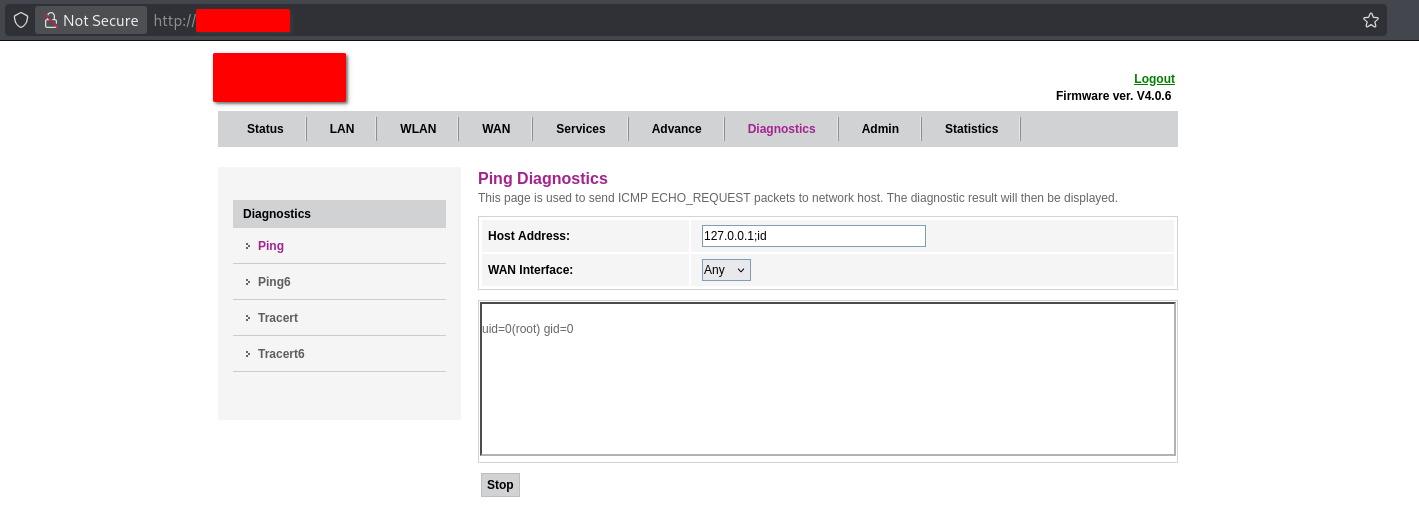
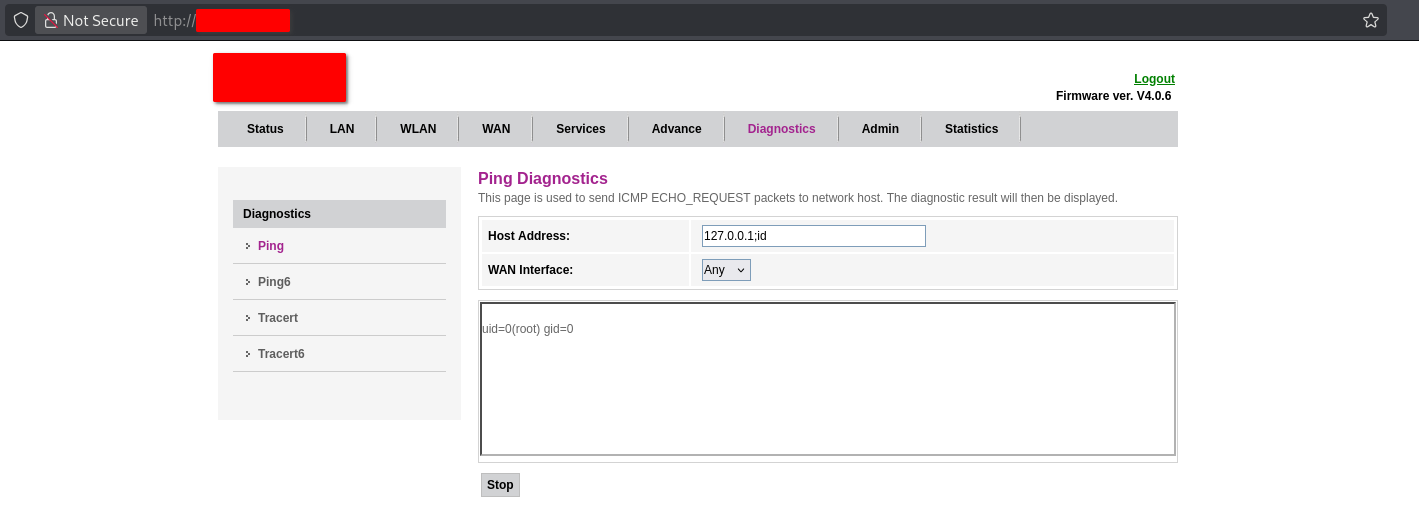
Observe the diagnostic output panel. Instead of (or in addition to) standard ping output, the result of the injected command is displayed — for example:
uid=0(root) gid=0
This confirms that arbitrary OS commands are executed on the underlying operating system with root-level privileges, triggered entirely through the web-exposed Ping diagnostic field.
Screenshot:
Screenshot showing the Ping Diagnostics page with the payload
127.0.0.1;idsubmitted in the Host Address field, and the resulting command output (uid=0(root) gid=0) displayed in the diagnostic result panel.
Other commands can be substituted after the ; separator to demonstrate further impact (e.g., cat /etc/passwd, reading configuration files, or establishing outbound connections), subject to the constraints of the device's underlying shell environment and available binaries.
| Impact area | Description |
|---|---|
| Confidentiality | Full disclosure of device configuration, stored credentials, and any sensitive data accessible to the OS process |
| Integrity | Full ability to modify device configuration, firmware behavior (where writable), and network settings |
| Availability | Ability to disrupt or disable device functionality, including bricking the device via destructive commands |
| Lateral movement | The device sits at the network edge (ONT/router role), making it a high-value pivot point into the connected LAN |
| Barrier to exploitation | Effectively negligible on any device using default superadmin credentials, which is the out-of-box configuration |
Discovered by: PL41NT3XT (FX3ND)