
Skip to content
KitploitKITPLOIT
ToolsExploitsBlog
Log in
Submit
ToolsExploitsBlog
Submit

Hacking, PenTest, and Cybersecurity Tools for Your Security Arsenal!

Kitploit is a directory of hacking, cybersecurity, and pentesting tools. Discover the latest project updates to find vulnerabilities, analyze systems, automate testing, and strengthen your security.

FeedsContactPrivacy© 2026 Kitploit

Tool Directory

Categories

View all categories
Loading categories
Tools/GitHubGitHub/filipi86/cve-2024-6387-vulnerability-checker
Vulnerability ScannersExploitationNetwork Security
GitHubfilipi86/cve-2024-6387-vulnerability-checker

CVE-2024-6387-Vulnerability-Checker

This Python script checks for the CVE-2024-6387 vulnerability in OpenSSH servers. It supports multiple IP addresses, URLs, CIDR ranges, and ports. The script can also read addresses from a file.

View Repository
10218272 years agoReviewed by Kitploit
Share

CVE-2024-6387 Vulnerability Checker

Overview

This Python script is designed to check SSH servers for the CVE-2024-6387 vulnerability, specifically targeting the recently discovered regreSSHion, which is associated with specific versions of OpenSSH. The tool supports multiple IP addresses, URLs, CIDR ranges, and ports, and can also read addresses from a file. The results are displayed in a categorized and color-coded manner for better readability.

regreSSHion

Features

  • Customizable: Specify multiple IP addresses, URLs, CIDR ranges, and ports.
  • File Input Support: Read addresses and ranges from a file.
  • Color-Coded Output: Easily distinguish between vulnerable, safe, unknown, and error results.
  • Network Range Handling: Automatically expands CIDR ranges into individual IP addresses.

Output

  • SAFE: Non-vulnerable servers.
  • VULNERABLE: Servers running a vulnerable version of OpenSSH.
  • UNKNOWN: Servers with an unknown SSH version.
  • ERROR: Servers that could not be accessed or resolved.

Usage

Command Line

To run the script with multiple IPs, URLs, or CIDR ranges directly from the command line:

python3 CVE-2024-6387-Vulnerability-Checker.py <addresses> -p <ports> -t <timeout> 
  • addresses: IP addresses, URLs, or CIDR ranges to check (space-separated).

  • -p, --ports: Comma-separated list of port numbers for SSH (default: 22).

  • -t, --timeout: Connection timeout in seconds (default: 5.0).
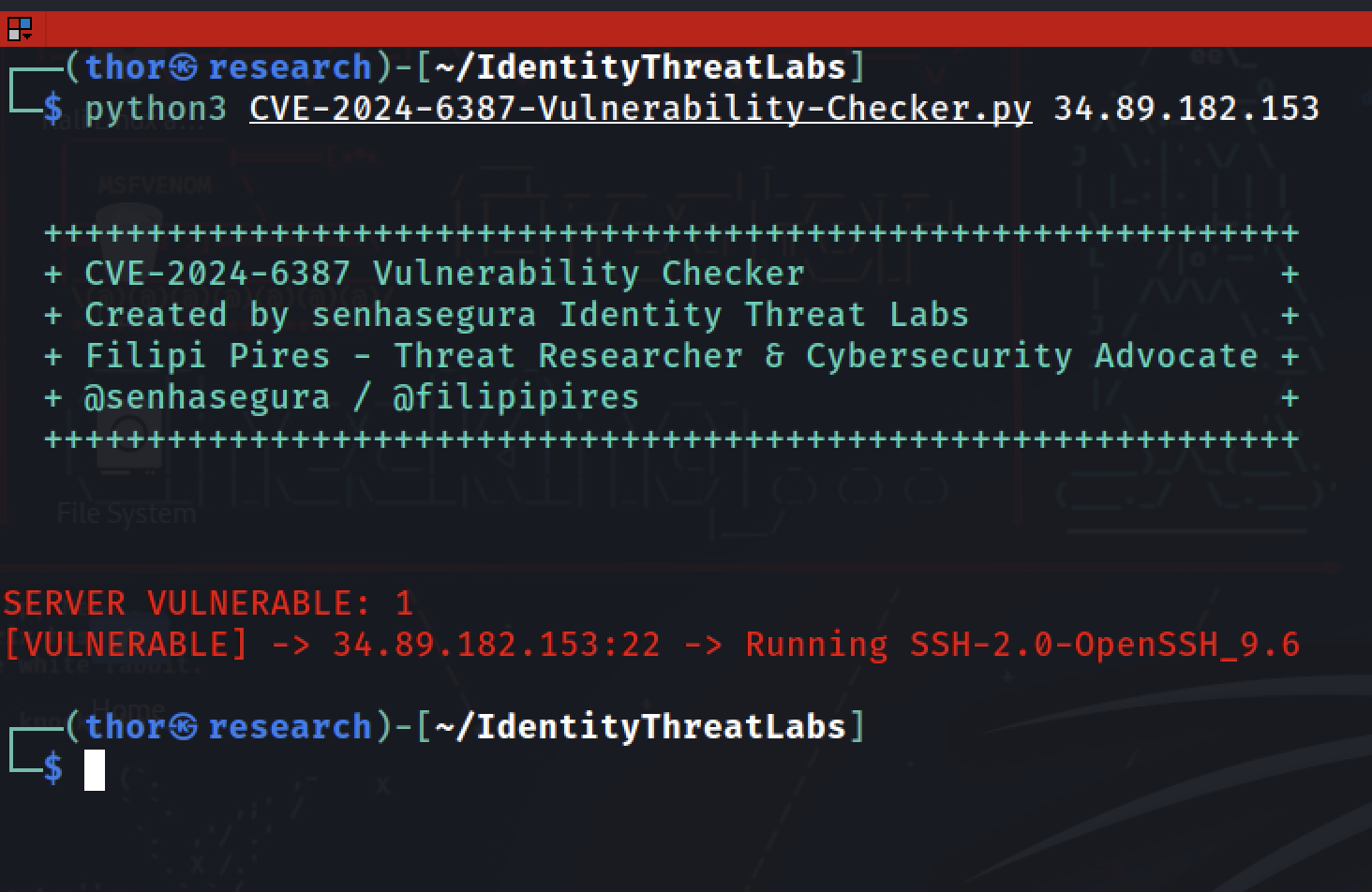
image

From a File

To run the script with addresses specified in a file:

python3 CVE-2024-6387-Vulnerability-Checker.py -f <filename> -p <ports> -t <timeout>
  • filename: File containing a list of IP addresses or CIDR ranges.
image

Example Usage

To check multiple IPs, URLs, or CIDR ranges directly from the command line:

python3 CVE-2024-6387-Vulnerability-Checker.py 192.168.1.1 192.168.1.2 192.168.1.0/24 example.com -p 22,2222 -t 5.0
  • To check addresses from a file:
python3 CVE-2024-6387-Vulnerability-Checker.py -f addresses.txt -p 22,2222 -t 5.0

Example addresses.txt file:

192.168.1.1
example.com
192.168.1.0/24

Contributing

Contributions are welcome! Please follow these steps to contribute:

1. Fork the Repository: Click the "Fork" button at the top right of this page.

2. Clone Your Fork: Clone your forked repository to your local machine:

git clone https://github.com/YOUR_USERNAME/CVE-2024-6387-Vulnerability-Checker.git
cd CVE-2024-6387-Vulnerability-Checker

3. Create a Branch: Create a new branch for your feature or bugfix.

git checkout -b my-feature-branch

4. Make Changes: Make your changes to the code.

5. Commit Your Changes: Commit your changes with a descriptive commit message.

git add .
git commit -m "Description of the changes"

6. Push Your Branch: Push your branch to your forked repository.

git push origin my-feature-branch

7. Create a Pull Request: Go to the original repository on GitHub, and click "New Pull Request". Select your branch from the compare dropdown, and submit your pull request.


Launch

[July 09th-2024]

  • First Version - Launch

References

Qualys's Blog - regreSSHion: Remote Unauthenticated Code Execution Vulnerability in OpenSSH server


Download Tool

Most Popular

View all →

Discover the most used tools by our community.

  • 1

    OsintHunter

    letox4/osinthunter

    🎯 The ultimate OSINT toolkit: investigation graph, confidence scoring, alias families, map, timeline and reports. 49 modules, 400+ sites, no API keys required.

    851
  • 2

    ghostlock-app

    yukonga/ghostlock-app

    GhostLock One-Tap Execution App (CVE-2026-43499)

    538
  • 3

    ARTEX

    baarai/artex

    LLM multi-agent autonomous penetration testing platform with planner/worker agents, asset and exploration graphs, MITM traffic recording, and vulnerability retesting.

    420
  • 4

    redforge

    cybersecurity91/redforge

    Browser-side red team toolkit with 102 offline tools for recon, payload generation, credential attacks, crypto, encoding and engagement reporting.

    357
  • 5

    looking-glass

    anonghosty/looking-glass

    CSIRT platform that ingests Shadowserver reports into MongoDB and replays them as interactive maps, analysis, findings, advisories and executive dashboards.

    297
  • 6

    CyberStrikeAI

    ed1s0nz/cyberstrikeai

    The system of action for AI-native cybersecurity—where intent becomes governed execution, evidence becomes operational memory, and every operation improves the next.

    280

Explore all tools

Browse our collection of tools

View all tools →




