
Skip to content
KitploitKITPLOIT
ToolsExploitsBlog
Log in
Submit
ToolsExploitsBlog
Submit

Hacking, PenTest, and Cybersecurity Tools for Your Security Arsenal!

Kitploit is a directory of hacking, cybersecurity, and pentesting tools. Discover the latest project updates to find vulnerabilities, analyze systems, automate testing, and strengthen your security.

FeedsContactPrivacy© 2026 Kitploit

Tool Directory

Categories

View all categories
Loading categories
CVE-2026-120232-RUST-POC — Rust proof-of-concept demonstrating local privilege escalation to SYSTEM via the shield.sys driver in Horizon DataSys Reboot Restore Standard (CVE-2026-120232). | Kitploit
Tools/GitHubGitHub/element2023h/cve-2026-120232-rust-poc
Privilege EscalationVulnerability AnalysisExploitationRed Teaming
GitHubelement2023h/cve-2026-120232-rust-poc

CVE-2026-120232-RUST-POC

Rust proof-of-concept demonstrating local privilege escalation to SYSTEM via the shield.sys driver in Horizon DataSys Reboot Restore Standard (CVE-2026-120232).

View Repository
Share
19 days agoNot yet reviewed

中文 | EN

CVE-2026-120232 Logo

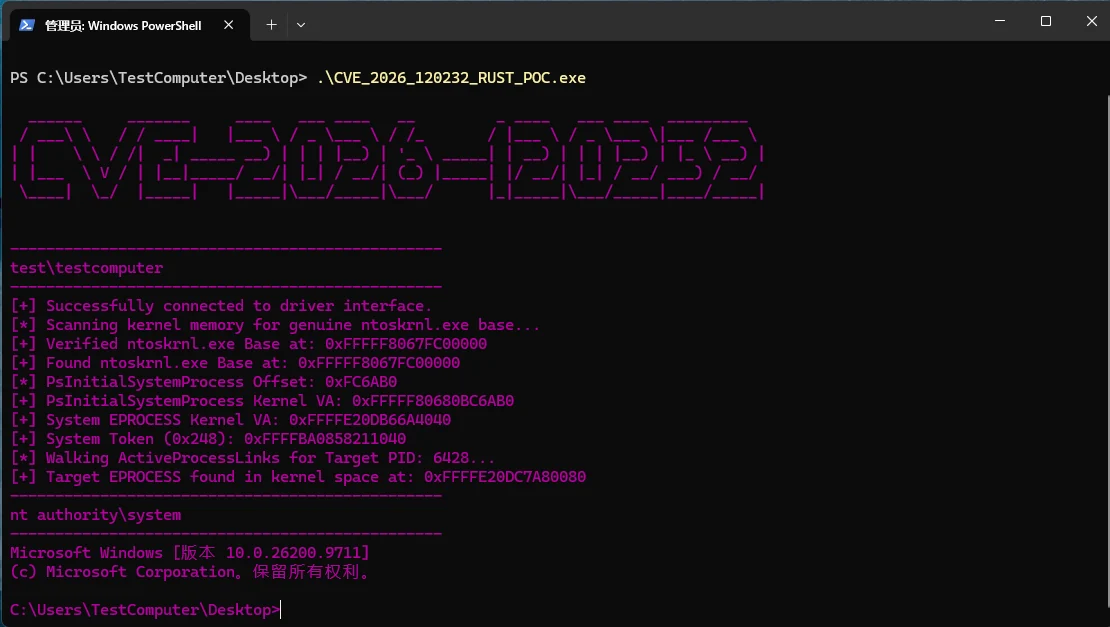
POC demonstration

CVE-2026-120232 Rust POC

A Windows security research demonstration written in Rust, showcasing the local privilege escalation (LPE) impact associated with CVE-2026-120232.

Overview

The upstream research report describes a security issue involving the shield.sys driver in Horizon DataSys Reboot Restore Standard v13.2 and earlier. This project is a Rust implementation based on that research and demonstrates how, in a specific vulnerable environment, a local unprivileged user may be able to elevate privileges to SYSTEM.

The project is written in Rust and uses windows-sys to call Windows APIs and crossterm for terminal output. The source code identifies Windows 11 build 26200 as the test environment. Behavior may vary depending on the Windows version, installed patches, driver version, and system configuration.


Responsible Use

  • Use this project only for security research in an isolated environment that you own or are explicitly authorized to test.
  • Do not run it on production systems or devices without authorization.
  • This project demonstrates security impact; it is not a remediation. Keep affected software updated and follow the vendor's security guidance.
  • You are responsible for assessing and accepting the risks of any testing.

References

  • Upstream research and original POC (CVE-2026-120232)
Download Tool

Most Popular

View all →

Discover the most used tools by our community.

  • 1

    OsintHunter

    letox4/osinthunter

    🎯 The ultimate OSINT toolkit: investigation graph, confidence scoring, alias families, map, timeline and reports. 49 modules, 400+ sites, no API keys required.

    985
  • 2

    ghostlock-app

    yukonga/ghostlock-app

    GhostLock One-Tap Execution App (CVE-2026-43499)

    571
  • 3

    looking-glass

    anonghosty/looking-glass

    CSIRT platform that ingests Shadowserver reports into MongoDB and replays them as interactive maps, analysis, findings, advisories and executive dashboards.

    354
  • 4

    redforge

    cybersecurity91/redforge

    Browser-side red team toolkit with 102 offline tools for recon, payload generation, credential attacks, crypto, encoding and engagement reporting.

    341
  • 5

    ARTEX

    baarai/artex

    LLM multi-agent autonomous penetration testing platform with planner/worker agents, asset and exploration graphs, MITM traffic recording, and vulnerability retesting.

    324
  • 6

    CyberStrikeAI

    ed1s0nz/cyberstrikeai

    The system of action for AI-native cybersecurity—where intent becomes governed execution, evidence becomes operational memory, and every operation improves the next.

    309

Explore all tools

Browse our collection of tools

View all tools →