
 completetech-security/sonicwall-sma1000-cve-2026-102256-check
Offline SonicWall SMA1000 evidence checker for CVE-2026-102256. Reported build and configuration evidence. Standalone Python; JSON/CSV/HTML reports; no exploit payloads.





Offline, version-only triage for CVE-2026-102256: SonicWall SMA1000 (models 6210, 7210 and 8200v) authenticated remote code execution. The checker compares operator-supplied build strings and inventories with the vendor's published version table and reports one of three statuses per asset. It never contacts a target, sends exploit payloads or tests exploitability.
Missing, qualified, custom, conflicting and uncovered evidence stays unknown, and unknown is never a clean result.
623862394d2de9e360a4c3c29e8e47105e3b71a8, and no other checker is required at runtime.# Assess a single reported build
python sonicwall_sma1000_cve_2026_102256_check.py --version 12.4.3-03526
# Assess the synthetic inventory and write an HTML report
python sonicwall_sma1000_cve_2026_102256_check.py --inventory examples/inventory.example.json --format html --output report.html
# Show all options and exit statuses
python sonicwall_sma1000_cve_2026_102256_check.py --help
# Run the local-only tests
python -m unittest -v
The synthetic inventory deliberately includes findings and unknowns, so its example command exits 1.
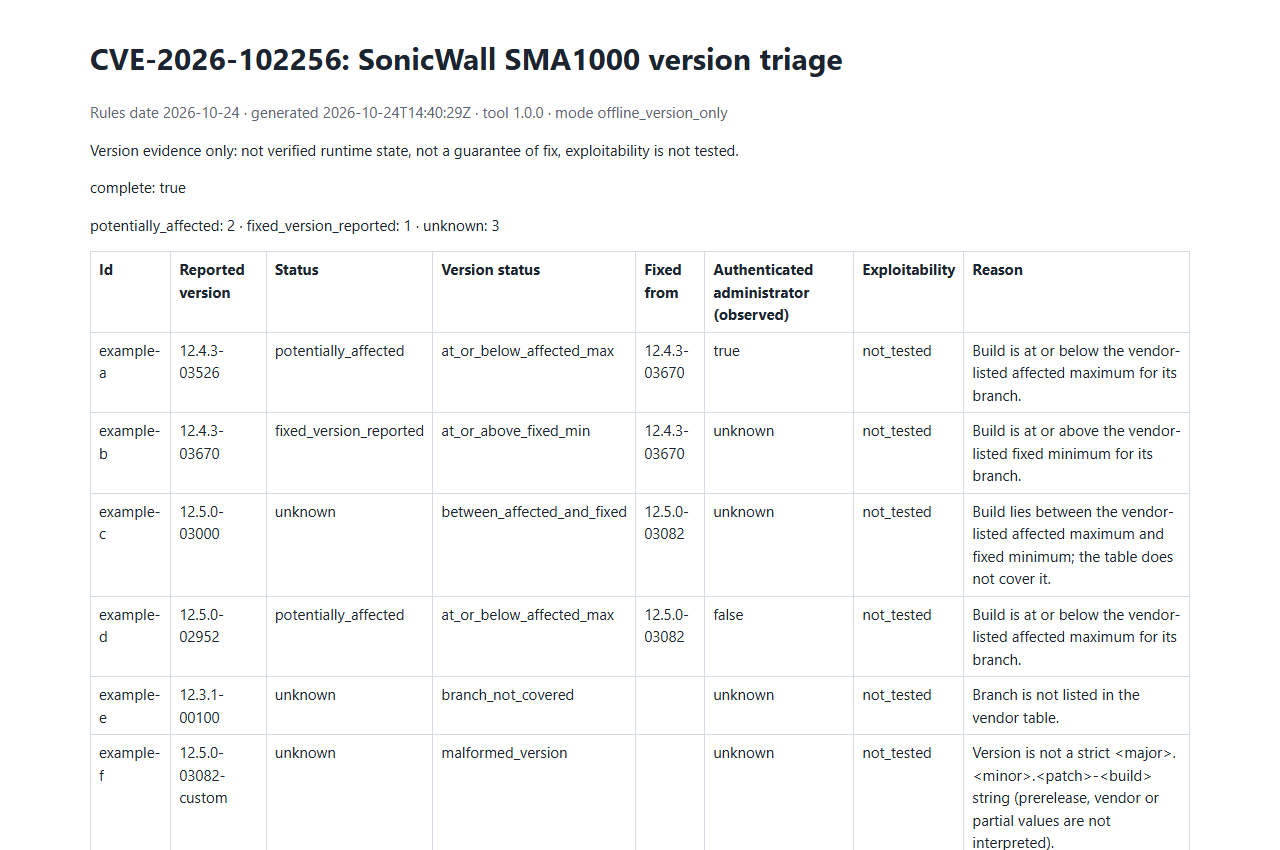
Open the synthetic example report. Example data only; this is not a live assessment.
| Branch | Affected through | Fixed from |
|---|---|---|
| 12.4.3 | 12.4.3-03526 | 12.4.3-03670 |
| 12.5.0 | 12.5.0-02952 | 12.5.0-03082 |
Comparison is by build number within the exact branch, for SMA1000 models 6210, 7210 and 8200v. Builds in the gap between the two bounds, other branches and every unparsable value are unknown.
| Option | Purpose |
|---|---|
--version BUILD | Reported build in <major>.<minor>.<patch>-<build> form (repeatable). |
--branch, --model | Optional branch cross-check and model (6210, 7210, 8200v) applied to --version values. A disagreeing branch or an uncovered model gives unknown. |
--authenticated-administrator true|false|unknown | Operator observation recorded with the result; it never changes the version assessment. |
--inventory FILE | JSON inventory (object or array, schema_version: 1; repeatable). |
--csv-list FILE | CSV list with a version header column (repeatable). |
--format json|csv|html | Report format; json is the default. HTML is script-free. |
--output FILE | Write the report to a file instead of stdout. Existing files are not overwritten unless --force is given. |
--force | Allow --output to overwrite an existing file. |
--strict | Treat unknown results as findings for the exit status. |
Input and output rules worth knowing:
--force; use a new output path. Without --force, publication never overwrites a destination that appears mid-run.', every cell is quoted, and CSV rejects NUL characters before writing a report.The full reference specifies the inventory schema, CSV input, boolean values, boundary semantics, bounds and no-clobber output.
JSON, CSV and HTML share the same assessments.
status | Meaning |
|---|---|
potentially_affected | At or below the listed affected maximum for a listed branch. Not confirmed exploitability. |
fixed_version_reported | At or above the listed fixed minimum. Not a guarantee of patch state. |
unknown | Everything else. Never safe. |
exploitability is always not_tested.authenticated_administrator observation is operator-supplied. It is not proof of reachability or effective configuration.version_status, fixed_version, reason, remediation, evidence_type, evidence_confidence and source_url; the report carries schema_version, rules_date, sources, a notice and complete. See the reference for the full list of version_status values.record_type=result rows are asset observations. If no asset completed, a record_type=summary row preserves completeness, schema, rule date, CVE and not_tested without inventing a finding.tool, tool_version and generated_at after the existing columns, including external KEV fields. Every result and empty or interrupted summary copies these values from the canonical report. Existing column positions and formula escaping are preserved.generated_at is the UTC time the assessment was generated. It is not evidence acquisition time, an advisory review date or deployed-patch attestation.





