
 completetech-security/node-cve-2026-58041-check
Offline Node.js evidence checker for CVE-2026-58041: SQLite cached iterator write replay. Single-file Python; JSON/CSV/HTML reports; no exploit payloads.






Offline version-evidence checker for CVE-2026-58041 — Node.js: SQLite cached iterator write replay.
The checker compares operator-reported Node.js runtime versions with the fixed releases in a dated rule snapshot (reviewed 2026-10-24). It never contacts websites, executes Node.js or project code, or sends exploit payloads, and there is no network mode. Hidden versions, custom builds, conflicting evidence, and uncovered branches remain unknown. A public URL is not an inventory.
Results are triage evidence, not a runtime assessment: every result has exploitability: not_tested, and no deployed-target assessment, runtime attestation or exploit verification is claimed.
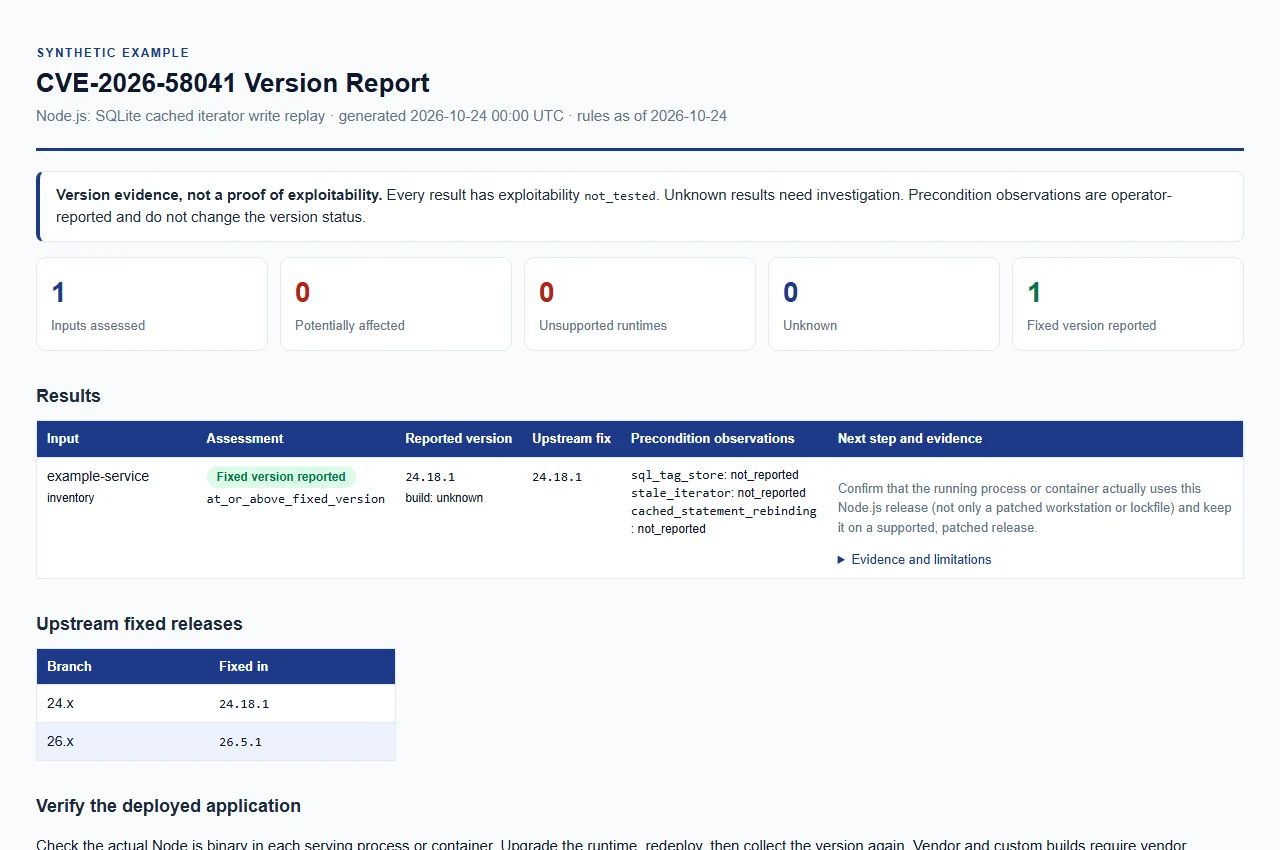
Open the synthetic example report. Example data only; this is not a live assessment.
node_cve_2026_58041_check.py can be copied alone.python node_cve_2026_58041_check.py --version 24.18.1 --format json
Without --format, the report is CSV. Output goes to stdout unless --output is given.
# Several runtimes at once (each --version is a separate runtime)
python node_cve_2026_58041_check.py --version 24.18.1 --version 26.5.0 --format json
# JSON inventory to an HTML report file
python node_cve_2026_58041_check.py --inventory examples/inventory.example.json --format html --output report.html
# CSV inventory; exit 1 if any result is a finding
python node_cve_2026_58041_check.py --csv-list inventory.csv --fail-on-finding
# Help and local synthetic tests
python node_cve_2026_58041_check.py --help
python -m unittest -v
At least one of --version, --inventory or --csv-list is required. All three can be combined and each can be repeated; every --version value describes a separate runtime. JSON, CSV and HTML reports are built from the same evidence.
| Option | Purpose |
|---|---|
--version VERSION (alias --node-version) | Assess an explicitly supplied Node.js version offline; a leading v is accepted. Repeatable. |
--build-source SOURCE | Provenance of the --version builds, at most 512 characters. Default unknown, which is compared as upstream. upstream, official and official_upstream are also treated as upstream; any other value (such as a vendor name) yields vendor_build_unverified. |
--sql-tag-store, --stale-iterator, --cached-statement-rebinding | Operator observation (true or false) applied to the --version inputs. See Interpreting results. |
--inventory FILE | JSON object or array of entries. Repeatable. |
--csv-list FILE | CSV with a node_version column. Repeatable. |
--format csv|json|html | Report format. Default csv. |
--output FILE | Write the report to a new file instead of stdout. The directory must already exist. |
--force | Replace an existing output file. Inputs can never be overwritten, even with --force. |
--brand NAME | Organization name shown in the HTML report, at most 512 characters. Default CompleteTech LLC. |
--fail-on-finding | Exit 1 when any result is potentially_affected or unsupported_runtime. |
--tool-version, --help | Print the tool version or the help text. |
Existing report files are protected unless --force is explicit.
Reviewed 2026-10-24 against the official release advisory and linked fixed releases. These are versions the vendor reports as fixed; the checker cannot verify that a given deployment actually runs them.
| Node.js major | Fixed version |
|---|---|
| 24.x | 24.18.1 |
| 26.x | 26.5.1 |
How versions are classified:
potentially_affected and require remediation.fixed_version_reported.unknown; a newer or unlisted major is not assumed to be patched.unsupported_runtime as upgrade guidance, not as a claim that this particular flaw exists in every historical build. End-of-life is taken from the Node.js release schedule (https://raw.githubusercontent.com/nodejs/Release/main/schedule.json, reviewed 2026-10-24).unknown. Do not label unknown builds safe.The sources disagree about Node.js 22.x, and the conflict is unresolved:
vuln/core/190.json lists vulnerable 24.x || 26.x and patched ^24.18.1 || ^26.5.1, but its overview text says it affects 22.x, 24.x and 26.x.<=22.23.1, <=24.18.0 and <=26.5.0.No 22.x fixed version is asserted for this CVE, so 22.x is deliberately not listed as affected or fixed and must stay unknown unless explicit evidence is obtained.






