 completetech-security/node-cve-2026-105483-check
Offline Node.js evidence checker for CVE-2026-105483: TLS fullwidth-IP hostname validation bypass. Single-file Python; JSON/CSV/HTML reports; no exploit payloads.





Offline evidence checker for CVE-2026-105483 — Node.js: TLS fullwidth-IP hostname validation bypass. It compares Node.js versions that you report against the fixed releases named in the official Node.js advisory. Python 3.10+, standard library only; the executable is a single file and can be copied on its own.
Scope. The checker compares operator-reported runtime versions. It never contacts websites, executes Node.js or project code, or sends exploit payloads, and it does not scan the current machine. Hidden versions, custom builds, conflicting evidence, and uncovered branches remain unknown. A public URL is not an inventory. No result is an exploit test, a deployed-patch attestation, or a production verification.
Requires Python 3.10 or newer and nothing else. Supply an exact version obtained from the deployed process (for example, from the running binary or container, not a workstation):
python node_cve_2026_105483_check.py --version 24.22.1 --format json
python node_cve_2026_105483_check.py --inventory examples/inventory.example.json --format html --output report.html
python node_cve_2026_105483_check.py --csv-list inventory.csv --fail-on-finding
python node_cve_2026_105483_check.py --help
python -m unittest -v
--version (alias --node-version) is repeatable; each value describes a separate runtime. A leading v is accepted.--inventory FILE (JSON) and --csv-list FILE (CSV) are repeatable and can be combined with --version.--format is csv (default), json, or html. Without --output, the report goes to stdout.--build-source SOURCE states the provenance of the --version builds (default unknown, compared as upstream; upstream, official, or a vendor name).--tls-client, --untrusted-nonascii-ip-host and --trusted-numeric-dns-certificate each take true or false and apply to every --version input. See Interpreting results.--output FILE writes a new file. An existing report is protected unless --force is explicit, and an input file can never be overwritten, even with --force.--brand NAME sets the organization name in the HTML report (default CompleteTech LLC, at most 512 characters).--fail-on-finding makes potentially_affected and unsupported_runtime results exit 1.--tool-version prints the tool name and version.JSON, CSV and HTML reports are built from the same evidence. At least one of --version, --inventory or --csv-list is required.
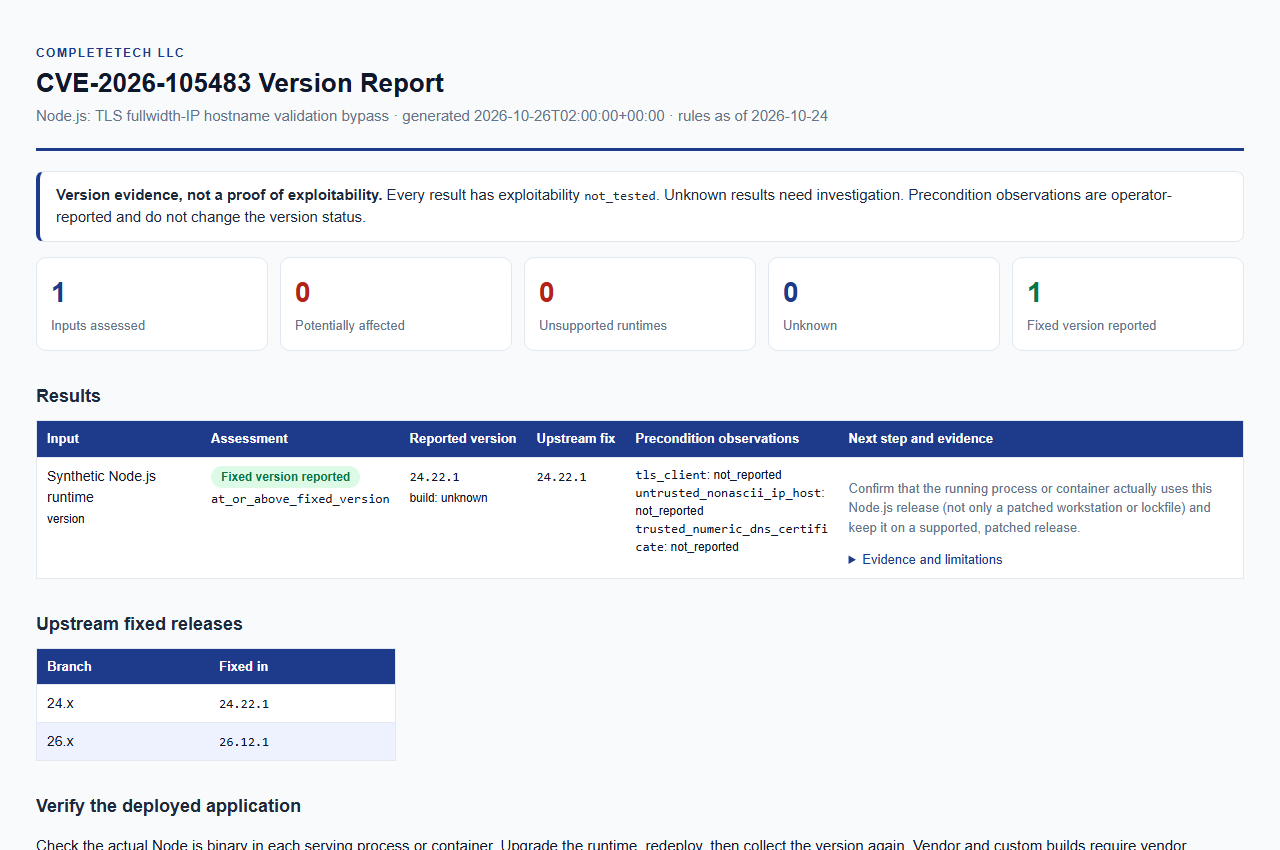
Open the synthetic example report. Example data only; this is not a live assessment.
Reviewed 2026-10-24 against the official release advisory and the linked fixed releases.
| Node.js major | Fixed version |
|---|---|
| 24.x | 24.22.1 |
| 26.x | 26.12.1 |
The vendor does not specify an introduced version in the release advisory. How a reported version is classified:
potentially_affected. These versions require remediation.fixed_version_reported.unsupported_runtime. This is upgrade guidance, not a claim that this particular flaw exists in every historical build. End-of-life status follows the Node.js release schedule reviewed 2026-10-24.unknown; they are not assumed to be patched.unknown; they need explicit evidence.--build-source or inventory build_source other than blank, unknown, upstream, official or official_upstream): unknown. They need vendor evidence, because fixes may be backported and the upstream version does not show which patches a build contains.unknown. Missing metadata does not establish that a runtime is unaffected.Unknown builds must never be labeled safe.
status | Meaning |
|---|---|
potentially_affected | The reported version is below the fixed release of its major and needs remediation review. |
fixed_version_reported | The reported version is at or above the fixed release. This is not deployed-patch attestation: confirm that the running process or container actually uses that release, not only a patched workstation or lockfile. |
unsupported_runtime | The major is past end-of-life. Upgrade guidance, not proof that the flaw is present. |
unknown | Missing, conflicting, qualified, vendor/custom-build, or uncovered evidence. |
Each result also carries a more specific version_status (for example below_fixed_version, at_or_above_fixed_version, unsupported_release_line, release_line_not_in_rules, qualified_version_unverified, vendor_build_unverified, conflicting_versions, unrecognized_or_partial_version, version_not_disclosed).
Every result has exploitability: not_tested. A reported fixed version is not a verified deployed patch, and a potentially_affected result is not evidence of actual exploitation.
Operator-supplied preconditions are recorded separately as reported_true, reported_false, or not_reported. They are unverified, never change the version result, and do not establish reachability.
| Precondition observation | Meaning |
|---|---|
tls_client | tls client |
untrusted_nonascii_ip_host | untrusted nonascii ip host |
trusted_numeric_dns_certificate | trusted numeric dns certificate |
All input files must be regular UTF-8 files. Use stable local copies.
JSON inventory (--inventory) is one object or an array. See examples/inventory.example.json.






