completetech-security/flowise-cve-2026-69254-check
Offline Flowise evidence checker for CVE-2026-69254. Flowise version and configuration evidence. Standalone Python; JSON/CSV/HTML reports; no exploit payloads.






Offline version triage for the Flowise nodeVMOptions sandbox override
(CVE-2026-69254, GHSA-3769-jgqc-cxm7; npm packages flowise and flowise-components).
flowise-cve-2026-69254-check is a single-file, standard-library Python 3.10+ checker for CVE-2026-69254.
It compares reported flowise / flowise-components versions, package-lock.json entries, or a small
operator-written inventory against the advisory's affected and fixed versions, and writes CSV, JSON, or an
offline HTML report.
It is offline only. It reads JSON, never runs npm, never imports or executes Flowise or any package code,
never contacts a target, and never submits custom-function code anywhere. The advisory is version-based, so there
is no network mode.
[!IMPORTANT] A version match is evidence, not proof.
potentially_affectedis not confirmed exploitability, andfixed_version_reportedis not a guarantee that the running process is patched. Every result carriesexploitability: not_tested. A lockfile describes what an install resolves, not what a deployed process loads.
npm, or Flowise installation is needed. The checker is one file.python flowise_cve_2026_69254_check.py --version 3.1.2
python flowise_cve_2026_69254_check.py --version 3.1.3 --package flowise-components --format json
python flowise_cve_2026_69254_check.py --inventory package-lock.json --format html --output report.html
python flowise_cve_2026_69254_check.py --inventory inventory.example.json --fail-on-finding
python flowise_cve_2026_69254_check.py --deployment-export examples/deployment.json --format json
On systems where Python is called python3, substitute it. At least one of --version, --inventory, or
--deployment-export is required. By default the report is CSV on stdout; use --format and --output to change that.
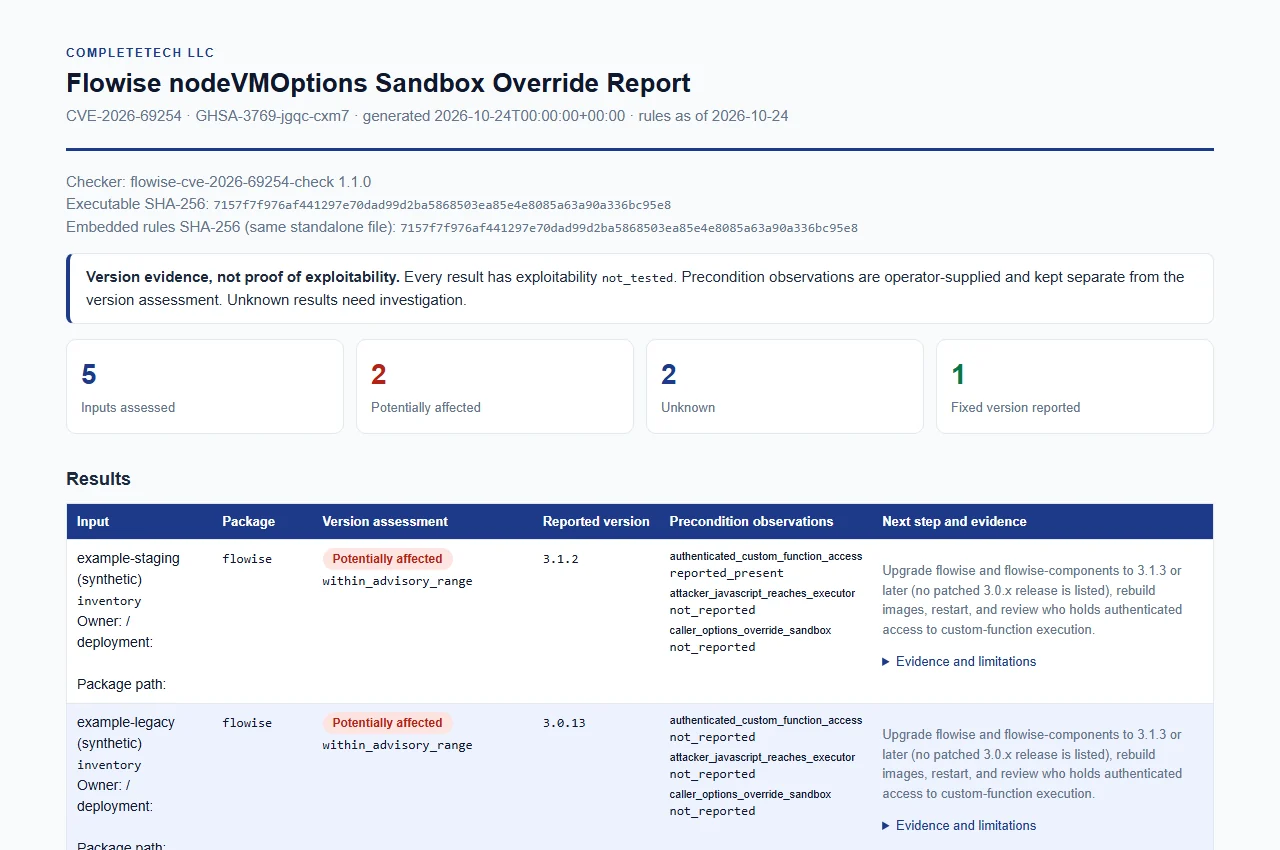
Synthetic example built from inventory.example.json with invented labels. View the HTML.
Inputs are parsed as JSON only and are never executed. They are bounded (16 MiB per file, 10,000 results per run). Field-level rules, accepted lockfile versions, and rejected shapes are in docs/REFERENCE.md.
--version VERSION (repeatable) with --package and optional --build-source and --observe KEY=yes|no|unknown.--inventory FILE (repeatable): an npm package-lock.json / npm-shrinkwrap.json (lockfile v1, v2, v3), a
package.json (declaration only, always unknown), or the small checker inventory in
inventory.example.json.--deployment-export FILE (repeatable): a sanitized administrator export of deployments, owners and image
labels; see the next section.python flowise_cve_2026_69254_check.py --deployment-export examples/deployment.json --format json
This mode reads an explicit, allowlisted administrator export, not raw Docker inspect output or Kubernetes manifests. Environment, commands, registry credentials and unrelated fields are rejected. No container or application is executed or pulled.
Format. The synthetic format (examples/deployment.json) has exactly
deployment_metadata_version: 1 and a deployments list.
deployment_id, unique across every export supplied in the same run.owner (128 characters) and image_digest (sha256: plus 64 lower-case hex digits) are optional,
operator-supplied labels.packages holds independent entries with package, version and/or version_candidates, an optional
relative install_path, and package-specific observations using the existing documented keys. Precondition
observations never transfer from one component to another.unknown coverage rows for each missing Flowise component.How to read the results.
deployment_metadata_unverified, and no package provenance is attested.unknown, including numbers inside the affected and fixed
ranges. This mode cannot establish absence of findings or clear a version as fixed.--fail-on-finding does not flag unknown rows, so review those rows explicitly or apply an unknown-aware
downstream policy.unknown, and exact instance observations remain intact.Output. JSON adds deployment_groups with owner, deployment and image identity and references to the
original zero-based result indices. It does not collapse instances or make an aggregate safety verdict. JSON and
CSV preserve deployment_id, owner, image_digest and install_path on each result; HTML displays the group
labels with escaping. These labels are intentionally reportable operator metadata, so provide sanitized IDs and
team names, not customer information or credentials.