 cedowens/swift-attack
Unit tests for blue teams to aid with building detections for some common macOS post exploitation methods.

Unit tests for blue teams to aid with building detections for some common macOS post exploitation methods. I have included some post exploitation examples using both command line history and API calls. The post exploitation examples included here are not all encompassing. Instead these are just some common examples that I thought would be useful to conduct unit tests around. I plan to continue to add to this project over time with additional unit tests.
All of these tests run locally and return results to stdout (i.e., Swift-Attack does not connect to a server).
git clone https://github.com/cedowens/Swift-Attack && cd Swift-Attack
Ensure you have installed swift and developer tools (can install from the mac app store)
Build calc.c for the dylib injection test:
gcc -dynamiclib -o calc.dylib calc.c
swiftc -o Swift-Attack swift-attack.swift
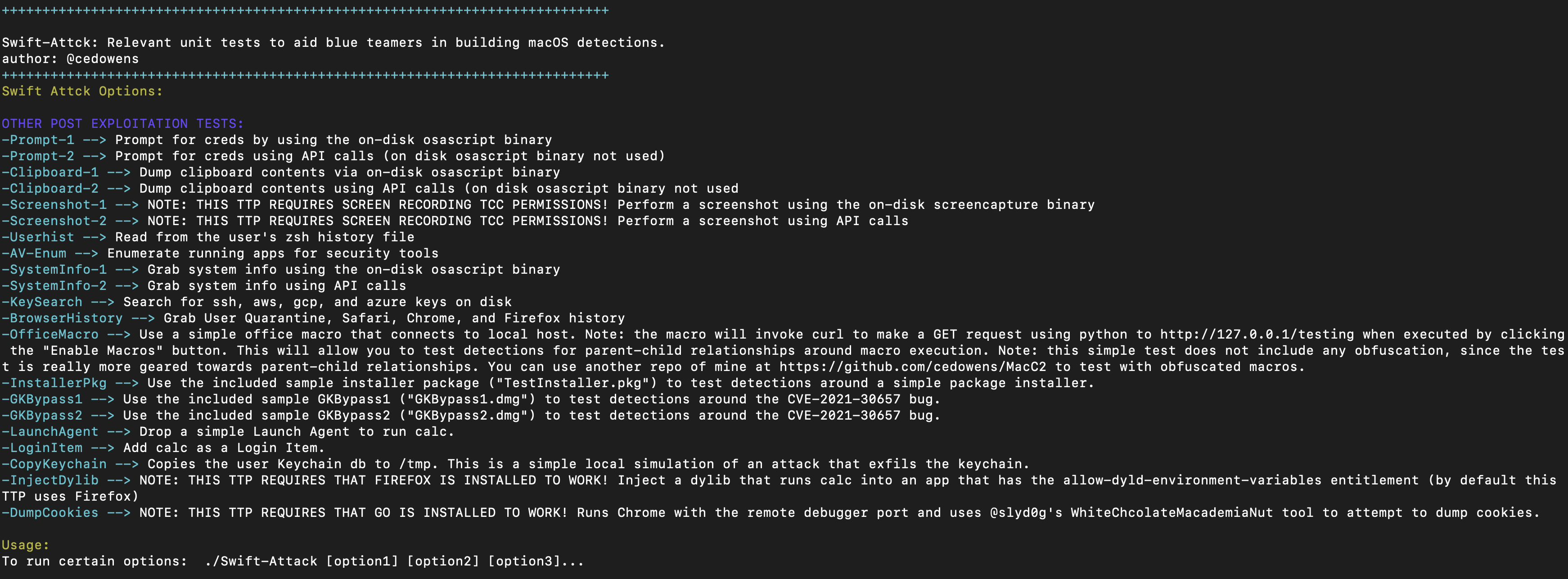
./Swift-Attack -h
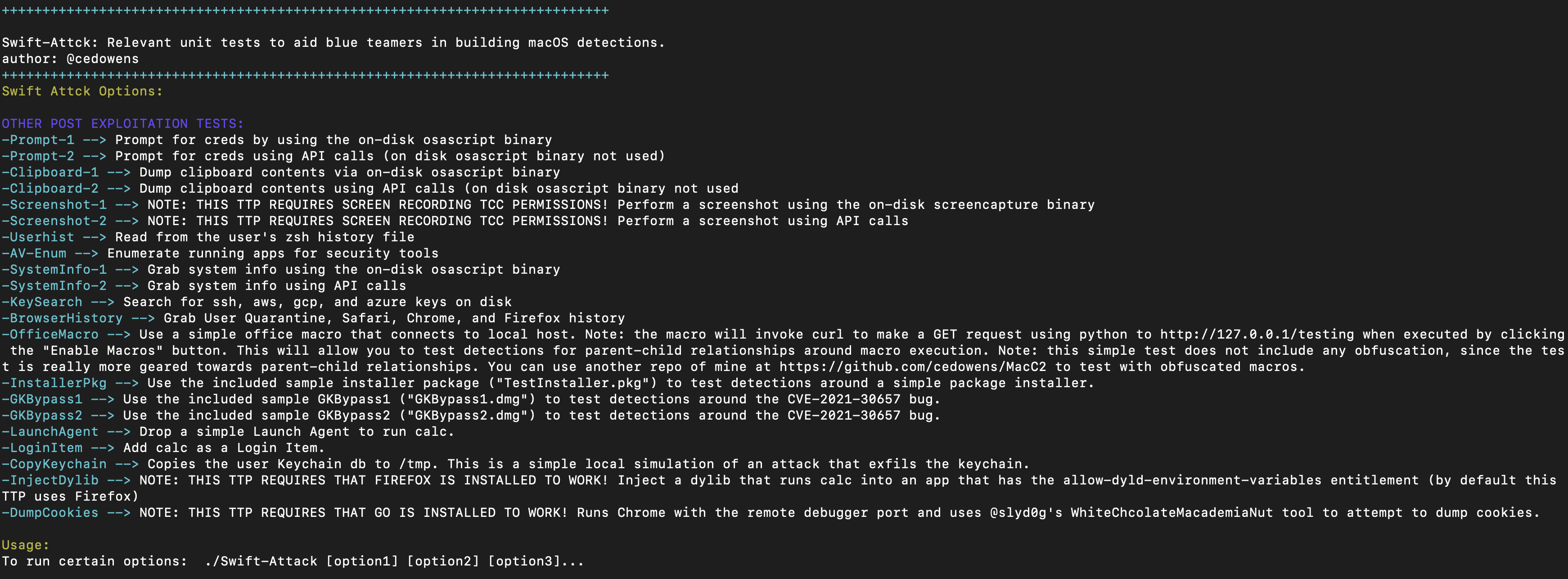
Note: Other TTP dependencies are below:
You can run Swift-Attack with a single option or multiple options
./Swift-Attack [option1] [option2]...
I also included a simple macro.txt file (unobfuscated) for testing parent-child relationships around office macro executions on macOS. I did not obfuscate it since the focus is on parent-child relationship visibility/detection. If you want to test with an obfuscated macro, I have a repo at github.com/cedowens/MacC2 that contains an obfuscated macro.
I only included two persistence tests (Launch Agent, and Login Item). Check out Leo Pitt's persistent JXA repo https://github.com/D00MFist/PersistentJXA for a more comprehensive list of persistence examples.
Prompt using osascript binary
Prompt via API calls
Clipboard dump using osascript binary
Clipboard dump using API calls
Screenshot using screencapture binary
Screenshot using API calls
Dumping zsh history
Security tool enumeration
Grabbing system info using osascript binary
Grabbing system info via API calls
Dumping ssh, aws, gcp, and azure keys on disk
Dumping browser history (Chrome, Safari, Firefox)
Dumping Quarantine history
Office Macro: I included a simple office macro that connects to local host. Note: the macro will invoke curl to make a GET request using python to http://127.0.0.1/testing when executed by clicking the "Enable Macros" button. This will allow you to test detections for parent-child relationships around macro execution. Note: this simple test does not include any obfuscation, since the test is really more geared towards parent-child relationships. You can use another repo of mine at https://github.com/cedowens/MacC2 to test with obfuscated macros. To use, just simply paste the contents of "macro.txt" into an office Doc, save as a macro enabled document or as 97-2004 document format (ex: .doc, .xls, etc.), and click "Enable Macros" when opening the doc to execute.
Installer Package: I included TestInstaller.pkg file to test for detections around a basic installer package. This installer package includes a preinstall script which runs in bash and drops com.simple.agent.plist to /Library/LaunchDaemons/ and drops test.js (simple popup prompt) to /Library/Application Support/. The com.simple.agent.plist file simply runs osascript against /Library/Application Support/test.js. It also includes a postinstall script which runs in bash and loads the com.simple.agent.plis using launchctl load. While holding the Control button click Open on TestInstaller.pkg to run it. TestInstaller.pkg will drop the aforementioned files as root.
CVE-2021-30657 Bypass Payloads: Two sample payloads (both make curl requests to localhost when detonated) to test two different types of payloads that abuse cve-2021-30657. More info here: https://cedowens.medium.com/macos-gatekeeper-bypass-2021-edition-5256a2955508
Launch Agent Persistence
Login Item Persistence
Accessing/Copying the User Keychain db
Dylib Injection
Dumping Chrome Cookies
