 0xblackash/cve-2026-98432
Technical advisory and defensive analysis of CVE-2026-98432, a Linux kernel IPv4 TCP use-after-free, with affected versions, detection commands, and patch guidance.




Linux Kernel IPv4 TCP Memory Corruption Vulnerability
Technical Analysis • Vulnerability Research • Defensive Security
Overview • Analysis • Affected Versions • Detection • Mitigation
CVE-2026-98432 is a critical Use-After-Free (UAF) vulnerability affecting the Linux kernel's IPv4 networking subsystem.
The vulnerability results from improper memory lifetime management during concurrent TCP connection request processing.
Under specific conditions, kernel memory containing IPv4 socket options can be released while another execution path is still accessing it.
This creates a potential memory corruption condition that can result in:
| Property | Details |
|---|---|
| CVE ID | CVE-2026-98432 |
| Product | Linux Kernel |
| Component | IPv4 Networking |
| Vulnerability | Use-After-Free |
| CWE | CWE-825 |
| CVSS v3.1 | 9.8 Critical |
| Attack Vector | Network |
| Attack Complexity | Low |
| Privileges Required | None |
| User Interaction | None |
| Protocol | IPv4 / TCP |
| Introduced | Linux Kernel 4.4 |
| Published | October 15, 2026 |
| Affected Files | net/ipv4/af_inet.c, net/ipv4/tcp_ipv4.c |
The vulnerability involves the ownership and deallocation of IPv4 socket option structures.
During TCP connection establishment, the function:
tcp_v4_syn_recv_sock()
transfers ownership of:
ireq->ireq_opt
to the child socket:
newinet->inet_opt
The transfer occurs without copying the underlying structure.
Another CPU can concurrently process a retransmitted SYN request and access the same options through RCU-protected read paths.
If the associated memory is released using ordinary kfree() while readers are still accessing it, a Use-After-Free condition can occur.
| Function | Purpose |
|---|---|
tcp_v4_syn_recv_sock() | Creates child TCP sockets |
tcp_v4_send_synack() | Sends TCP SYN-ACK responses |
inet_csk_route_req() | Processes request socket routing |
ip_options_build() | Builds IPv4 options |
inet_sock_destruct() | Destroys internet sockets |
tcp_v4_reqsk_destructor() | Destroys TCP request sockets |
The problematic deallocation behavior:
kfree(opt);
The upstream correction uses RCU-aware deallocation:
kfree_rcu(opt, rcu);
This delays memory reclamation until the relevant RCU grace period has elapsed, allowing existing readers to finish safely.



The primary security concern is improper memory access inside the kernel.
Potential consequences include system instability, memory corruption, and more serious exploitation depending on the execution environment.
The vulnerability was introduced in Linux kernel 4.4.
The following upstream releases contain the corresponding fixes:
| Kernel Branch | Fixed Version |
|---|---|
| 5.10 | 5.10.272 |
| 5.15 | 5.15.223 |
| 6.1 | 6.1.190 |
| 6.6 | 6.6.159 |
| 6.12 | 6.12.113 |
| 6.18 | 6.18.56 |
| 7.2 | 7.2.10 |
| 7.3 | 7.3 |
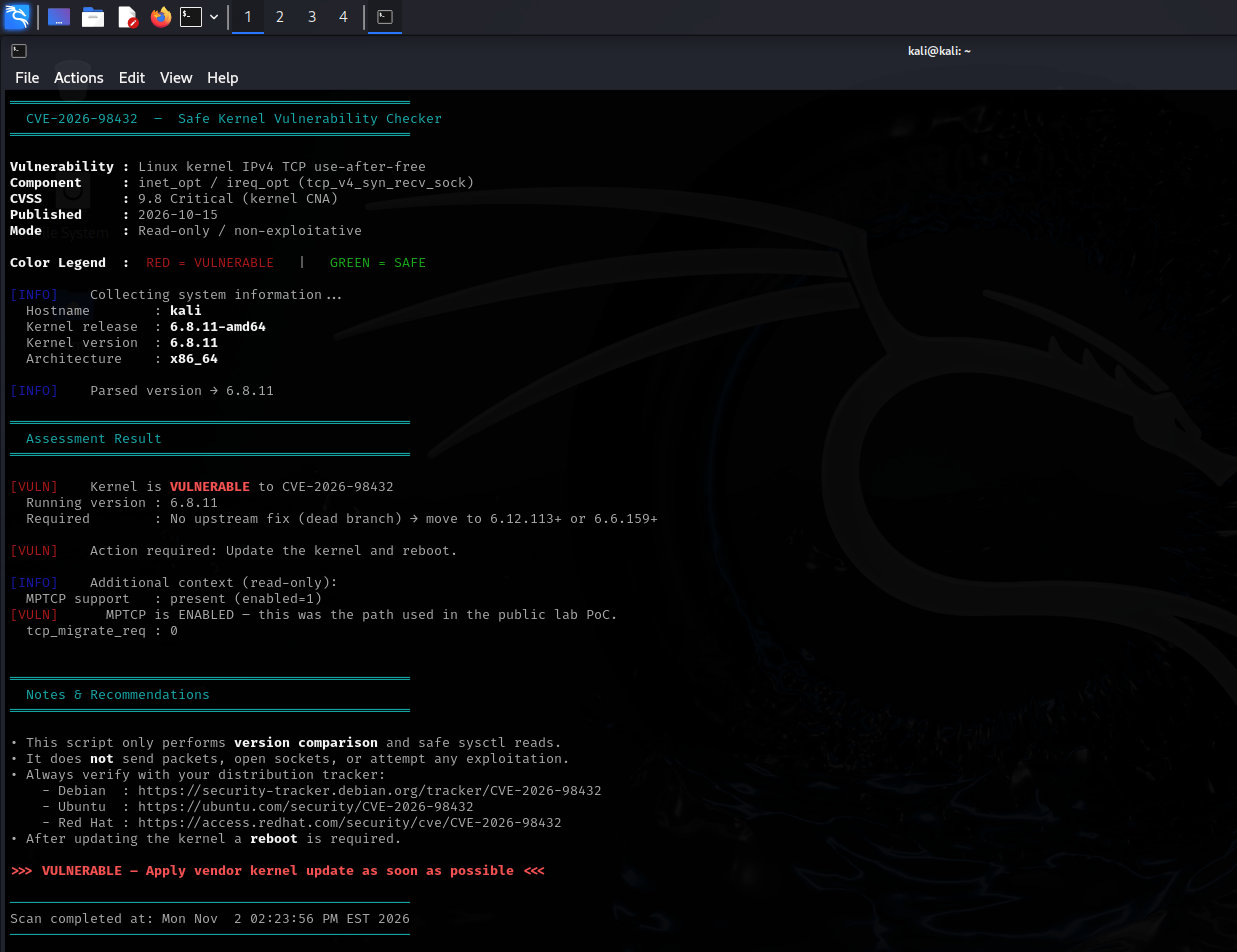
Important: Distribution vendors may backport security fixes. An older-looking kernel version does not automatically mean the installed package is vulnerable.
The following commands are intended for defensive inspection and do not exploit the vulnerability.
uname -r
cat /etc/os-release
uname -a
Debian / Ubuntu / Kali:
dpkg -l | grep linux-image
RHEL / Fedora:
rpm -qa | grep '^kernel'
sysctl net.ipv4.tcp_migrate_req
These checks provide system information but do not independently confirm vulnerability status. Verify the installed package against your distribution's security advisory.
Debian / Ubuntu / Kali Linux:
sudo apt update
sudo apt full-upgrade
RHEL / Fedora:
sudo dnf update kernel
Reboot after installing the updated kernel:
sudo reboot
Verify the running version:
uname -r
Note: Network restrictions are defense-in-depth measures, not substitutes for applying the kernel patch.
The Linux kernel resolves this issue by using RCU-aware memory deallocation in the affected destructors.
| Kernel Branch | Fix Commit |
|---|---|
| 5.10 | b3b027ef0cd322bfa839b9aaf5b27551eea54cf6 |
| 5.15 | 95a8c8fa9f27dce64c40c41c062de7728bf34ab5 |
| 6.1 | 89b5b1eb7d633c33832b7ff2c02e19a144705036 |
| 6.6 | 742f73df544e03744f2981c467d6542fe8172a2a |
| 6.12 | 11a03ce3c4a62d84c10ccdfe47f8075006498568 |
| 6.18 | a47406c769f72c070386985488f1c4d057df86b2 |
| 7.2 | 26d4c36d318cffbbd160884a0e4cec0da4da4936 |
| 7.3 | e3f33b0a1d89d738e2b913dab519226eaf76e15b |
For production systems, prefer complete vendor-supported kernel updates instead of manually cherry-picking individual commits.
Official security references:
This repository is intended for:






