 0xblackash/cve-2026-6471
Non-destructive PostgreSQL vulnerability checker for CVE-2026-6471. Audits server version and REPLICATION privileges to identify exposure to logical decoding authorization flaw, with remediation guidance.

PostGREShell 🛢️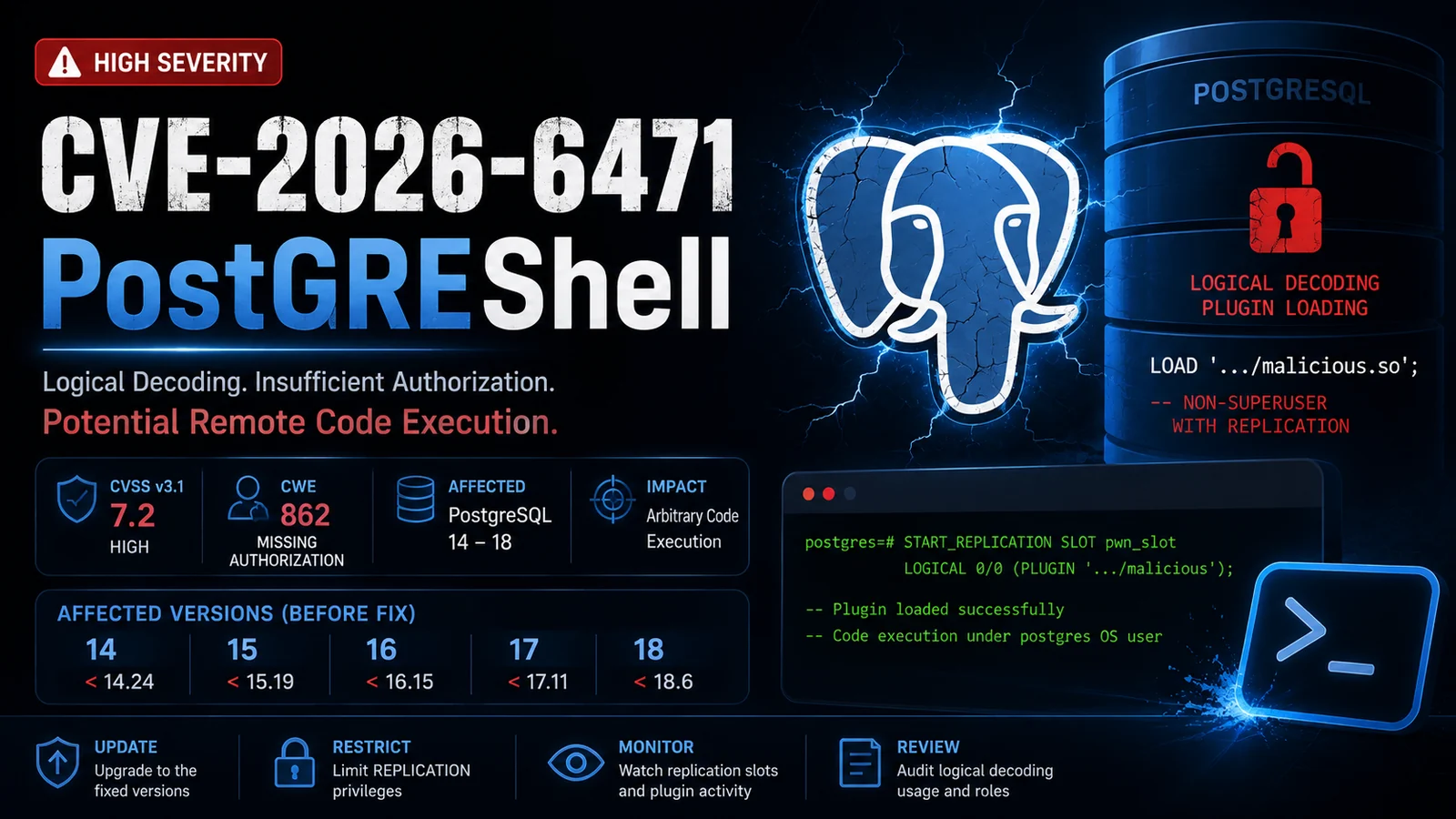




A defensive, non-destructive vulnerability checker for CVE-2026-6471
CVE-2026-6471 is a PostgreSQL authorization vulnerability involving the logical decoding subsystem.
The vulnerability can allow a PostgreSQL role possessing the REPLICATION privilege, but lacking superuser privileges, to cause the PostgreSQL server to load an attacker-controlled library accessible to the PostgreSQL operating-system account.
Successful exploitation can result in arbitrary code execution with the privileges of the PostgreSQL server process.
This repository provides a safe detection PoC designed for authorized security assessments.
⚠️ No malicious shared library is loaded and no operating-system command is executed by the checker.
| Property | Value |
|---|---|
| CVE | CVE-2026-6471 |
| Product | PostgreSQL |
| Component | Logical Decoding |
| CWE | CWE-862 — Missing Authorization |
| CVSS v3.1 | 7.2 High |
| Attack Vector | Network |
| Attack Complexity | Low |
| Privileges Required | High |
| User Interaction | None |
| Confidentiality | High |
| Integrity | High |
| Availability | High |
CVSS:3.1/AV:N/AC:L/PR:H/UI:N/S:U/C:H/I:H/A:H
Under the vulnerable conditions, an attacker who already possesses a PostgreSQL account with the required replication capability may potentially cross the database-to-operating-system privilege boundary.
┌──────────────────────┐
│   PostgreSQL User    │
│  REPLICATION = YES   │
└──────────┬───────────┘
           │
           ▼
┌──────────────────────┐
│   Logical Decoding   │
└──────────┬───────────┘
           │
           ▼
┌──────────────────────┐
│ Missing Authorization│
│      Validation      │
└──────────┬───────────┘
           │
           ▼
┌──────────────────────┐
│   Library Loading    │
└──────────┬───────────┘
           │
           ▼
┌──────────────────────┐
│ PostgreSQL OS User   │
└──────────────────────┘
The actual impact depends heavily on the privileges and filesystem permissions of the PostgreSQL operating-system account.
The PostgreSQL project's security advisory identifies the following affected branches:
| Branch | Affected | Fixed |
|---|---|---|
| PostgreSQL 14 | < 14.24 | 14.24 |
| PostgreSQL 15 | < 15.19 | 15.19 |
| PostgreSQL 16 | < 16.15 | 16.15 |
| PostgreSQL 17 | < 17.11 | 17.11 |
| PostgreSQL 18 | < 18.6 | 18.6 |
Upgrade to the latest security release available for your PostgreSQL branch.
This project intentionally performs non-destructive checks only.
The checker should verify:
REPLICATIONSELECT
version() AS postgres_version,
current_user AS current_user,
rolsuper AS is_superuser,
rolreplication AS has_replication
FROM pg_roles
WHERE rolname = current_user;
Example output:
postgres_version : PostgreSQL 17.x
current_user     : security_audit
is_superuser     : f
has_replication  : t
A vulnerable version combined with REPLICATION privileges should be treated as requiring remediation.
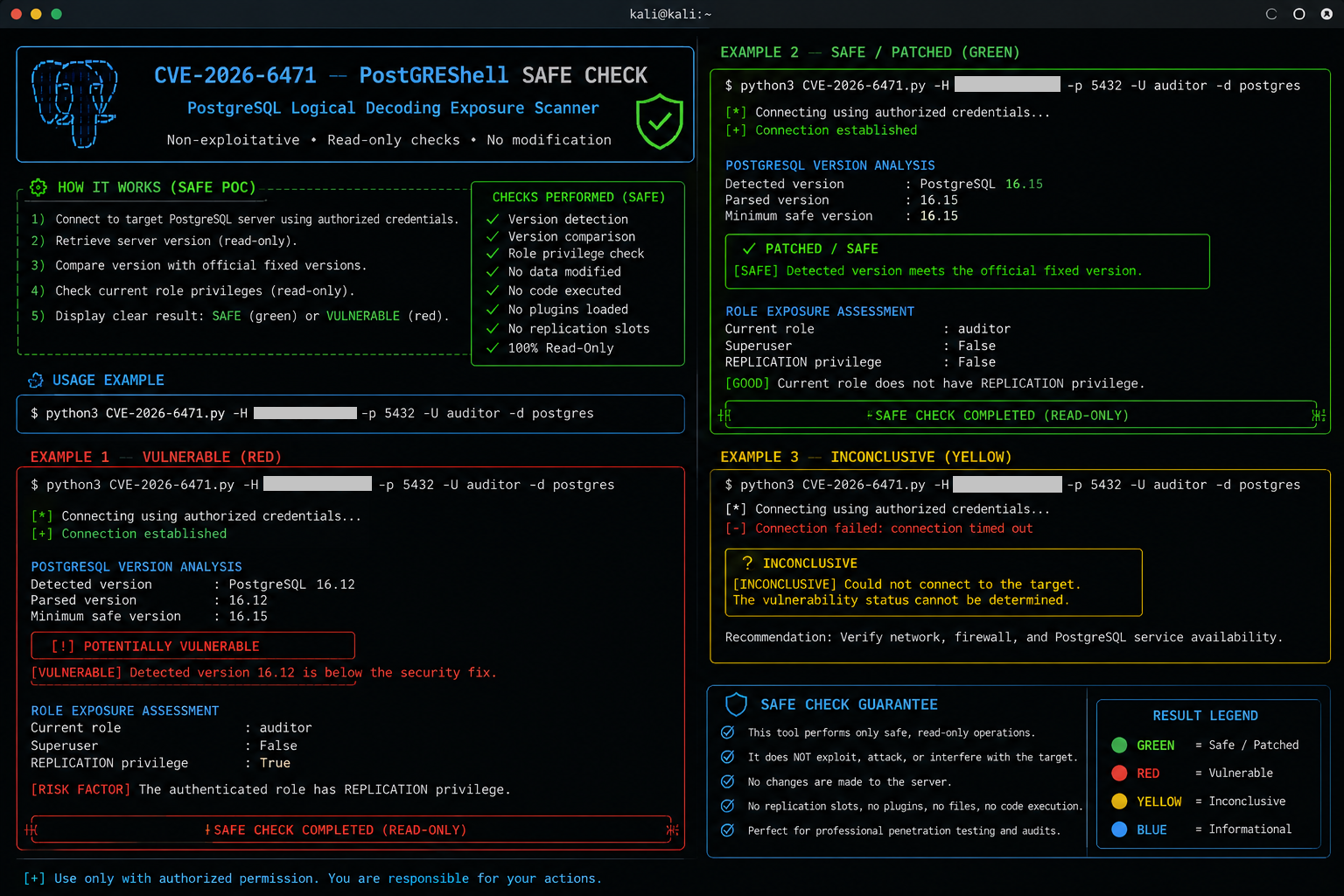
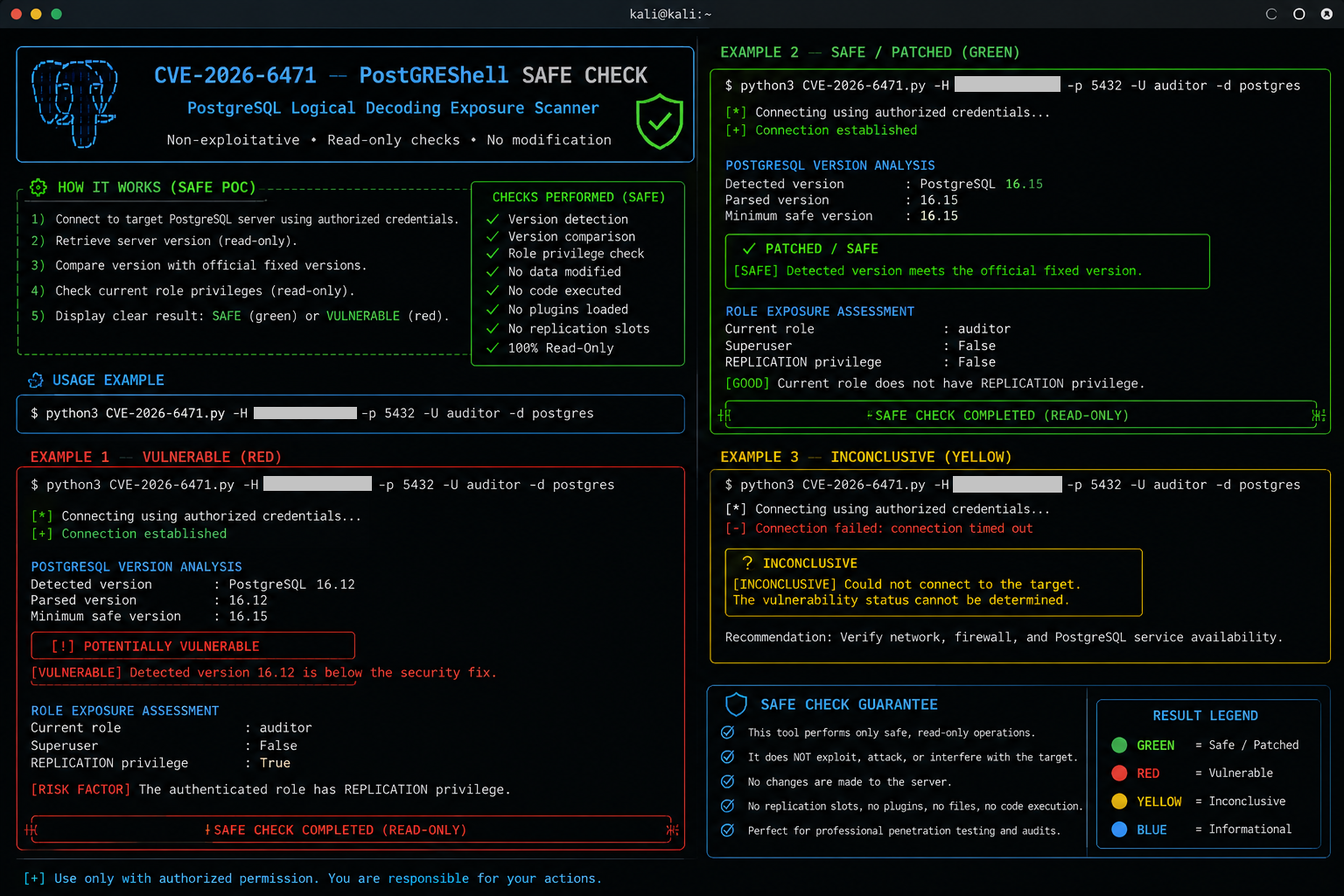
The PoC follows this workflow:
              ┌───────────────┐
              │ PostgreSQL    │
              │ Connection    │
              └───────┬───────┘
                      │
                      ▼
             ┌─────────────────┐
             │ Get Server      │
             │ Version         │
             └────────┬────────┘
                      │
                      ▼
             ┌─────────────────┐
             │ Check Current   │
             │ Role            │
             └────────┬────────┘
                      │
                      ▼
             ┌─────────────────┐
             │ Check           │
             │ REPLICATION     │
             └────────┬────────┘
                      │
                      ▼
             ┌─────────────────┐
             │ Compare Against │
             │ Fixed Releases  │
             └────────┬────────┘
                      │
              ┌───────┴────────┐
              ▼                ▼
        Potentially          Not
        Vulnerable         Affected
❌ Load an attacker-controlled .so
❌ Execute arbitrary SQL payloads
❌ Execute operating-system commands
❌ Spawn a reverse shell
❌ Modify PostgreSQL configuration
❌ Modify filesystem contents
❌ Create persistence
❌ Exploit production systems
This makes the checker suitable for controlled vulnerability assessment and inventory workflows.
Clone the repository:
git clone https://github.com/<YOUR-USERNAME>/CVE-2026-6471.git
cd CVE-2026-6471
Install the required Python dependency:
python3 -m pip install psycopg2-binary
Run the checker:
python3 CVE-2026-6471.py
Example:
╔════════════════════════════════════════════════════╗
║             CVE-2026-6471 SAFE CHECK               ║
║       PostgreSQL Logical Decoding Audit            ║
╚════════════════════════════════════════════════════╝

[+] Connecting to PostgreSQL...
[+] Server version : PostgreSQL 17.x
[+] Current role   : security_audit
[+] Superuser      : False
[+] Replication    : True

[!] PostgreSQL version requires security update
[!] REPLICATION privilege detected

[!] POTENTIALLY VULNERABLE
[!] Upgrade PostgreSQL to a fixed release.
Administrators can inspect replication-enabled roles with:

