
Skip to content
KitploitKITPLOIT
ToolsExploitsBlog
Log in
Submit
ToolsExploitsBlog
Submit

Hacking, PenTest, and Cybersecurity Tools for Your Security Arsenal!

Kitploit is a directory of hacking, cybersecurity, and pentesting tools. Discover the latest project updates to find vulnerabilities, analyze systems, automate testing, and strengthen your security.

FeedsContactPrivacy© 2026 Kitploit

Tool Directory

Categories

View all categories
Loading categories
CVE-2026-41651 — CVE-2026-41651 | Kitploit
Tools/GitHubGitHub/0xblackash/cve-2026-41651
Privilege EscalationVulnerability AnalysisExploitationPapers & ResearchLearning & Education
GitHub0xblackash/cve-2026-41651

CVE-2026-41651

CVE-2026-41651

View Repository
81516 months agoNot yet reviewed
Share

🚨 CVE-2026-41651 — Pack2TheRoot

Pack2TheRoot

Privilege Escalation Vulnerability in PackageKit (TOCTOU Race Condition)

Severity Affected Type Status


📌 Overview

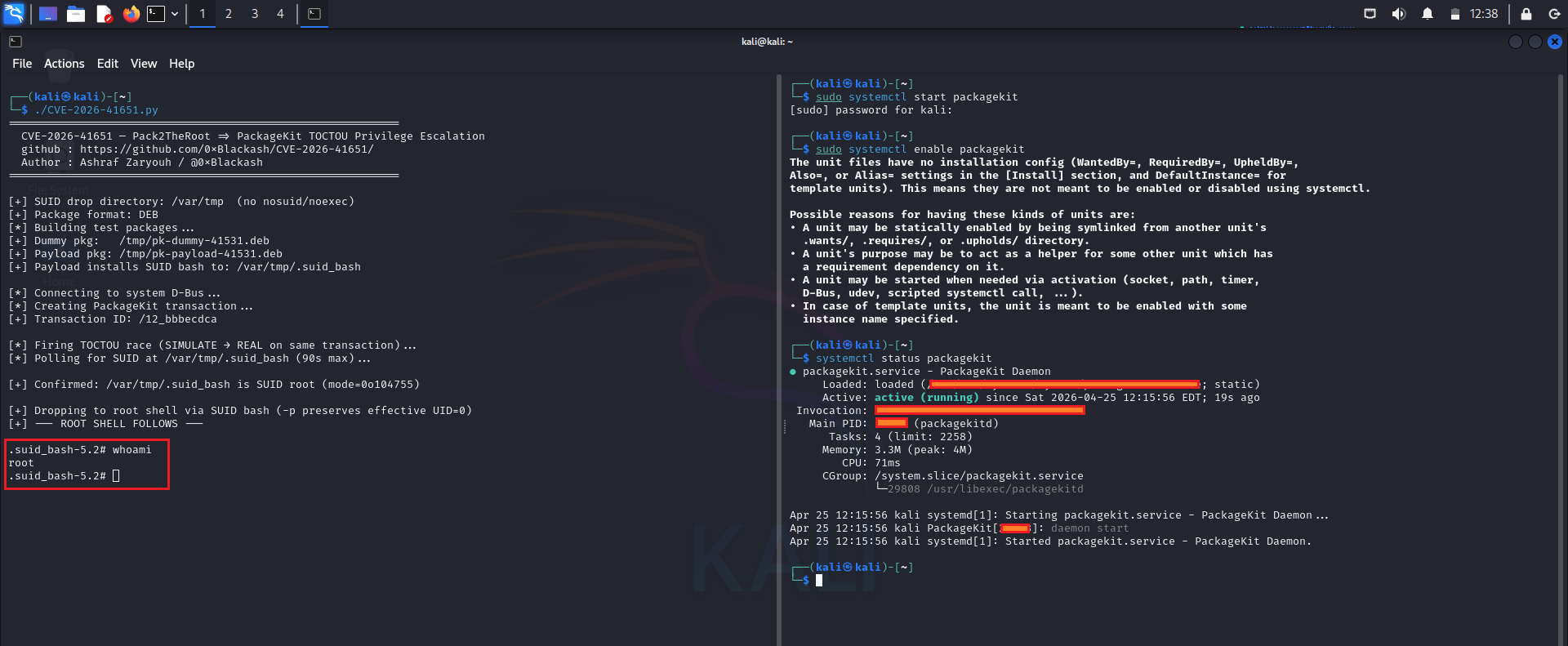
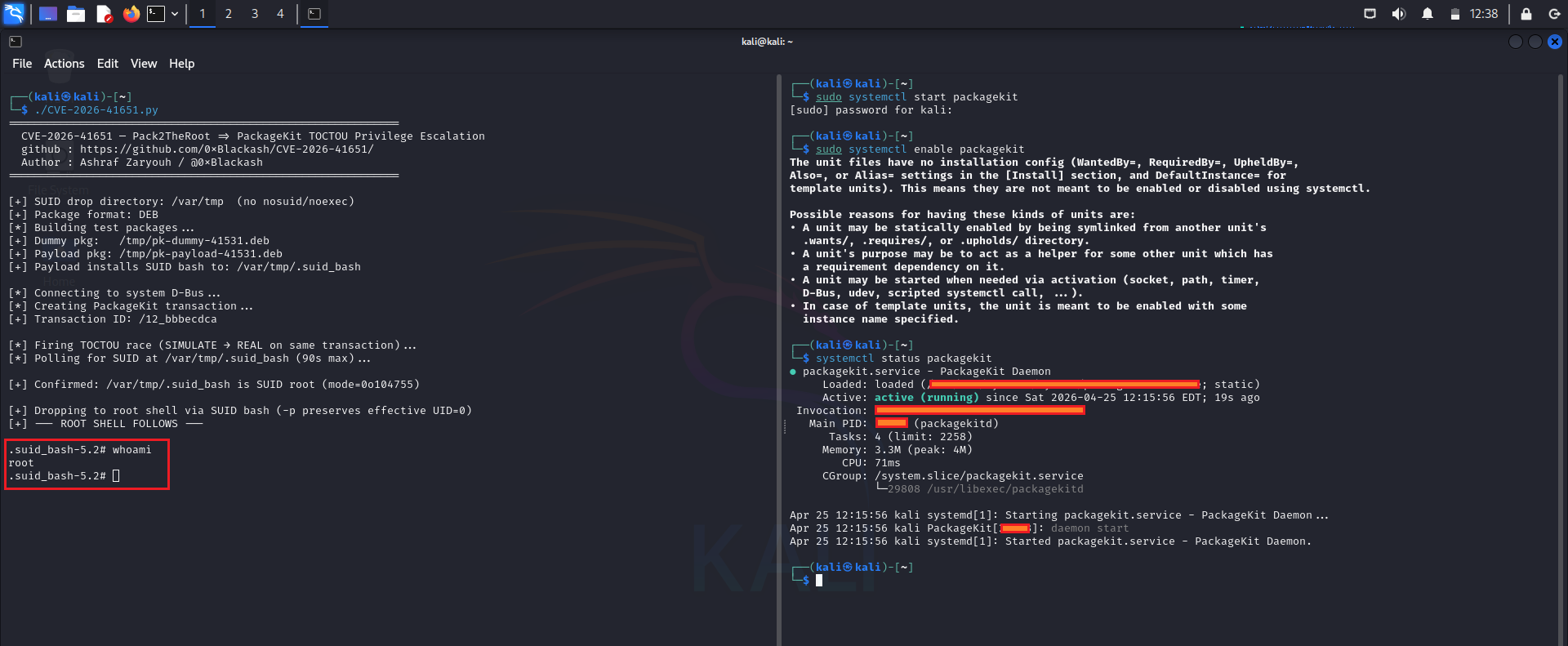
CVE-2026-41651 is a local privilege escalation vulnerability affecting the PackageKit system service used in various Linux distributions.

The vulnerability is caused by a Time-of-Check to Time-of-Use (TOCTOU) race condition, which can be abused to manipulate package installation workflows and escalate privileges to root.


⚠️ Impact

If successfully exploited, this vulnerability may allow a local unprivileged user to:
CVE-2026-41651
  • Gain root-level privileges
  • Execute arbitrary package installation scripts (RPM scriptlets)
  • Modify system-level configurations
  • Compromise system integrity and confidentiality

🧠 Note: This vulnerability requires local access and cannot be exploited remotely.


🧩 Affected Versions

  • PackageKit 1.0.2 → 1.3.4

🔧 Fixed Version

  • PackageKit 1.3.5

🧬 Technical Description

The issue originates from an unsafe handling of transactional state within PackageKit. A race condition occurs between:

  1. Validation phase (check permissions / flags)
  2. Execution phase (perform privileged operation)

During this window, an attacker may manipulate system state, leading to unintended privileged execution.


🛡️ Mitigation

To reduce risk:

  • Upgrade PackageKit to version 1.3.5 or later
  • Apply security updates from your Linux distribution vendor
  • Restrict local user access on multi-user systems
  • Monitor package management activity logs

🧾 References

  • Vendor Security Advisory (PackageKit)
  • Linux Distribution Security Updates
  • Common Vulnerabilities and Exposures: CVE-2026-41651

📊 Risk Summary

AttributeValue
Attack VectorLocal
ComplexityMedium
Privileges Req.Low
ImpactHigh (System Compromise)

⚡ Disclaimer

This repository is for educational and defensive security purposes only.
No exploit code or malicious instructions are included.


🧠 Stay Secure

Always keep systems updated and review privilege escalation risks in system services regularly.

Download Tool

Most Popular

View all →

Discover the most used tools by our community.

  • 1

    OsintHunter

    letox4/osinthunter

    🎯 The ultimate OSINT toolkit: investigation graph, confidence scoring, alias families, map, timeline and reports. 49 modules, 400+ sites, no API keys required.

    911
  • 2

    ghostlock-app

    yukonga/ghostlock-app

    GhostLock One-Tap Execution App (CVE-2026-43499)

    548
  • 3

    redforge

    cybersecurity91/redforge

    Browser-side red team toolkit with 102 offline tools for recon, payload generation, credential attacks, crypto, encoding and engagement reporting.

    366
  • 4

    ARTEX

    baarai/artex

    LLM multi-agent autonomous penetration testing platform with planner/worker agents, asset and exploration graphs, MITM traffic recording, and vulnerability retesting.

    362
  • 5

    looking-glass

    anonghosty/looking-glass

    CSIRT platform that ingests Shadowserver reports into MongoDB and replays them as interactive maps, analysis, findings, advisories and executive dashboards.

    311
  • 6

    CyberStrikeAI

    ed1s0nz/cyberstrikeai

    The system of action for AI-native cybersecurity—where intent becomes governed execution, evidence becomes operational memory, and every operation improves the next.

    287

Explore all tools

Browse our collection of tools

View all tools →